
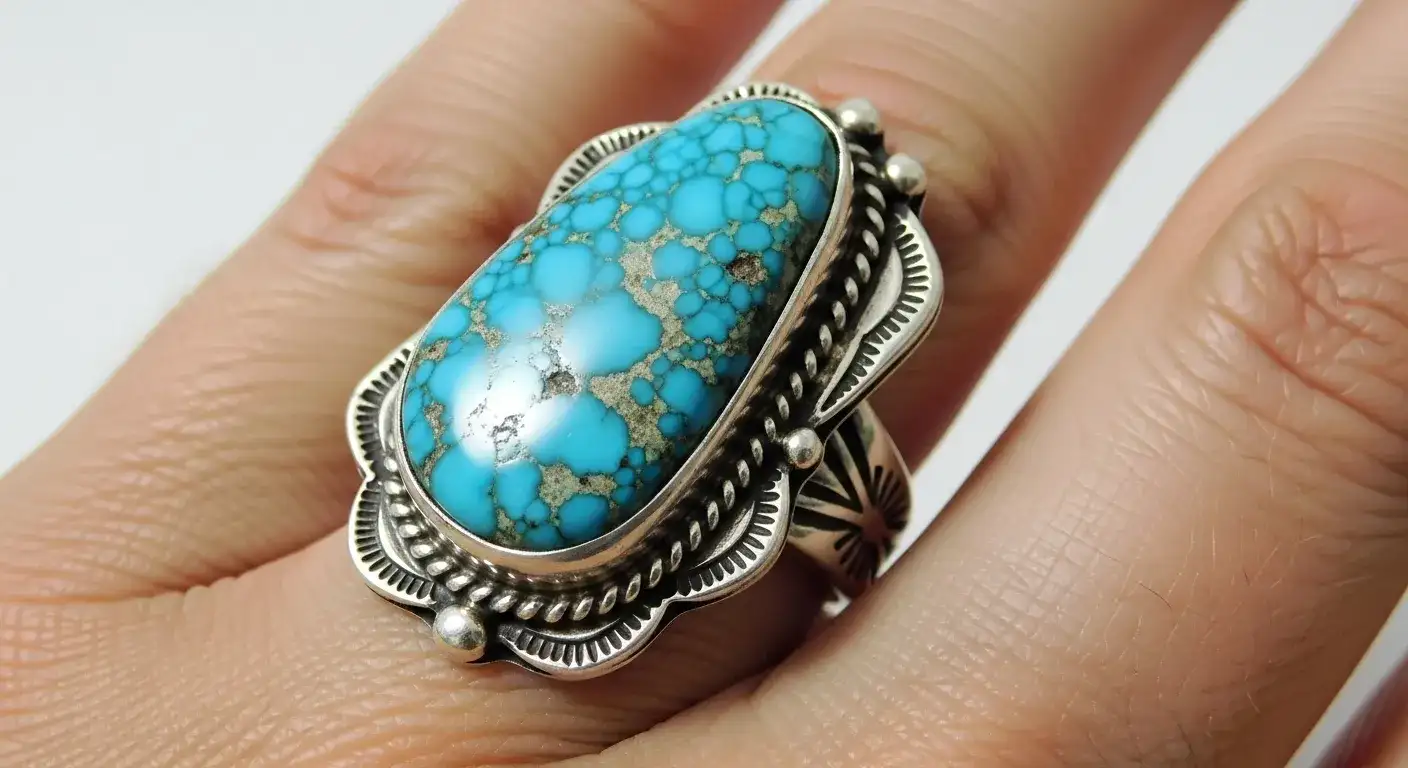
Complete Guide to Symbols, Meanings, and Tribal Traditions
Native American jewelry represents far more than beautiful adornment. Each piece carries profound cultural significance, with symbols that communicate stories, spiritual beliefs, and tribal heritage spanning thousands of years. Understanding the symbolism of jewelry in Native American tribes reveals a complex visual language where every element—from the turquoise stone to the bear claw—conveys specific meanings rooted in the natural world and spiritual practices.
This comprehensive guide explores the rich symbolic traditions across major Southwestern tribes, examining how materials, animals, geometric patterns, and tribal techniques create a sophisticated system of cultural expression. Whether you’re a collector seeking authentic pieces, a jewelry enthusiast appreciating craftsmanship, or someone drawn to the spiritual dimensions of Native art, understanding these symbols deepens your connection to each piece’s cultural narrative.
The jewelry traditions of tribes like the Navajo, Zuni, Hopi, and Santo Domingo Pueblo reflect distinct artistic philosophies while sharing common reverence for nature’s elements. From the protective properties attributed to turquoise to the courage embodied in bear symbolism, these adornments function as wearable stories that preserve ancestral wisdom and connect wearers to generations of cultural knowledge.
Origins of Symbolic Jewelry in Native American Culture
Native American jewelry-making extends back over 12,000 years, with the earliest known pieces—bone earrings discovered at Alaska’s Mead Site—demonstrating humanity’s ancient impulse to create meaningful adornment. In the American Southwest, Paleo-Indians began drilling and shaping turquoise, shells, and multicolored stones into beads and pendants as early as 8800 BCE, establishing traditions that would evolve into the sophisticated symbolic systems we recognize today.
Before European contact, indigenous artisans relied exclusively on materials available in their environment. Coastal tribes incorporated shells like olivella and abalone, while desert communities prized turquoise from local mines. Major trade routes connected Ancestral Puebloan communities from Chaco Canyon throughout the Southwest, exchanging shells, turquoise, and other precious materials. The arrival of Spanish colonizers in the 16th century introduced metalworking techniques, fundamentally transforming Native jewelry traditions. By the mid-1800s, Navajo and Zuni silversmiths learned silversmithing from Mexican artisans, combining these new skills with ancestral symbolic vocabularies to create the distinctive styles we associate with Southwestern jewelry today.
This fusion of traditional symbolism with European metalworking created an artistic renaissance. Navajo silversmith Atsidi Sani, recognized as the first Navajo to work silver around 1850, pioneered techniques that would spread throughout the region. By 1880, turquoise was first set in silver, marking a pivotal moment when ancient stone symbolism merged with new metalworking capabilities. The result was jewelry that maintained deep cultural meaning while adopting forms that would become internationally recognized—squash blossom necklaces, concho belts, and elaborate cuff bracelets adorned with sacred symbols.
The symbolic content of Native jewelry serves multiple functions within tribal communities. Pieces mark life transitions, communicate social status, offer spiritual protection, and preserve oral histories through visual storytelling. Unlike Western jewelry traditions that often prioritize aesthetic beauty, Native American jewelry integrates form with function, creating objects where artistic merit and cultural significance are inseparable. This integration explains why authentic Native jewelry commands respect as cultural artifacts rather than mere accessories.
Sacred Materials and Their Symbolic Meanings
The materials comprising Native American jewelry carry symbolic weight equal to the finished designs. Each substance—whether mineral, metal, or organic—embodies specific spiritual properties and cultural associations that Native artisans intentionally incorporate into their work.
Turquoise: The Sky Stone
Turquoise holds unparalleled significance across Southwestern tribes, particularly among the Navajo, who call it “sky stone” due to its celestial blue-green coloration. This precious mineral symbolizes life, protection, health, and good fortune. Navajo tradition associates turquoise with rainfall and fertility, making it especially valued in desert environments where water determines survival. The stone’s matrix patterns—brown or black veining running through the blue—are considered indicators of authenticity and desirability among collectors.
Different turquoise mines produce distinctive characteristics that influence symbolic associations. Sleeping Beauty turquoise from Arizona, prized for its pure robin’s-egg blue without matrix, represents clarity and spiritual purity. Bisbee turquoise, known for its deep blue with chocolate-brown matrix, carries grounding energy. The Zuni particularly favor turquoise for their intricate stone inlay work, viewing its protective qualities as essential for ceremonial pieces.
Beyond aesthetic appeal, turquoise functions as a living stone in Native belief systems. Many believe turquoise absorbs negative energy to protect its wearer, sometimes changing color or cracking when fulfilling this protective function. This quality makes turquoise essential for medicine pouches, ceremonial jewelry, and pieces worn during spiritual practices. The stone’s perceived ability to facilitate communication with the spirit world further elevates its ceremonial importance.
Silver: Reflection and Strength
While silver arrived through European contact, Native artisans quickly invested it with symbolic meaning aligned with their worldviews. Silver’s reflective surface is believed to deflect negative energy and evil spirits, functioning as spiritual armor. The metal’s association with the moon connects it to feminine energy, intuition, and emotional balance in many tribal cosmologies.
The weight and quality of silverwork often signals a piece’s ceremonial importance. Heavy silver construction in Navajo jewelry isn’t merely aesthetic preference—it represents substantial investment in materials that embody strength and permanence. The process of working silver, from hammering to stamping to oxidizing, transforms raw metal into spiritually charged objects through the artisan’s focused intention and traditional techniques passed through generations.
Coral: Life Force from the Sea
Mediterranean coral, introduced by Spanish traders, became integrated into Southwestern jewelry symbolism despite its non-native origins. Its deep red color associates coral with life force, vitality, and blood—the essence of existence. Coral balances turquoise’s cooling blue energy with warming red vibrations, creating harmony in pieces that combine both materials.
Zuni artisans particularly excel at incorporating coral into cluster work and channel inlay designs. The stone’s association with protection makes it popular for children’s jewelry, while its life-giving symbolism appears in wedding sets and fertility-related ceremonial pieces. As Mediterranean coral has become increasingly scarce and expensive, some contemporary artisans substitute spiny oyster shell, which carries similar red tones and ocean associations.
Shell: Ocean’s Blessing
Shells from both coasts—abalone from the Pacific and conch from the Gulf—carry ocean symbolism despite the Southwest’s desert environment. This contrast makes shell particularly powerful, representing life-giving water’s spiritual importance. Abalone’s iridescent interior symbolizes the rainbow, considered a bridge between earth and sky in many Native cosmologies.
Santo Domingo Pueblo artisans created sophisticated shell mosaic inlay techniques, cutting tiny shell pieces to create intricate patterns on shell bases. These labor-intensive works demonstrate respect for shell’s symbolic value through meticulous craftsmanship. The practice continues ancient Ancestral Puebloan traditions documented at sites like Chaco Canyon, where shell beads were central to extensive trade networks.
Jet: Protective Darkness
Jet, a fossilized wood, provides black contrast in multi-stone jewelry while carrying protective symbolism. Its deep black absorbs negative energy, making jet popular for pieces worn during ceremonies or spiritual work. Zuni artisans frequently incorporate jet alongside turquoise and coral in their signature cluster work, where the black provides visual depth while offering spiritual protection.
Feathers: Divine Messengers
Feathers, particularly from eagles and other raptors, represent one of the most sacred materials in Native American culture. Eagle feathers symbolize connection to the Creator, honor, courage, and spiritual ascension. Their use in jewelry is restricted by federal law—only enrolled tribal members can legally possess eagle feathers, underscoring their ceremonial significance.
When incorporated into jewelry, feathers carry prayers upward to the spirit world. Feather motifs in stamped or overlay silver work invoke these same qualities without using actual feathers. The practice demonstrates how symbolic representation can convey spiritual meaning equivalent to the physical material, allowing wider use of protected imagery while respecting legal and cultural restrictions.
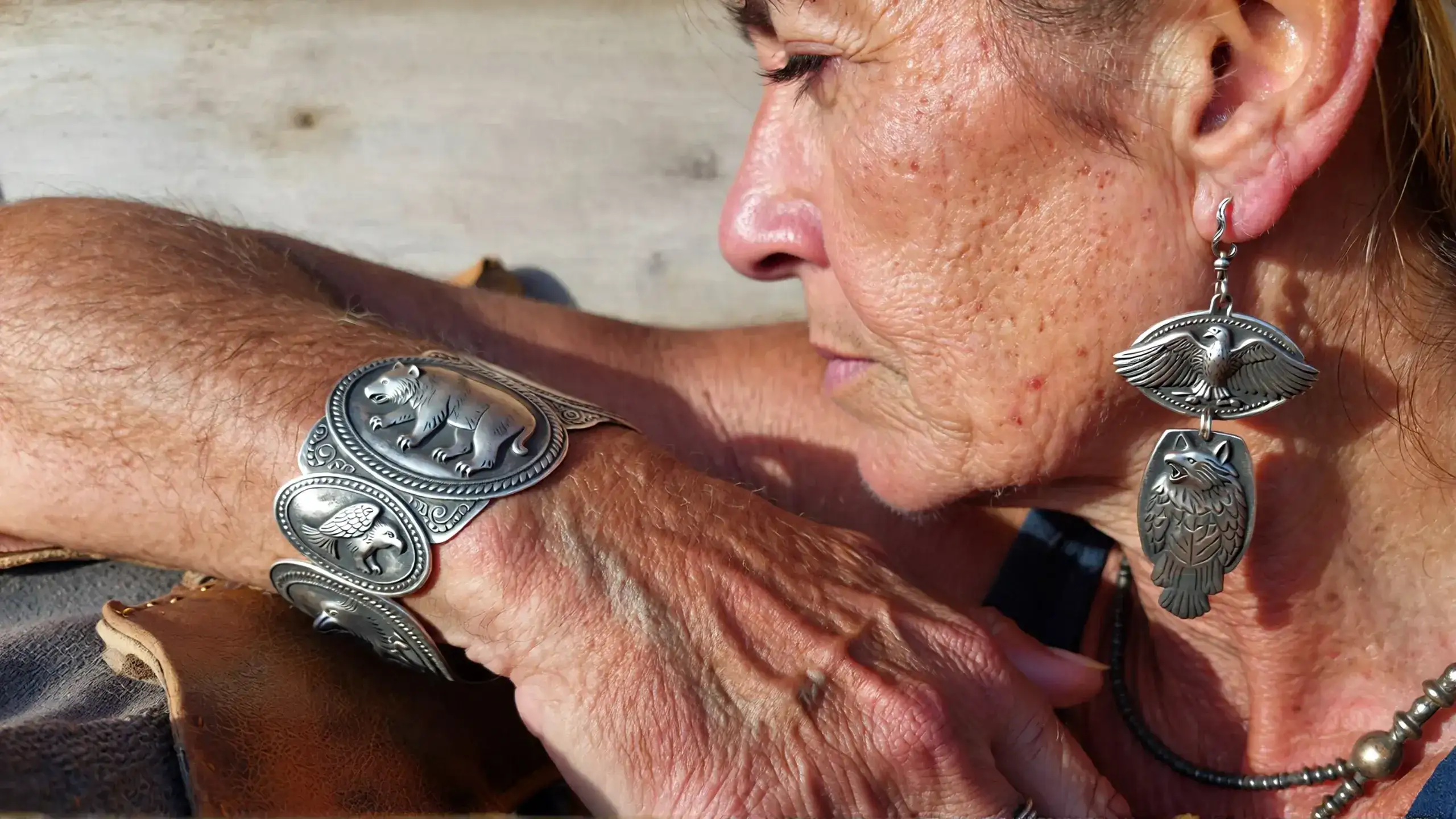
Animal Symbolism in Native Jewelry
Animals occupy central positions in Native American spiritual systems, serving as clan totems, spirit guides, and embodiments of specific qualities. Jewelry incorporating animal imagery allows wearers to invoke these attributes and maintain connection with animal spirits.
Bear: Courage and Healing
The bear represents physical strength, courage, and introspection across nearly all Southwestern tribes. Bear symbolism appears in jewelry through carved fetishes, stamped designs, and bear claw pendants. Wearing bear imagery invokes the animal’s fearlessness while honoring its association with healing—many tribes view bears as medicine animals due to their knowledge of healing plants.
Bear hibernation connects the animal to cycles of death and rebirth, introspection, and renewal. Warriors traditionally wore bear symbols for protection and courage in battle, while healers incorporated bear imagery into ceremonial jewelry used during healing practices. Contemporary artists continue these traditions, creating bear rings and pendants that serve both aesthetic and spiritual functions.
Eagle and Thunderbird: Divine Power
Eagles soar closest to the Creator, making them supreme spiritual messengers in Native cosmology. Eagle imagery in jewelry represents vision, power, leadership, and spiritual ascension. The thunderbird—a mythological eagle-like being who creates thunder and lightning—embodies even greater supernatural force. Thunderbird symbols appear prominently in Zuni and Hopi jewelry, particularly in overlay work where the bird’s distinctive profile becomes instantly recognizable.
The thunderbird’s connection to rain makes it especially significant in agricultural communities dependent on seasonal precipitation. Jewelry featuring thunderbird designs might be worn during rain dances or ceremonies requesting water. The symbol’s protective qualities also make it popular for everyday wear, offering spiritual guardianship to the wearer.
Wolf: Community and Loyalty
Wolves symbolize family bonds, communication, and community cooperation. Their pack behavior models ideal social organization, making wolf imagery appropriate for jewelry celebrating family or tribal identity. Wolf symbolism emphasizes loyalty, intelligence, and the balance between individual needs and collective good.
Navajo tradition particularly honors wolves as teachers who demonstrated hunting cooperation to humans. Wolf jewelry might be given to young people entering adulthood, symbolizing their transition into community responsibilities. The animal’s association with clear communication makes wolf symbols appropriate for pieces worn during tribal councils or community gatherings.
Turtle: Mother Earth and Longevity
Turtle symbolism connects directly to Earth herself in many Native traditions. Creation stories often describe Earth being carried on Turtle’s back, making the animal synonymous with stability, grounding, and the sustaining power of nature. Turtles’ long lifespans associate them with longevity and ancestral wisdom.
Turtle shell patterns appear frequently in stamped silver work and overlay designs. Some traditions believe wearing turtle imagery promotes long life and protection from illness. The turtle’s connection to water—despite being an Earth symbol—creates a duality that represents balance between elements, making turtle jewelry appropriate for healing and harmony-seeking purposes.
Butterfly: Transformation and Joy
Butterflies embody transformation, beauty, and messages from the spirit world. Their metamorphosis from caterpillar to winged creature makes them powerful symbols of personal change and spiritual evolution. Butterfly imagery appears delicately in filigree work and more boldly in inlay designs where multiple stone colors capture the insect’s colorful wings.
Pueblo traditions associate butterflies with pollination and crop fertility, making them important in agricultural ceremonies. Some beliefs hold that butterflies carry wishes to the Creator, making butterfly jewelry appropriate for pieces with prayer intentions. Their association with joy and light-heartedness balances heavier spiritual symbolism in jewelry collections.
Snake: Healing and Renewal
Snakes’ ability to shed their skin makes them universal symbols of healing, transformation, and renewal. While some Western traditions view snakes negatively, Southwestern tribes revere them as powerful medicine animals and rain bringers. Hopi snake ceremonies explicitly invoke snakes as intermediaries between humans and water-bringing spirits.
Snake imagery in jewelry appears as spiraling or undulating forms in stamped and overlay work. Some artisans create realistic snake rings where the serpent wraps around the finger, others prefer stylized representations focusing on the animal’s essential qualities rather than literal appearance. The snake’s earth-dwelling nature connects it to grounding and physical healing.
Lizard and Gecko: Survival and Dreams
Desert lizards represent survival, adaptation, and masculine solar energy. Navajo tradition holds lizards sacred as survival teachers who demonstrated how to live in harsh environments. Geckos specifically are considered lucky, with superstitions suggesting they bring good fortune to households where they reside.
Lizard jewelry often features the animal in profile with distinctive curled tail and splayed feet. Some pieces incorporate actual lizard forms cast in silver, while others use stylized representations. The lizard’s association with dreaming—they’re believed to carry dream messages—makes lizard jewelry popular for pieces intended to enhance dream recall or spiritual vision.
Horse: Freedom and Nobility
Despite arriving with Spanish colonizers, horses quickly became central to Plains and Southwestern cultures. Horse symbolism represents freedom, mobility, nobility, and the partnership between humans and animals. The dramatic transformation horses brought to Native life elevated them to spiritual significance relatively rapidly.
Horse imagery appears in stamped jewelry designs and overlay work, often depicted in motion to emphasize freedom and vitality. Pueblo pottery motifs featuring horses frequently inspire jewelry designs, maintaining visual continuity across art forms. Horse jewelry might be given to mark journeys or transitions, invoking the animal’s association with exploration and discovery.
Raven and Crow: Magic and Intelligence
Ravens and crows occupy complex symbolic positions as tricksters, magic workers, and intelligent problem-solvers. Their black coloration associates them with mystery and the unknown, while their proven intelligence commands respect. Raven symbols appear in healing contexts, as the bird is believed to possess medicine knowledge and transformation powers.
Hopi tradition features crow as a rain-bringing kachina, making crow imagery appropriate for jewelry worn during agricultural ceremonies. The bird’s association with messages from the spirit world parallels feather symbolism generally, but crow energy carries more mischievous or unpredictable qualities compared to eagles’ straightforward spiritual authority.
Kokopelli: Fertility and Music
Kokopelli, the humpbacked flute player, represents one of the most recognizable figures in Southwestern art. This fertility deity appears in Ancestral Puebloan petroglyphs dating to 750-850 AD, making Kokopelli imagery some of the oldest continuously used Native symbols. The figure embodies fertility, agriculture, music, and joyful mischief.
Kokopelli jewelry appears across multiple tribal styles, from Hopi overlay work to simple stamped designs. The figure’s association with fertility makes Kokopelli popular in wedding jewelry and pieces celebrating new beginnings. Modern interpretations sometimes simplify the traditional humpbacked form while maintaining the essential flute-playing posture that makes Kokopelli instantly identifiable.
Geometric Symbols and Natural Elements
Beyond animal imagery, Native American jewelry incorporates geometric patterns and natural element symbols that communicate cosmological understanding and spiritual concepts.
Zia Symbol: Circle of Life
The Zia sun symbol, official emblem of New Mexico since 1925, originated with Zia Pueblo. Four radiating groups of rays extend from a central circle, each representing sacred fours: four seasons, four directions, four times of day, and four stages of life. The circle binding these elements represents unity and the interconnectedness of all existence.
Zia symbols appear frequently in contemporary Southwestern jewelry, though Zia Pueblo has expressed concern about commercial exploitation of their sacred imagery. Respectful artisans acknowledge the symbol’s origins and sacred meaning when incorporating it into jewelry designs. The Zia’s perfect symmetry makes it popular for rings, pendants, and earrings where balanced design enhances aesthetic appeal.
Water Symbols: Life’s Flow
Water symbols take many forms—waves, rain clouds, lightning, and flowing patterns. In desert environments, water’s life-giving properties elevate it to sacred status. Wave patterns in jewelry represent not just physical water but the cycle of life, renewal, and continuous change. Some traditions view water waves as symbolic of the sacred waters present at creation.
Rain cloud symbols appear prominently in Hopi overlay jewelry, often accompanied by rain lines falling downward. These designs invoke prayers for precipitation while celebrating water’s essential role in agricultural success. Lightning symbols, associated with sudden illumination and divine power, appear as zigzag patterns in stamped work and inlay designs.
Mountain and Mesa Forms
Mountains represent sacred spaces where earth meets sky, making them powerful symbols of spiritual ascension and connection between worlds. Triangular forms in jewelry often reference mountains, particularly when appearing in multiples to suggest mountain ranges. Mesa formations—flat-topped elevated lands characteristic of the Southwest—symbolize stability and the land’s enduring presence.
Mountain symbols might incorporate specific peaks sacred to particular tribes. The four sacred mountains marking Navajo territory’s boundaries appear in some ceremonial jewelry, while Pueblo artists reference local mesas in their designs. These geological symbols ground spiritual concepts in physical landscape, reinforcing connections between people and place.
Spiral: Life’s Journey
Spirals represent life’s journey, growth, and evolution in many Native traditions. The form appears in ancient petroglyphs and continues in contemporary jewelry designs. Some interpret spirals as representing the path souls take through life, while others see them as symbols of continuous growth and expanding consciousness.
The direction of spiral winding can carry different meanings. Clockwise spirals might represent the sun’s movement, while counterclockwise spirals could reference the moon’s pull. Double spirals appearing together suggest balance between complementary forces—male and female, day and night, physical and spiritual. Spiral designs work particularly well in ring shanks and bracelet terminals where the form follows natural circular jewelry shapes.
Cross and Four Directions
Cross symbols in Native American jewelry predate Christianity, representing the four sacred directions with equal-armed crosses. Each direction carries specific associations—east with new beginnings, south with growth, west with reflection, and north with wisdom. The cross’s center represents the individual standing at the intersection of these forces.
After Spanish colonization, some Native artisans incorporated Christian cross symbolism, creating hybrid forms that acknowledge both indigenous and introduced spiritual traditions. Understanding a cross’s cultural context requires examining the jewelry’s tribal origin and the cross’s specific design characteristics. Traditional four-directions crosses maintain equal arms, while Christian crosses feature elongated lower arms.
Sunface and Star Symbols
The sun represents the ultimate life-giver, providing warmth, light, and energy necessary for existence. Sunface symbols appear as circular forms with radiating rays, often including facial features that personify solar power. Zuni artisans particularly excel at creating detailed sunface designs in their channel inlay work, using multiple stone colors to differentiate facial features from radiating rays.
Star symbols connect to navigation, destiny, and cosmic order. Morning star imagery appears in jewelry associated with guidance and new beginnings, while general star patterns reference the night sky’s mystery and beauty. Some pieces incorporate actual astronomical knowledge, positioning stars in configurations matching constellations significant to tribal calendars or navigation practices.
Corn and Plant Symbols
Corn holds sacred status as the sustaining crop that allowed Southwestern agricultural societies to flourish. Corn symbols appear in jewelry as stylized plants or individual kernels arranged in patterns. The crop’s significance extends beyond nutrition—creation stories often describe humans being made from corn, making corn imagery reference to humanity’s origins.
Other plant symbols include cacti (endurance and protection in harsh conditions), pine trees (longevity and connection between earth and sky), and flowering plants representing specific medicinal or ceremonial purposes. The fact that these symbols appear in permanent jewelry rather than temporary art forms underscores plants’ essential role in sustaining both physical and spiritual life.
Arrows and Weapons
Arrow symbols convey multiple meanings depending on context. A single arrow represents protection and defense, while crossed arrows symbolize friendship and alliance. Broken arrows indicate peace—the weapon rendered inoperable demonstrates commitment to non-violence. Multiple arrows in a bundle reference the Iroquois teaching that while one arrow breaks easily, a bundle remains strong, representing unity’s power.
Arrowhead pendants remain popular in Native jewelry, valued both for authentic stone arrowheads set in silver and for silver-cast arrowhead designs. The triangular form inherently creates visual interest, while the symbol’s layered meanings make arrowhead jewelry appropriate for many occasions—from everyday protection to ceremonial peace-making.
Tribal Styles and Techniques
While symbolic vocabularies overlap across tribes, each group developed distinctive techniques and aesthetic preferences that make their work recognizable to knowledgeable collectors.
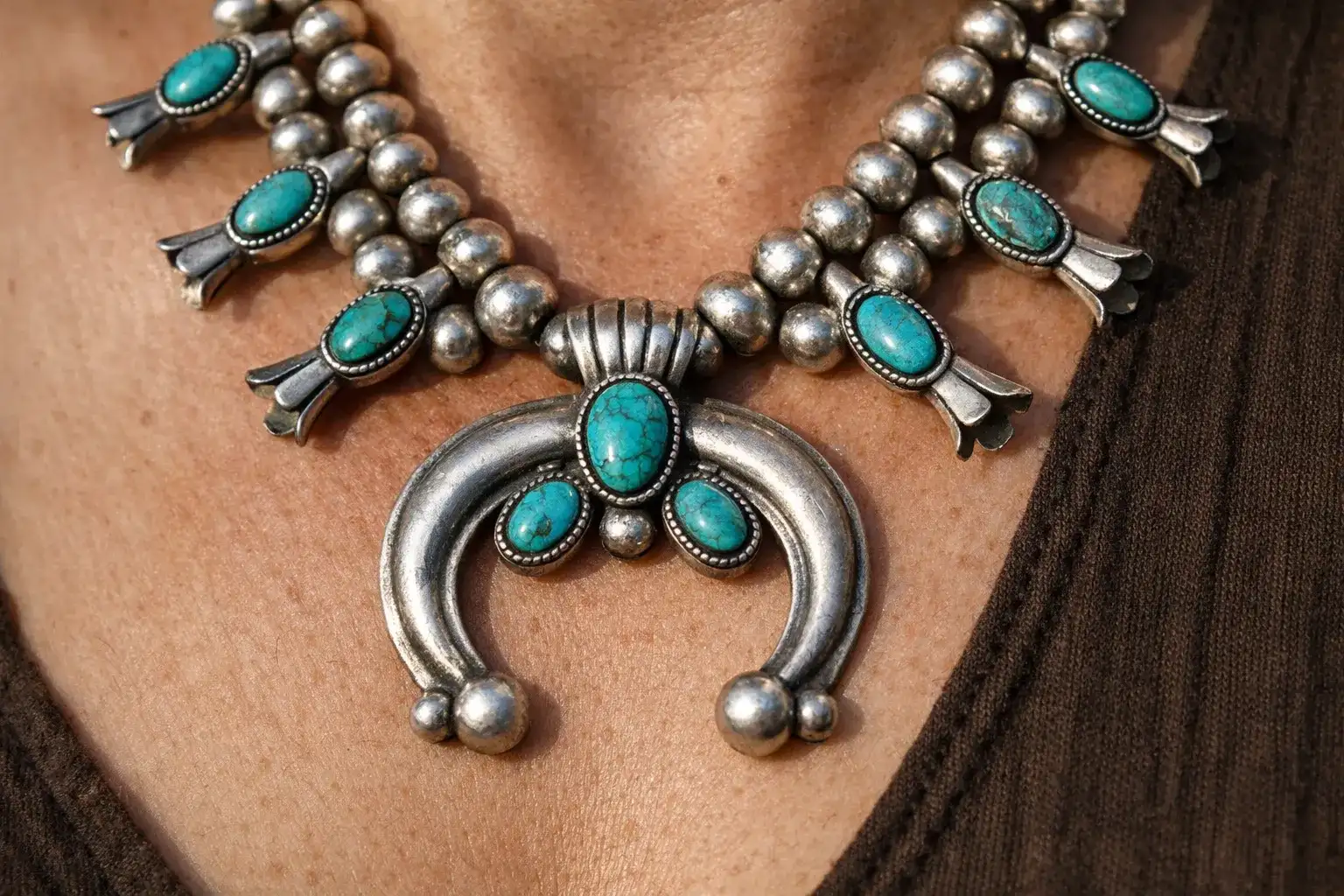
Navajo (Diné): Silver Mastery
Navajo silversmiths pioneered Southwestern metalworking, developing techniques that prioritize substantial silver construction shaped around natural stones. Navajo pieces typically feature heavy gauge silver, bold stampwork, and large turquoise cabochons left in relatively natural forms. The silver is the star—meticulously crafted, often oxidized to highlight stamped or repoussé designs, and constructed to last generations.
Distinctive Navajo techniques include sandcasting, where designs are carved into sandstone molds before molten silver is poured, creating unique organic textures. Squash blossom necklaces—featuring pomegranate-inspired silver beads and a crescent naja pendant—originated with Navajo smiths. The naja’s crescent form references both Spanish-Moorish horse bridle ornaments and ancient fertility symbolism, demonstrating how Navajo artists synthesized diverse influences into cohesive designs.
Navajo stampwork uses handmade steel stamps to impress designs into silver surfaces. Artisans collect stamps throughout their careers, developing personal design vocabularies. Traditional stamps reference natural forms—raindrops, lightning, mountains—while individual smiths create unique stamps that become recognizable signatures. The density and precision of stampwork often indicates a piece’s quality and the smith’s skill level.
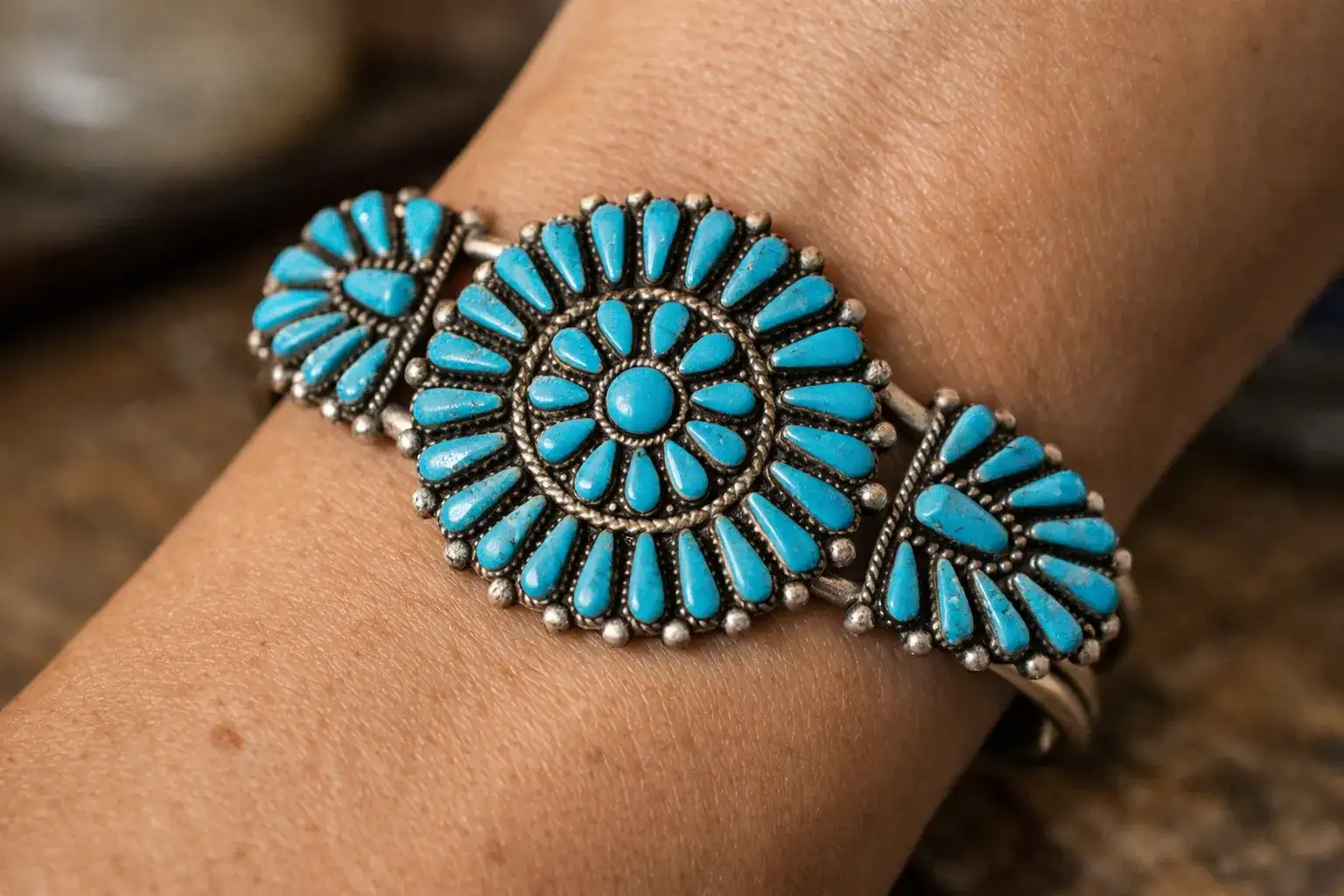
Zuni: Stone Setting Excellence
Zuni jewelry emphasizes intricate stonework over silver, with artisans cutting gemstones into precise shapes for elaborate inlay and cluster designs. While Navajo smiths shape silver around stones, Zuni lapidaries shape stones to fit pre-designed silver channels. This reversed priority produces distinctly different aesthetics—where Navajo pieces feel silver-dominant with stone accents, Zuni work appears as gemstone mosaics held by minimal silver frameworks.
Zuni cluster work sets multiple small stones—often dozens in a single piece—into elaborate patterns resembling flowers, snowflakes, or geometric forms. Needlepoint cluster work features stones cut into thin needles, while petit point uses small teardrop or oval shapes. Both techniques require exceptional lapidary skills to cut uniform stones that fit seamlessly together. True handcut Zuni cluster work represents hundreds of hours of skilled labor, making authentic pieces valuable investments.
Channel inlay, where precisely cut stones are set into pre-formed silver channels, allows Zuni artists to create complex pictorial scenes and geometric patterns in jewelry. Rainbow Man designs, featuring a yei figure with a rainbow arc, demonstrate Zuni artists’ ability to translate sacred imagery into intricate stone mosaics. The technique requires perfect coordination between silversmithing (creating channels) and lapidary work (cutting stones to fit channels exactly).
Zuni fetish carving—creating small animal figures from semi-precious stones—extends into jewelry through fetish necklaces stringing carved animals on traditional heishi beads. Each animal carries the symbolic meanings discussed earlier, with additional significance based on stone selection. A bear carved from jet invokes different energy than one carved from turquoise, allowing layered symbolic expression.
Hopi: Overlay Artistry
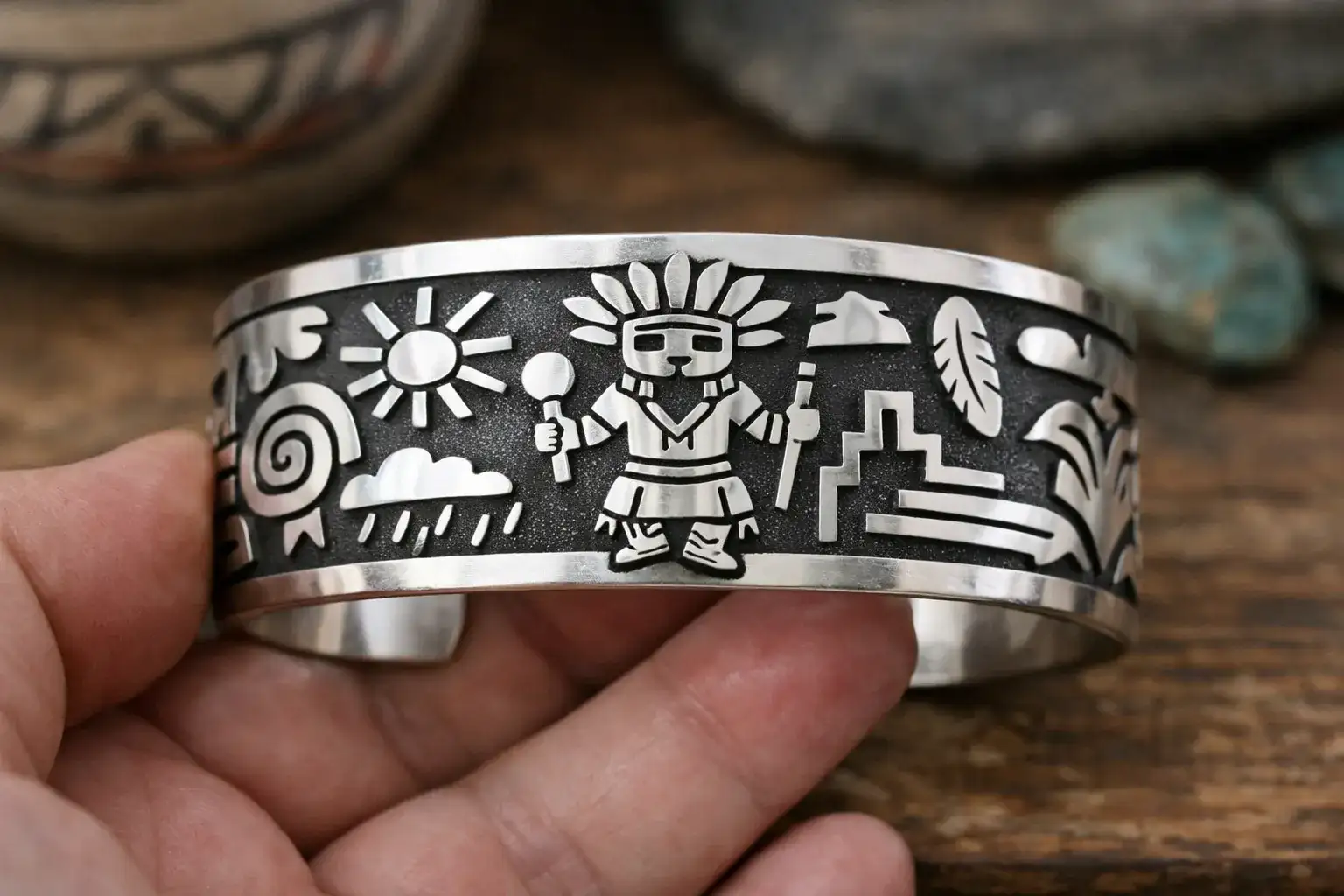
Hopi overlay technique layers two sheets of silver, with the top sheet cut out to reveal an oxidized bottom sheet beneath. This creates striking contrast between polished silver and dark background, producing designs that appear to float above the surface. Hopi artisans developed this technique in the 1940s, though it draws inspiration from traditional pottery and basket designs.
Hopi overlay frequently depicts clan symbols, kachinas, and pottery designs. Unlike Navajo stampwork’s repeated pattern approach, Hopi overlay often features large-scale singular designs that fill the entire piece surface. Corn plants, rain clouds, kachina faces, and geometric pottery patterns appear as bold graphic elements with precise clean edges defining forms.
The texturing of the oxidized bottom layer adds subtle detail that rewards close examination. Some artists create cross-hatched or lined textures before oxidation, adding depth to the dark background. The high polish given to the top layer creates maximum contrast, making Hopi overlay jewelry instantly recognizable by its dramatic black-and-silver aesthetic.
Hopi artisans generally avoid using stones, allowing pure silver artistry to dominate. When stones do appear, they’re incorporated minimally and deliberately, never competing with the overlay design’s graphic impact. This restraint differentiates Hopi work from other Southwestern styles and demonstrates how varying artistic philosophies—stone-focused Zuni versus silver-focused Hopi—can coexist within the same regional tradition.
Santo Domingo Pueblo: Heishi Masters
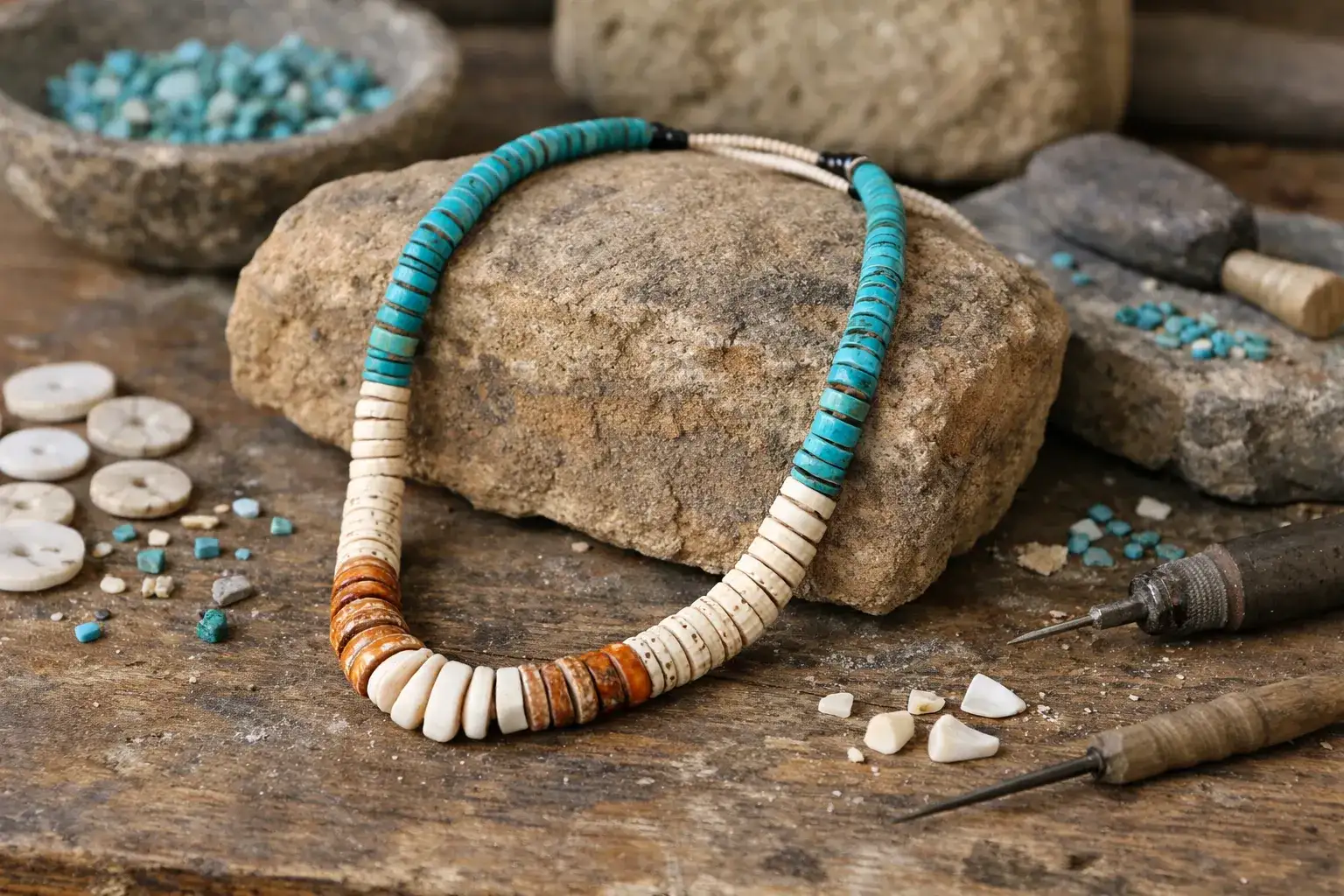
Santo Domingo (Kewa Pueblo) artisans are renowned for heishi—hand-cut, drilled, and polished shell and stone beads strung into necklaces. The term “heishi” derives from the Santo Domingo word for “shell,” though contemporary heishi includes turquoise, coral, jet, and other materials. True handmade heishi requires cutting material into small squares, drilling each piece, stringing them together, and rolling the entire strand against sandstone to create uniform cylindrical beads.
Authentic handmade heishi has become increasingly rare as fewer artisans master the time-intensive traditional technique. Machine-cut imitations flood the market, but knowledgeable collectors can distinguish handmade heishi by its slight irregularities and natural gradations in stone color and thickness. Vintage Santo Domingo heishi necklaces, particularly those featuring rare materials or exceptional craftsmanship, command premium prices among collectors.
Santo Domingo artisans also excel at shell mosaic inlay, creating geometric patterns by setting tiny shell pieces into shell bases. These labor-intensive works demonstrate exceptional patience and precision, with individual mosaic pieces sometimes measuring less than a millimeter across. The technique continues ancient Ancestral Puebloan traditions documented at Chaco Canyon and other archaeological sites.
Contemporary Innovations
While traditional techniques remain central to Native American jewelry, contemporary artists increasingly experiment with new materials and hybrid approaches. Some incorporate gold alongside traditional silver, while others use non-traditional stones or explore sculptural forms that push beyond jewelry’s conventional parameters.
Charles Loloma (Hopi, 1921-1991) revolutionized Native jewelry by incorporating gold, exotic stones like lapis lazuli and fossilized ivory, and asymmetrical designs influenced by international modernist movements. His innovations initially sparked controversy among traditionalists but ultimately expanded possibilities for Native artists while maintaining cultural integrity through continued engagement with ancestral symbols and techniques. Today, organizations like the Heard Museum’s Indian Fair & Market showcase both traditional and innovative Native artists, celebrating jewelry as living art form.
Contemporary artisans might overlay traditional Hopi techniques with Zuni-style inlay, or combine Navajo tufa casting with modern laser engraving. These innovations demonstrate that Native jewelry remains a living tradition rather than a fossilized art form. The most successful contemporary work honors ancestral knowledge while exploring new expressions, maintaining the essential connection between craftsmanship, symbolism, and cultural identity that defines authentic Native American jewelry.
How to Identify Authentic Native American Jewelry
With the proliferation of mass-produced imitations, identifying authentic Native American jewelry requires knowledge and attention to detail. Federal law through the Indian Arts and Crafts Act (1990) prohibits falsely marketing items as Native-made, but enforcement challenges mean buyers must educate themselves.
Examine Craftsmanship Quality
Authentic pieces exhibit meticulous handwork. Examine stone settings closely—are bezels hand-formed around each stone with slight irregularities that indicate handwork, or do they appear identical and machine-perfect? Check the back of pieces for exposed stone pavilions (bottoms), which often indicate mass production rather than traditional setting techniques that fully encase stones.
Stampwork should show crisp, clear impressions with consistent depth. Machine stamping appears mechanically precise, while handstamping shows subtle variations in pressure and alignment that prove each strike was individually executed. Solder joints in authentic pieces should be clean but visible upon close inspection, whereas factory pieces often use seamless construction methods foreign to traditional techniques.
Verify Materials
Sterling silver, marked “925” or “sterling,” should be standard for authentic pieces, though older works might use coin silver. Test silver with a magnet—genuine silver is non-magnetic, while base metals attract magnets. Nickel silver, despite its name, contains no actual silver and often appears in counterfeit work.
Turquoise authenticity proves more challenging. Genuine turquoise feels cool to the touch and has distinctive matrix patterns. Plastic imitations feel warm and show uniform color without natural stone variation. Howlite (a white stone) is frequently dyed turquoise-blue to deceive buyers. Stabilized turquoise—natural stone treated with resins for durability—is legitimate and widely used in authentic Native jewelry, though it should be disclosed by sellers.
Look for Artist Signatures
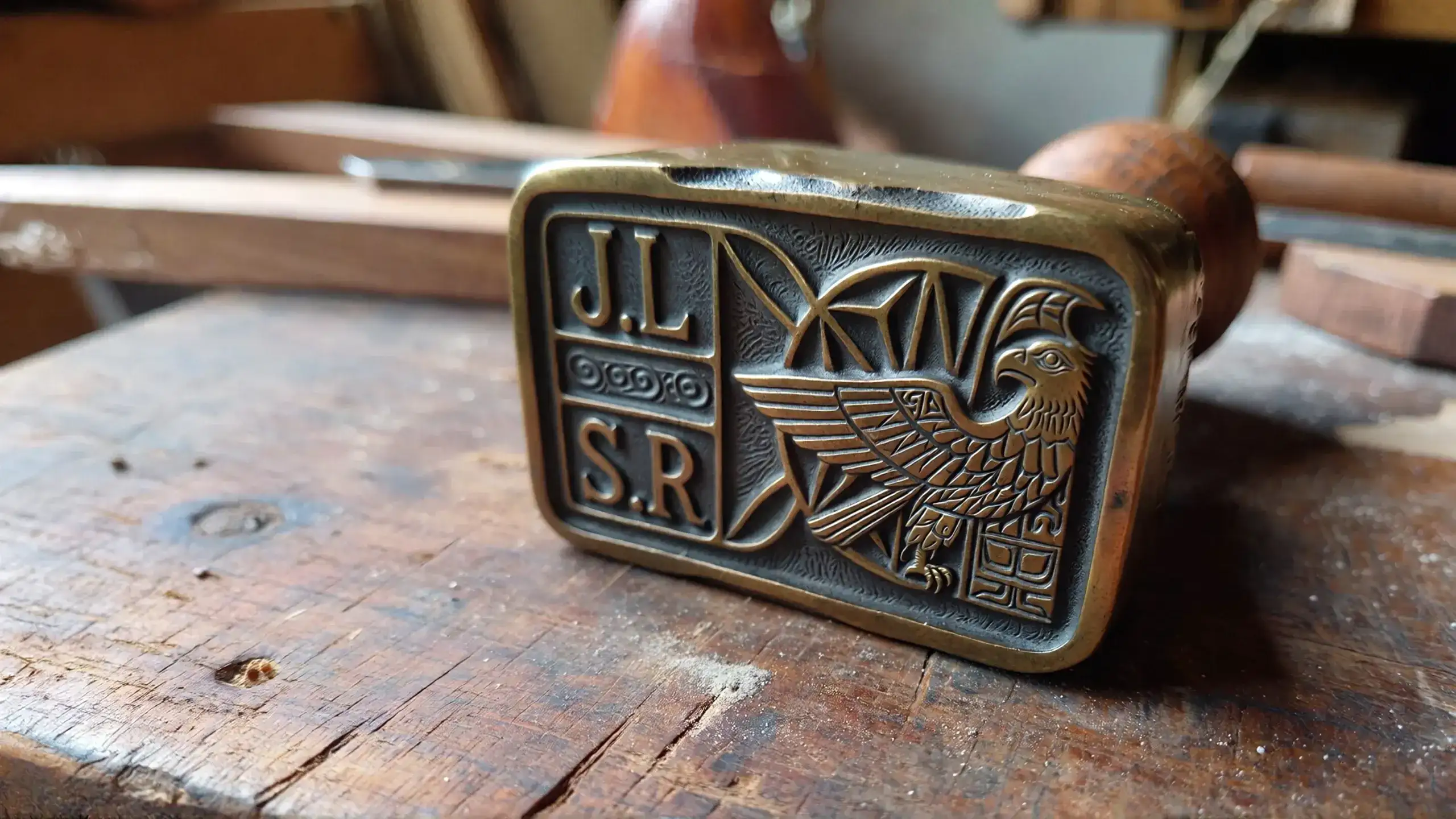
Many authentic pieces bear hallmarks—symbols or initials stamped into the silver identifying the artist. Research hallmarks through reference guides or online databases to verify tribal affiliation and artist reputation. However, absence of hallmarks doesn’t necessarily indicate fake work, as many older pieces and some contemporary artists don’t sign their work consistently.
When hallmarks appear, they should be struck into the metal rather than etched or engraved in ways that could be added after manufacture. The hallmark’s style should match the piece’s overall aesthetic—an obviously modern mark on supposedly vintage jewelry raises authenticity questions.
Assess Pricing Realistically
Authentic Native American jewelry requires substantial skilled labor and quality materials. Suspiciously low prices often indicate counterfeit or mass-produced pieces. While bargains exist, especially at estate sales or direct from artists, extremely cheap jewelry claiming Native origins should trigger skepticism. A genuine Zuni needlepoint bracelet requiring 40+ hours of hand-cutting and setting stones cannot legitimately sell for $30.
Buy from Reputable Sources
Purchase from established galleries, museum shops, Native-owned businesses, or directly from enrolled tribal artists. Reputable dealers provide documentation, artist information, and authenticity guarantees. Organizations like the Indian Arts and Crafts Association (IACA) maintain directories of verified authentic sources.
At markets and shows, ask sellers about the artist, which tribe they’re enrolled in, and specifics about the piece’s creation. Legitimate sellers welcome these questions and provide detailed answers. Evasive responses or claims that “an old Indian made it” without specific attribution suggest questionable authenticity. Cultural centers like the Indian Pueblo Cultural Center offer educational resources to help buyers understand what they’re purchasing.
Common Mistakes Collectors and Buyers Make
Even knowledgeable enthusiasts make errors when collecting Native American jewelry. Avoiding these common pitfalls protects both your investment and tribal artists’ livelihoods.
Assuming All Southwestern-Style Jewelry is Native-Made
Southwestern aesthetic influences mainstream jewelry widely. Many non-Native jewelers create turquoise and silver pieces inspired by Native designs without claiming Native origins—this practice is legal and legitimate when marketed honestly. Problems arise when retailers or resellers misrepresent such work as Native-made. Carefully read item descriptions and ask direct questions about artist tribal enrollment.
Confusing “Native American Style” with “Native American Made”
Legal terminology matters. “Native American style,” “Southwestern style,” or “Indian style” indicate aesthetic inspiration, not Native authorship. Only items marked “Native American made,” “Navajo made,” or similar tribal-specific attributions should be understood as authentic Native work—and even then, verify through other authentication methods.
Neglecting to Research Tribal Characteristics
Understanding tribal artistic traditions helps identify misattributed pieces. A bracelet marketed as “Hopi” but featuring elaborate stone cluster work likely isn’t Hopi-made, since Hopi artisans typically focus on overlay silverwork without stones. Knowledge of each tribe’s distinctive techniques and aesthetics serves as your first authentication filter.
Overvaluing Age Without Considering Quality
Age alone doesn’t guarantee value. Poorly crafted vintage pieces remain poorly crafted regardless of age. Conversely, exceptional contemporary work by renowned artists often exceeds vintage pieces in both quality and investment value. Assess each piece on its artistic merit, craftsmanship quality, and cultural significance rather than age alone.
Failing to Preserve Original Patina
Over-cleaning or polishing Native jewelry can destroy oxidation that highlights stampwork and adds character. Black oxidation in recessed areas is intentional patina, not tarnish requiring removal. Aggressive polishing also removes silver, literally wearing away the piece’s substance. Clean gently with soft cloths, avoiding harsh chemicals or abrasive materials.
Ignoring Provenance and Documentation
Maintaining documentation—purchase receipts, artist information, photos—preserves a piece’s history and enhances future resale value. Documentation proving a bracelet was made by a specific renowned artist dramatically affects its market value compared to an unsigned piece of similar aesthetic quality.
Buying Without Understanding Symbolism
Purchasing Native jewelry without understanding its symbolic content risks cultural insensitivity. Some pieces carry ceremonial significance inappropriate for casual wear or commercial display. Research symbols and respect their meanings. If unsure whether a piece’s imagery is suitable for your intended purpose, ask knowledgeable dealers or tribal cultural centers.
Care and Preservation of Native American Jewelry
Proper care maintains both jewelry’s physical condition and its spiritual integrity according to traditional beliefs.
Storage Practices
Store pieces separately to prevent scratching—silver is soft and damages easily when pieces rub together. Fabric-lined jewelry boxes or individual pouches provide ideal storage. Keep jewelry away from moisture and extreme temperature fluctuations that can affect stones and metal patina. Turquoise is particularly sensitive to chemicals, oils, and prolonged sun exposure that can alter its color.
Cleaning Methods
Clean silver gently using soft cloths specifically designed for silver jewelry. For detailed pieces, soft toothbrushes with mild soap and water remove accumulated dirt without damaging oxidation or stones. Avoid ultrasonic cleaners that can loosen stone settings or crack turquoise. Never use chemical silver dips, which strip oxidation and can damage stones.
Some traditions suggest “feeding” turquoise occasionally by wearing pieces, as skin oils are believed to maintain the stone’s vitality. While chemically questionable, this practice encourages regular wear rather than leaving pieces stored indefinitely—a benefit to both wearer and jewelry.
Wearing Considerations
Remove jewelry before swimming, bathing, or applying lotions and perfumes. Chlorine damages both silver and turquoise, while chemicals in cosmetics can stain or discolor stones. Put jewelry on last after applying makeup and perfume. Remove pieces before rigorous physical activity that might bend settings or strike stones against hard surfaces.
Professional Maintenance
Have valuable pieces professionally inspected periodically to check for loose stones, weak prongs, or structural issues. Jewelers experienced with Native American jewelry understand traditional construction techniques and can repair pieces using appropriate methods. General jewelers may not understand traditional setting techniques and could damage pieces through inappropriate repairs.
Spiritual Cleansing
Some traditions practice smudging with sage or cedar smoke to spiritually cleanse jewelry, particularly when acquiring pre-owned pieces or after pieces have been in storage. This practice acknowledges jewelry’s spiritual dimension beyond physical attributes. If you choose to smudge, research appropriate techniques that respect the tradition’s cultural origins.
Ethical Considerations When Collecting Native Jewelry
Collecting Native American jewelry responsibly requires awareness of cultural sensitivity and economic justice issues.
Support Tribal Artists Directly
Purchasing directly from artists or Native-owned businesses ensures fair compensation and supports tribal economies. Many Native communities rely significantly on jewelry sales, making each purchase decision potentially impactful. Direct purchases also provide opportunities to learn about pieces from their creators, enriching your understanding and appreciation.
Respect Sacred Imagery
Some symbols and designs carry ceremonial significance inappropriate for non-Native ownership or casual display. When uncertain about an item’s cultural appropriateness, ask knowledgeable sources. Respect if you’re advised that certain pieces should remain within tribal communities. This respect honors the cultural knowledge system that makes Native jewelry meaningful rather than treating it as purely decorative commodity.
Avoid Exploitative Dealers
Some dealers exploit Native artists by purchasing work at unfairly low prices then reselling at substantial markups. While all businesses mark up inventory, ethical dealers maintain reasonable margins and transparently credit artists. Dealers who can’t or won’t identify artists or provide information about tribal origins may be hiding problematic sourcing.
Educate Others
Share knowledge about authentic Native jewelry to combat the counterfeit market. When you see obvious fakes being sold as authentic, politely educate sellers and buyers if appropriate. Supporting organizations that fight jewelry fraud, like the Indian Arts and Crafts Association, strengthens protections for authentic Native artisans.
Consider the IACA
The Indian Arts and Crafts Act makes it illegal to falsely market items as Native-made. Report suspected violations to the Indian Arts and Crafts Board. While enforcement faces resource limitations, reporting patterns help authorities target systematic violators rather than isolated incidents.
The Contemporary Significance of Symbolic Jewelry
Native American jewelry’s symbolic traditions continue evolving while maintaining cultural continuity. Contemporary tribal members wear both traditional and innovative pieces that assert cultural identity in modern contexts.
Cultural Revitalization
Jewelry-making supports cultural revitalization efforts by providing income for artists while transmitting traditional knowledge to younger generations. Master artists teaching apprentices preserve techniques and symbolic vocabularies that might otherwise disappear. This living transmission ensures traditions adapt to contemporary contexts rather than freezing as historical artifacts.
Personal and Political Identity
Wearing Native jewelry asserts indigenous identity and cultural pride in contexts where Native people face ongoing marginalization. Jewelry becomes visible statement of tribal affiliation and cultural continuity. During Native American Heritage Month and at political events, jewelry often carries additional significance as demonstration of indigenous presence and persistence.
Economic Sovereignty
Jewelry sales provide economic opportunity for tribal members, particularly in communities with limited employment options. Success in jewelry markets demonstrates how traditional arts can generate sustainable income while maintaining cultural integrity. This economic sovereignty allows communities to support themselves on their own cultural terms rather than solely through wage labor in non-Native economies.
Artistic Innovation
Contemporary Native artists increasingly receive recognition in fine art contexts rather than being limited to craft markets. Museum exhibitions, gallery representation, and academic study acknowledge Native jewelry as sophisticated art form deserving serious critical attention. This elevation validates Native artistic traditions while creating new markets and opportunities for innovative artists.
Cross-Cultural Exchange
Non-Native jewelry collectors and wearers participate in cultural exchange when they approach Native jewelry with respect and knowledge. Appreciating Native jewelry’s symbolic depth and supporting authentic artists represents meaningful engagement rather than superficial appropriation. This exchange benefits all parties—artists receive fair compensation, collectors acquire meaningful objects, and cultural knowledge circulates respectfully.
Frequently Asked Questions About Native American Jewelry Symbolism
What is the most important symbol in Native American jewelry?
While different tribes emphasize various symbols, turquoise holds universally sacred status across Southwestern tribes. Known as the “sky stone,” turquoise represents protection, health, life, and connection to the spiritual realm. Its importance extends beyond symbolism to practical use—many traditions consider turquoise a living stone that actively protects its wearer by absorbing negative energy. The stone’s presence in jewelry dating back thousands of years in the Southwest demonstrates its enduring significance.
Beyond material symbolism, the circle represents perhaps the most fundamental geometric symbol, appearing in countless forms across Native jewelry. Circles embody wholeness, the cyclical nature of life, and the interconnectedness of all existence. From the Zia sun symbol’s binding circle to the continuous loops in heishi necklaces, circular forms communicate core philosophical principles about existence’s nature.
How can I tell if my Native American jewelry is authentic or mass-produced?
Authentic Native American jewelry exhibits several telltale characteristics. Hand-crafted pieces show slight irregularities in stampwork, stone settings, and construction that indicate individual artisan work rather than factory uniformity. Check the back of pieces—authentic works typically show hand-formed bezels completely encasing stones, while mass-produced pieces often leave stone backs exposed with uniform “dimples” where machinery held stones during setting.
Material quality provides another indicator. Genuine silver should be marked “sterling” or “925,” feel substantial in weight, and resist magnets. Turquoise authenticity requires more expertise—genuine stone feels cool, shows natural matrix variations, and has depth of color that plastic imitations lack. Price also signals authenticity; pieces requiring dozens of hours of skilled handwork cannot legitimately sell for $20-30. When in doubt, purchase from reputable dealers who provide artist documentation and authenticity guarantees.
What’s the difference between Navajo, Zuni, and Hopi jewelry styles?
Each tribe developed distinctive aesthetic approaches reflecting different priorities and skills. Navajo jewelry emphasizes substantial silverwork shaped around natural stones, with heavy gauge silver, bold stampwork, and large turquoise cabochons. The silver is the artwork’s focus, meticulously crafted and often oxidized to highlight detailed stamping. Navajo pieces feel weighted and substantial, reflecting the quality and quantity of silver used.
Zuni jewelry reverses these priorities, emphasizing intricate stonework over silver. Zuni lapidaries cut dozens of small stones into precise shapes for elaborate cluster work and channel inlay patterns. The gemstones create the design, with silver serving as minimal framework to hold stones in place. This fundamental philosophical difference—whether silver or stone dominates—creates immediately recognizable aesthetic distinctions between Navajo and Zuni work.
Hopi jewelry typically uses overlay technique layering two silver sheets with top layer cut out to reveal oxidized background beneath. This creates dramatic black-and-silver contrast showcasing designs drawn from Hopi pottery, baskets, and clan symbols. Unlike the other tribes, Hopi artisans generally avoid using stones, letting pure silver artistry dominate. These three distinct approaches demonstrate how neighboring tribes with shared regional materials developed radically different artistic philosophies.
Do symbols mean the same thing across all Native American tribes?
While some symbols carry similar meanings across tribes—bears generally represent courage, eagles symbolize spiritual connection, water indicates life—specific interpretations often vary significantly. The dragonfly, for example, serves as medicine animal and water symbol in Pueblo traditions but carries different associations among other tribes. Context matters tremendously when interpreting symbolism.
This variation reflects the diversity among hundreds of distinct tribal nations, each with unique languages, traditions, and cosmologies. Some symbols like the thunderbird appear widely but carry tribe-specific characteristics in their depiction and associated stories. What appears as universal Native American symbolism often represents Southwestern Pueblo and Navajo traditions specifically, which shouldn’t be assumed applicable to Plains, Northwest Coast, or Eastern Woodland tribes.
When researching specific pieces, identify the originating tribe and research their particular symbolic traditions rather than assuming pan-Native meanings. This specificity respects tribal diversity while ensuring accurate understanding of individual pieces’ cultural significance.
Is it appropriate for non-Native people to wear Native American jewelry?
Wearing authentic Native American jewelry purchased from legitimate tribal artists or reputable dealers is generally appropriate and supports Native economies. However, several important considerations apply. First, understand and respect the symbolism you’re wearing. Research pieces’ meanings to ensure you’re not unknowingly wearing ceremonial imagery inappropriate for casual use or non-Native ownership.
Second, ensure you’re purchasing authentic Native-made work rather than factory-produced imitations. Buying counterfeits harms the Native artists whose traditions inspired the designs while supporting exploitative manufacturers. Supporting authentic artists through fair-priced purchases represents respectful engagement rather than appropriation.
Third, be prepared to share information about your jewelry’s origins when asked. Many Native people appreciate seeing their cultural art honored through respectful wear and display. Conversely, treating pieces merely as trendy accessories without acknowledging their cultural significance demonstrates superficial appropriation. Approach Native jewelry with the respect you’d accord any significant cultural art form, recognizing each piece’s connection to living traditions and communities.
How should I care for vintage Native American jewelry?
Vintage pieces require special consideration beyond general jewelry care. First, avoid over-cleaning or polishing. Patina that has developed over decades—oxidation in stampwork, slight wear on high points, natural darkening of silver—adds character and proves age. Aggressive cleaning destroys this patina, actually diminishing the piece’s value and historical authenticity. Clean gently using soft cloths, preserving rather than removing age indicators.
Store vintage pieces carefully, protected from moisture, extreme temperatures, and mechanical damage. Because vintage jewelry may have weakened settings or structural issues from years of wear, have pieces professionally inspected before wearing regularly. Jewelers experienced with Native jewelry can identify and address potential problems using techniques appropriate to traditional construction methods.
If stones have become loose or fallen out—common in vintage pieces—this doesn’t necessarily indicate poor quality but rather normal wear over time. Traditional setting techniques may allow more stone movement than contemporary mass-production methods, so loose stones sometimes prove authenticity rather than indicating defects. Professional jewelers can tighten settings while maintaining traditional construction integrity.
Conclusion
Native American jewelry’s symbolic richness transforms decorative objects into meaningful cultural expressions carrying stories, beliefs, and wisdom developed over millennia. Understanding these symbols—from turquoise’s protective properties to the bear’s courage, from Hopi overlay’s graphic sophistication to Zuni channel inlay’s meticulous precision—deepens appreciation for each piece’s artistry and cultural significance.
The living traditions of Native jewelry-making demonstrate cultural resilience and adaptation. Contemporary artists honor ancestral techniques while exploring innovative forms, ensuring these traditions evolve rather than calcify. By supporting authentic Native artists, educating ourselves about tribal-specific traditions, and wearing pieces with respect for their cultural origins, collectors and enthusiasts participate in preserving these vital artistic expressions.
Each authentic piece connects wearers to thousands of years of artistic evolution, spiritual practice, and cultural continuity. Whether you’re drawn to jewelry’s aesthetic beauty, symbolic depth, or cultural significance, approaching Native American jewelry with knowledge and respect honors both the artists who create these works and the communities whose traditions inspire them.
For more insights into jewelry traditions and collecting, explore our guides on vintage jewelry authentication, proper jewelry care techniques, and gemstone symbolism across cultures.

Hi, I’m Sara Hein, a passionate jewelry researcher and educator. I created Jewelry Carats to share well-researched insights on gemstones, precious metals, and jewelry care. My goal is making expert jewelry knowledge accessible to everyone.