
From Architectural Rebellion to Collectible Art
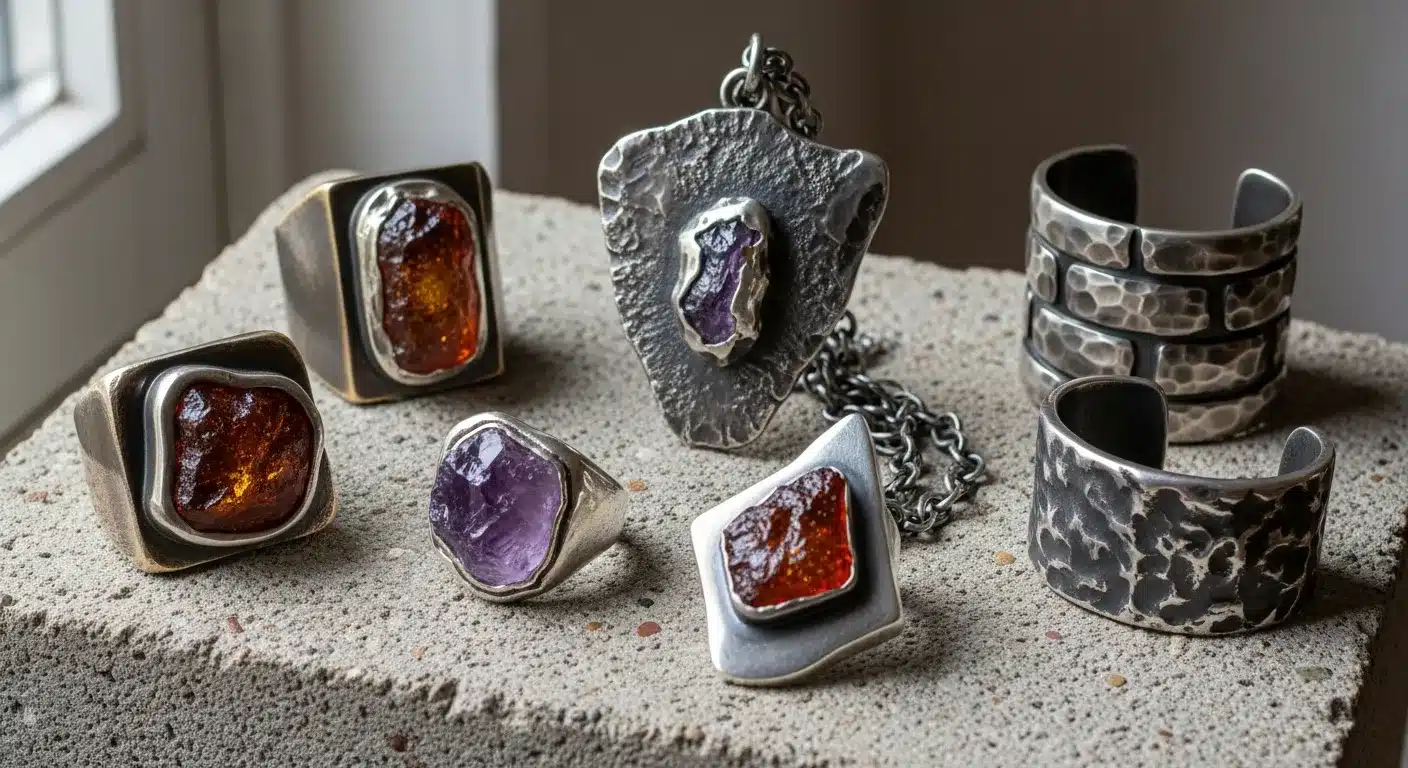
When Adrian Brody’s 2024 film The Brutalist swept through awards season, it brought renewed attention to a design movement that has captivated collectors for decades. Brutalism—that bold, raw aesthetic born from post-war architectural experimentation—found perhaps its most intimate expression in jewelry. From the late 1950s through the 1970s, artists working in metal transformed the movement’s uncompromising philosophy into wearable sculpture that challenged every convention of traditional adornment.
The history of brutalist jewelry is a story of rebellion, innovation, and enduring artistic vision. Unlike the delicate, gemstone-centered pieces that dominated mid-century design, brutalist jewelry embraced rough textures, asymmetric forms, and unexpected material combinations. Today, these once-controversial pieces command serious attention from collectors, with authenticated designer works selling for thousands of dollars and museum exhibitions celebrating their architectural heritage.
This comprehensive guide explores brutalism’s journey from underground art movement to collectible phenomenon, featuring the most complete designer database available online, authentic pricing guidance, and expert identification techniques you won’t find anywhere else.
Origins of Brutalist Jewelry (1948-1960)
Brutalist Architecture Movement Foundations
The brutalist jewelry movement cannot be understood without first examining its architectural parent. Brutalism emerged in late 1940s England, rooted in the International School of Modern Architecture championed by Swiss-French architect Le Corbusier. The term derives from the French phrase “béton brut,” meaning raw concrete—the material that would become synonymous with the style’s uncompromising aesthetic.
Architect Alison Smithson first used “brutalism” to describe her 1949 house design, though that project was never built. However, the Smithdon School in Hunstanton, England, designed by Alison and her husband Peter Smithson, became one of brutalism’s earliest realized examples. These structures rejected decoration entirely, displaying building materials in their original form—exposed concrete, visible infrastructure, sharp angular forms.
Post-WWII European Context
Post-World War II Europe’s desperate need for rapid reconstruction created the perfect environment for brutalist architecture to flourish. With cities devastated and resources scarce, the movement’s emphasis on functionality over ornament and cost-effective materials aligned perfectly with practical necessity. By the early 1950s, brutalist buildings were rising across Europe, their monolithic presence declaring a clean break from pre-war aesthetic traditions.
Translation from Architecture to Jewelry
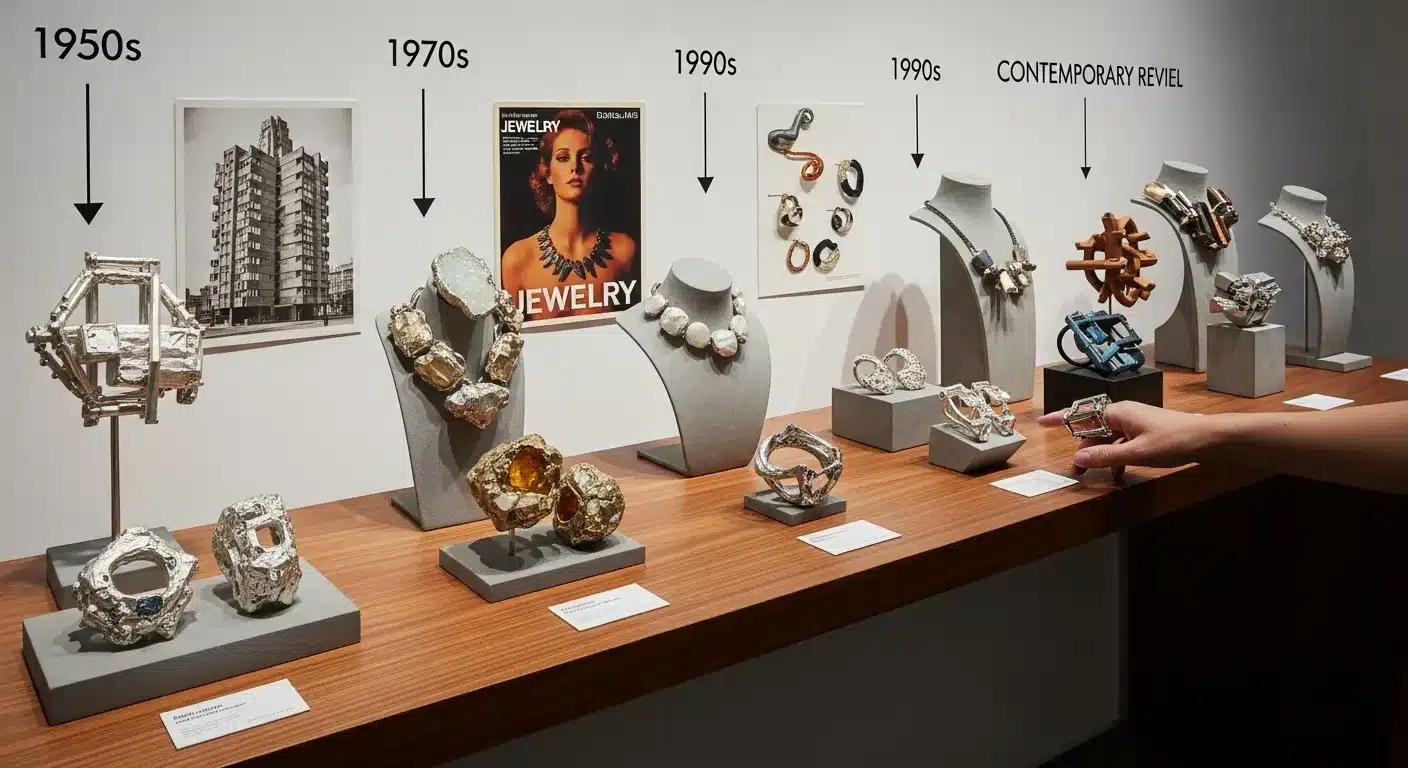
Art and architecture have always moved in tandem, and jewelry designers in the late 1950s began experimenting with brutalism’s visual language in miniature form. What made a building “brutalist”—raw materials, bold geometry, asymmetric composition, rejection of traditional beauty standards—could be translated into wearable art. By 1960, the movement had found its jewelry pioneers, artists willing to hammer, melt, and texture precious metals in ways that would have scandalized previous generations.
Defining Characteristics of Brutalist Jewelry
Raw, Unfinished Aesthetic
Brutalist jewelry celebrates imperfection. Where traditional jewelry demands flawless polish and perfect symmetry, brutalist pieces revel in rough surfaces, visible tool marks, and deliberately crude construction. This wasn’t sloppiness—it was intentional artistic choice, a rejection of bourgeois refinement in favor of honest materiality.
Bold Geometric Forms
Chunky, angular, and often massive in scale, brutalist jewelry makes no apologies for its presence. Pieces feature sharp corners, severe linear arrangements, and repetitive geometric elements like cubes, blocks, and towers. The jewelry equivalent of brutalist architecture’s concrete monoliths, these designs demanded attention and refused to fade politely into the background.
Unexpected Material Combinations
Perhaps brutalism’s most revolutionary aspect was its complete disregard for material hierarchy. A piece might combine humble copper with precious platinum, nest rough amber cabochons beside fine diamonds, or incorporate wood and fabric alongside gold. Value was determined by visual impact, not intrinsic worth—a philosophy that democratized jewelry design.
Difference Between Modernist vs Brutalist
While often confused, modernist and brutalist jewelry represent related but distinct aesthetics. Modernism in jewelry (emerging in the 1930s-1940s) encompasses broad experimentation with abstract forms and mixed materials. Brutalism, emerging later, takes modernism’s innovations to more extreme conclusions—rougher textures, heavier forms, more uncompromising asymmetry. Think of brutalism as modernism’s rebellious younger sibling, pushing every boundary even further.
Materials & Revolutionary Techniques
Controlled Gold Melting Innovation
One of brutalism’s most significant technical innovations involved melting gold under carefully controlled temperatures to create new surface textures. As documented by jewelry historians, this experimentation resulted in a profusion of new finishes. Beyond plain or polished gold, metal could now be chiseled, reeded, hammered, corded, braided, and textured to resemble the surface of the moon or the bed of the sea.
Texture Creation Methods
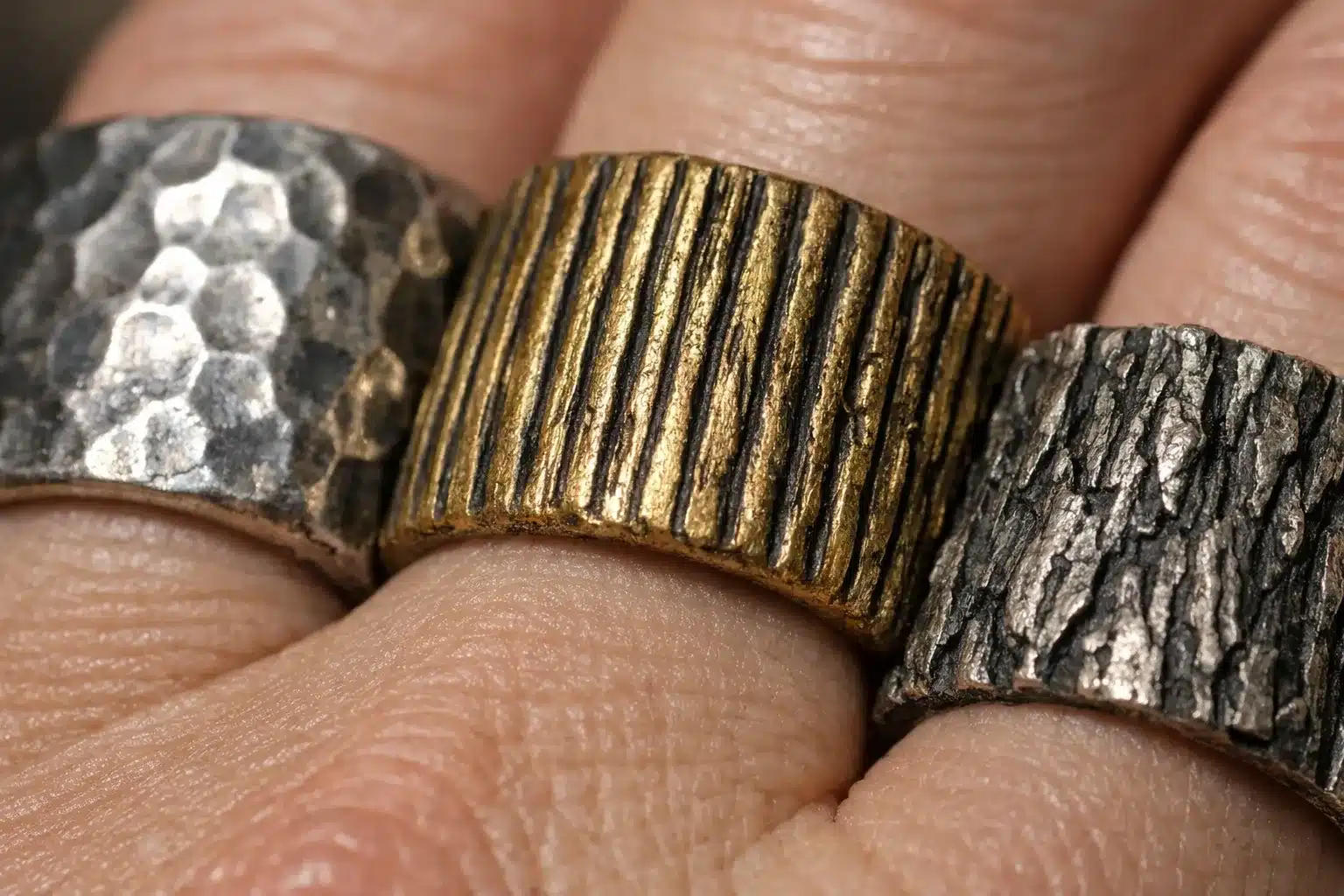
Brutalist jewelers developed an extensive vocabulary of surface treatments. The florentine finish created cross-hatched patterns through repeated tool strikes. Bark finishes mimicked tree texture through strategic hammering and carving. Faux nugget finishes replicated natural gold’s rough appearance. Sandblasting created matte surfaces that caught light differently than traditional polish. Each technique added to brutalism’s textural richness.
Mixed Metals Philosophy
Where traditional jewelry carefully separated metals by type and value, brutalist artists freely intermingled platinum, gold in various karats, silver, copper, brass, and bronze. This mixing wasn’t random—designers used contrasting metals to enhance visual interest, create color variation, and challenge assumptions about what “precious” meant in jewelry context.
Unconventional Gemstone Selection
Gemstone choices in brutalist jewelry prioritized visual effect over market value. Designers favored unusual stones like aventurine, tiger’s eye, lapis lazuli, and rough amethyst. Stones were frequently left unpolished to emphasize their natural state. Trillion cuts, oversized cabochons, custom-carved stones, and even rough crystal formations appeared regularly. The goal was aesthetic impact, not traditional prestige.
Surface Finishes
Beyond hammered and textured gold, brutalist jewelers employed specialized finishes that became style signatures. Florentine finish created intricate cross-hatching. Bark finish mimicked natural wood grain. Nugget finish replicated the appearance of raw gold fresh from a stream. Sandblasted surfaces provided matte contrast to polished elements. These finishes transformed simple metal into sculptural landscape.
Complete Designer Database: The Masters of Brutalism
North American Pioneers
David Yurman (1960s-1970s Early Work)
Before becoming synonymous with cable bracelets, David Yurman created striking brutalist pieces in his New York studio. His early work featured bold brass necklaces with rough, organic forms and heavy chain elements. One of his first designs—a necklace for wife Sybil Yurman—exemplifies classic brutalist characteristics with its chunky, sculptural presence. These early pieces, rarely seen today, command premium prices when they appear at auction.
Sam Kramer (1938-1979)
A founding father of American modernist and brutalist jewelry, Sam Kramer operated from his Greenwich Village studio beginning in 1938. His work fearlessly experimented with asymmetric forms, mixed metals, and unconventional materials. Kramer viewed himself as peer to contemporary painters and sculptors, bringing fine art sensibility to wearable objects. His influence on the movement cannot be overstated.
Art Smith (1940s-1970s)
Another Greenwich Village pioneer, Art Smith created bold, sculptural pieces that pushed modernist boundaries into brutalist territory. His work featured heavy gauge metal worked into organic, flowing forms with rough-hewn surfaces. Smith’s pieces are highly collectible today, with museum exhibitions celebrating his contribution to American avant-garde jewelry.
Arthur King (1960s-1980s)
Arthur King specialized in “flowed gold” techniques, creating pieces with organic, nugget-like appearances. His work exemplified brutalism’s “pushback to nature” philosophy, using textured gold surfaces and random gemstone placement to evoke natural formations. King’s designs influenced countless imitators but remain distinctive for their quality execution.
Canadian School of Brutalism
Robert Larin (1968-1972)
Montreal-based Robert Larin created some of brutalism’s most sought-after pieces during his brief but intense four-year career. Working primarily in pewter, Larin cast abstract, sculptural forms with deeply textured surfaces. His pieces are immediately recognizable for their bold, almost primitive aesthetic and exceptional quality. Current market value ranges from $200 for smaller brooches to $800+ for statement necklaces. Larin’s work appears regularly on eBay and specialized vintage jewelry platforms.
Guy Vidal (1970s)
Gilles “Guy” Vidal brought slightly more refined sensibility to Canadian brutalism while maintaining the movement’s essential characteristics. His pewter and mixed metal pieces feature smoother surfaces than Larin’s work but retain brutalism’s bold forms and organic shapes. Vidal created diverse jewelry types from choker necklaces (including one aptly named “Vertebrae”) to cuff bracelets. His pieces are marked with various signatures and remain affordable, typically selling for $150-$400.
Rafael Alfandary (1960s-1980s)
Perhaps the most influential Canadian brutalist jeweler, Rafael Alfandary created kinetic designs in hammered copper and brass, often accented with brightly colored cabochons. His work inspired countless Southwestern-style jewelry imitators still found in gift shops today. Alfandary’s authentic pieces achieved celebrity status—Prince famously wore one of his designs to the People’s Choice Awards. Current values range from $165 for necklaces to $400+ for complex kinetic pieces. His work appears on platforms like Lost Girls Chicago and Ruby Lane.
Walter Schluep (1960s-1980s)
Working in Montreal with high-karat gold, Walter Schluep created brutalist pieces that bridged studio art and fine jewelry. His 14k and 18k gold work features the movement’s characteristic textures and forms but with precious metal execution. Schluep pieces command premium prices, often exceeding $2,000, and are considered investment-grade brutalist jewelry.
European Masters
Andrew Grima (1951-2007)
London-based Andrew Grima stands as one of brutalism’s most celebrated designers. Born in Italy and trained in London, Grima’s innovative work captivated 1960s-1970s fashion. He became Crown Jeweller to the British Royal Family in 1970—remarkable recognition for an artist working in such an unconventional style. Grima’s pieces feature bold geometric shapes, rough-cut gemstones, and unconventional materials, blurring the line between jewelry and sculpture. His showroom was even dubbed “brutalist street furniture.” Authentic Grima pieces sell for $3,000-$15,000+ depending on materials and provenance.
Charles de Temple (1960s-1970s)
Another London jeweler, Charles de Temple famously created the engagement ring worn in the 1969 James Bond film On Her Majesty’s Secret Service. His brutalist approach featured spiky, abstract forms that perfectly captured the movement’s rebellious spirit. De Temple’s work exemplifies how brutalism penetrated even mainstream luxury jewelry.
Gerda Flockinger (1960s-1980s)
Austrian designer Gerda Flockinger created distinctive brutalist pieces with “crater-like” surfaces. Her sterling silver cufflinks and jewelry featured deeply textured, almost lunar landscapes in miniature. Flockinger’s work demonstrates brutalism’s international reach and varied national interpretations.
Scandinavian Contributors
David Andersen (Norway, 1960s-1970s)
The Norwegian firm David Andersen produced brutalist pieces alongside their traditional enamelwork. Their brutalist jewelry featured characteristic Scandinavian attention to craftsmanship combined with the movement’s bold aesthetic.
Matti J. Hyvarinen (Finland, 1960s-1970s)
Finnish designer Matti J. Hyvarinen brought Nordic sensibility to brutalist forms, creating pieces that balanced rough textures with elegant proportions. His work represents Scandinavian brutalism’s distinctive character.
Peter Wilhjelm Nielsen (Denmark, 1960s-1980s)
Danish designer Peter Wilhjelm Nielsen created unique brutalist interpretations, including sterling silver and aventurine necklaces with deeply dimensional pendant designs. His work showcases how Scandinavian designers adapted brutalism to their aesthetic traditions.
Jacob Hull (Denmark, 1970s)
Danish artist Jacob Hull achieved international recognition for his “spore and bubble” bronze jewelry and modernist sculpture. His brutalist jewelry pieces feature distinctive organic forms with complex surface textures. Hull’s work has been exhibited throughout the United States and commands collector interest, with pieces selling for $400-$1,500.
The Golden Age (1960-1975)
Peak Popularity and Mainstream Adoption
By the mid-1960s, brutalist jewelry had moved from underground art studios to mainstream consciousness. Fashion magazines featured the bold pieces, celebrities wore them publicly, and major retailers began stocking brutalist-inspired designs. The movement peaked between 1965 and 1972, when brutalist jewelry appeared everywhere from department stores to exclusive galleries.
Luxury Houses Embrace the Style
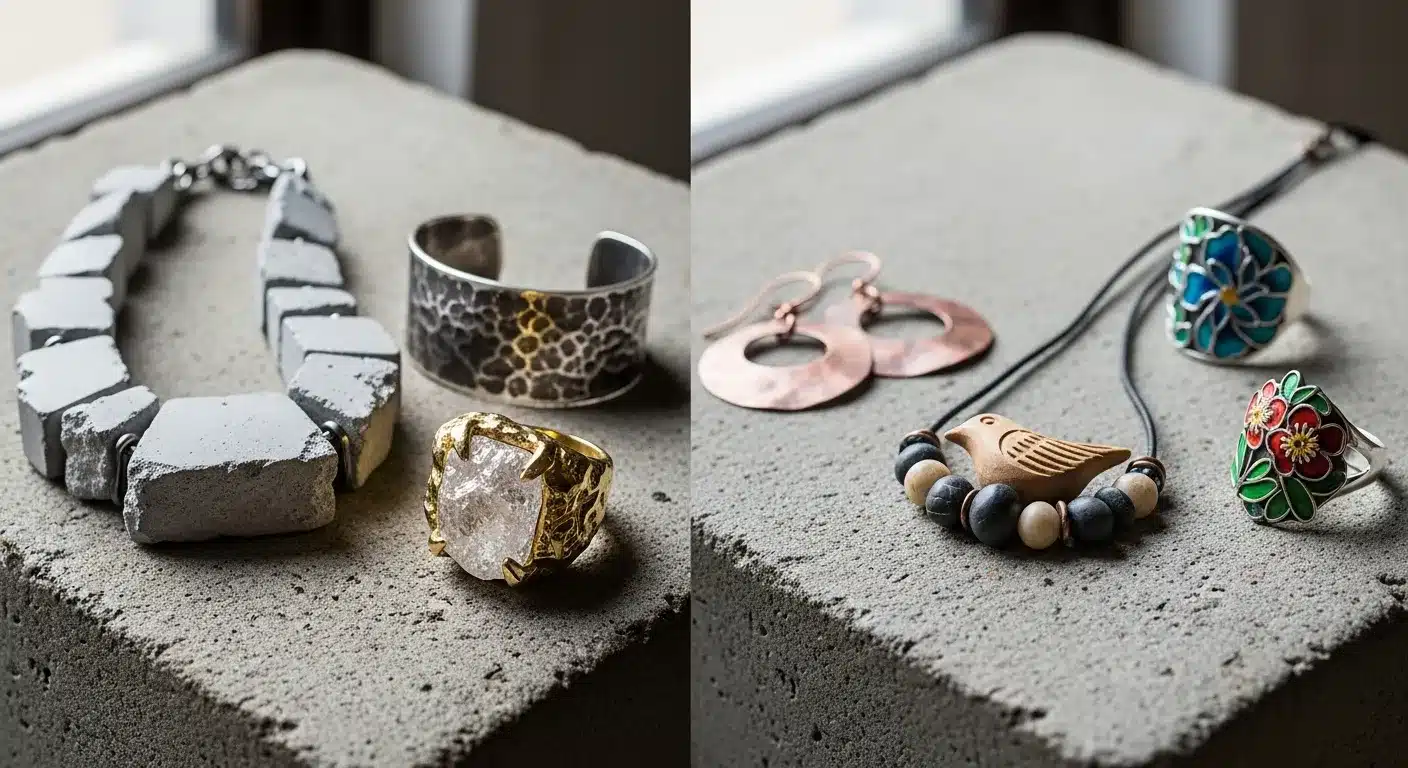
Even prestigious maisons known for traditional elegance couldn’t ignore brutalism’s cultural momentum. Cartier, Van Cleef & Arpels, Harry Winston, Tiffany & Co., and Boucheron all produced brutalist-influenced pieces during this period. These luxury interpretations typically featured high-karat gold and fine gemstones but incorporated brutalism’s characteristic textures and bold forms. The presence of brutalist elements in high jewelry collections validated the movement’s artistic legitimacy.
Costume Jewelry Brands Join In
Costume jewelry manufacturers also adapted brutalist aesthetics for mass production. Brands like Trifari, Panetta, Kenneth Jay Lane, and Napier released collections featuring brutalist-inspired textures, geometric forms, and mixed metal finishes. While lacking the hand-crafted quality of studio pieces, these adaptations made the brutalist look accessible to broader audiences. Kenneth Jay Lane’s “stick” necklace, for example, distilled brutalist aesthetics into an affordable yet striking design.
Geographic Centers of Production
Montreal emerged as brutalism’s Canadian epicenter, home to Larin, Vidal, Alfandary, and Schluep. New York’s Greenwich Village remained crucial for American pioneers like Kramer and Smith. London hosted Grima and de Temple’s influential work. Scandinavia contributed its own brutalist interpretation through designers in Norway, Denmark, and Finland. Israel, Mexico, and Brazil also produced notable brutalist jewelry, though their designers received less international attention.
Cultural Significance & Social Context
Rebellion Against 1950s Conventional Beauty
Brutalist jewelry represented direct rebellion against the delicate, feminine, gemstone-centered pieces that dominated 1950s fashion. Where post-war jewelry emphasized traditional femininity with pearls, pastel stones, and graceful forms, brutalist pieces were aggressive, gender-neutral, and unapologetically bold. This aesthetic rebellion mirrored broader cultural shifts questioning established norms.
Feminist Movement Connection
The brutalist aesthetic aligned with emerging feminist ideals of the 1960s-1970s. By rejecting traditional “pretty” jewelry in favor of powerful, sculptural forms, brutalist pieces offered women adornment that made statements about strength and independence rather than conventional femininity. The movement’s disregard for gender-specific design created jewelry that anyone could wear assertively.
Anti-Establishment Sentiment
Brutalism’s very existence challenged jewelry industry establishment. Using “cheap” materials like pewter and copper alongside gold, incorporating rough crystals instead of faceted gems, creating asymmetric designs that violated traditional composition rules—every choice represented rejection of industry standards. This anti-establishment spirit resonated with broader countercultural movements.
Environmental Consciousness
Many brutalist artists incorporated recycled or repurposed materials into their designs, aligning with growing environmental awareness. Using brass, copper, and pewter reduced reliance on newly mined precious metals. Selecting unpolished stones and rough crystals minimized processing. While not explicitly “green” by modern standards, brutalism’s material choices reflected emerging consciousness about sustainable creation.
The Decline (1975-2000)
Shift to Minimalism
By the mid-1970s, fashion began favoring minimalist aesthetics—delicate chains, simple forms, understated elegance. Brutalism’s bold, aggressive presence fell out of step with these trends. The same qualities that made brutalist jewelry revolutionary in the 1960s made it seem dated and excessive by 1980.
Consumer Preference Changes
As economic prosperity increased during the 1980s, consumers gravitated toward traditional luxury markers—diamonds, precious metals, refined craftsmanship. Brutalism’s deliberate roughness and material democracy lost appeal to buyers seeking conventional status symbols. The movement’s philosophical rejection of traditional value hierarchies became a market liability.
Poor Quality Imitators
Mass production of cheap brutalist-inspired jewelry flooded markets with inferior pieces lacking authentic handcrafted quality. These poorly executed imitations damaged brutalism’s reputation, making it difficult for consumers to distinguish between significant artistic works and mundane knock-offs. The resulting confusion accelerated the style’s decline.
Fading into Collectible Niche
By the 1990s, brutalist jewelry had largely disappeared from mainstream retail. However, it never completely vanished. A dedicated collector community continued acquiring and trading pieces, particularly signed works by recognized designers. This niche market quietly preserved brutalism’s legacy until its eventual revival.
Identification & Authentication Guide
Construction Techniques to Look For
Authentic brutalist jewelry displays specific construction characteristics. Look for hand-worked surfaces showing tool marks from hammering, chiseling, or texturing. Welded or soldered joints often appear deliberately crude rather than invisibly finished. Weight is substantial—genuine pieces feel heavy for their size due to solid metal construction. Asymmetry should appear intentional rather than accidental, with balanced visual weight despite irregular forms.
### 🔍 Recommended Jeweler’s Loupe
**10X Magnification Jeweler’s Loupe**
* ✓ Examine hallmarks and signatures clearly
* ✓ Inspect texture techniques in detail
* ✓ Verify construction quality
* ✓ Professional-grade magnification
Designer Hallmarks & Signatures Reference
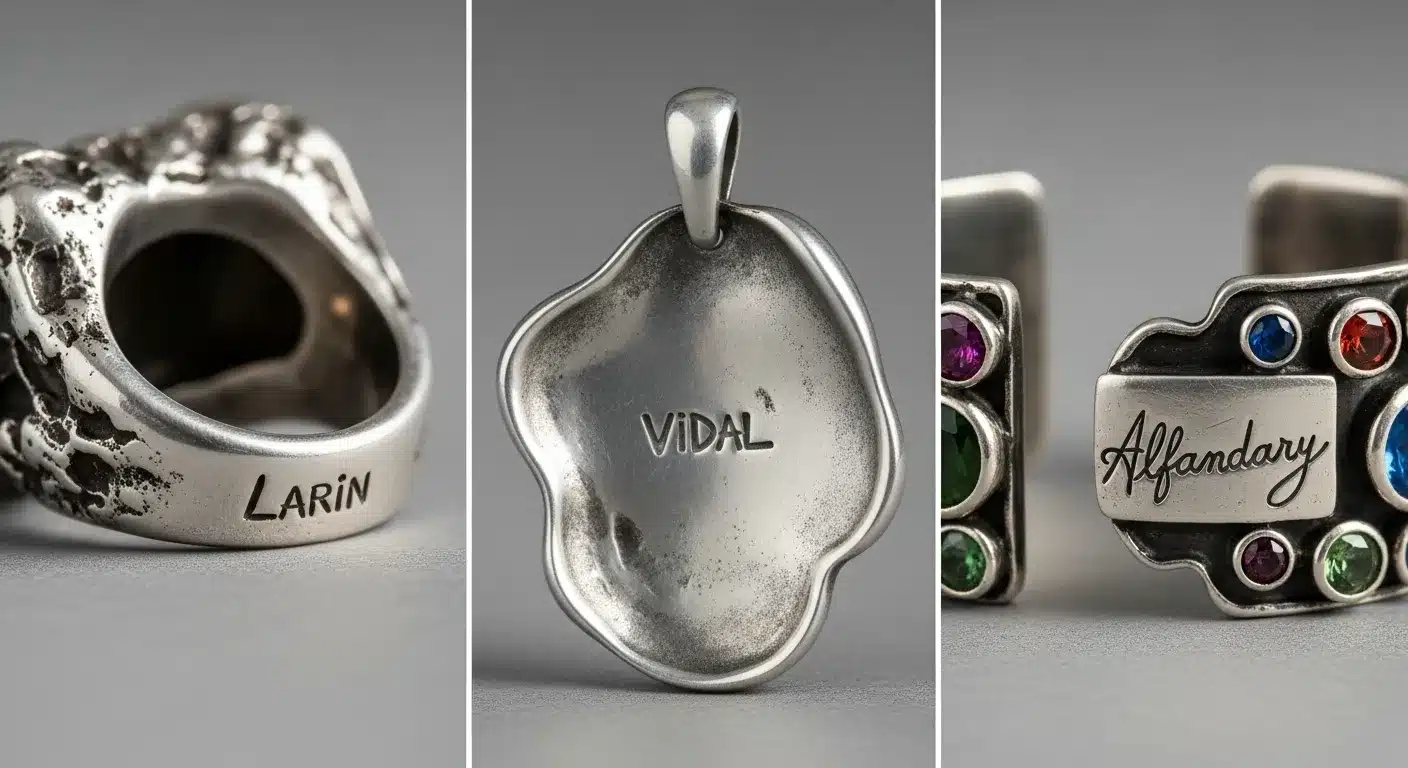
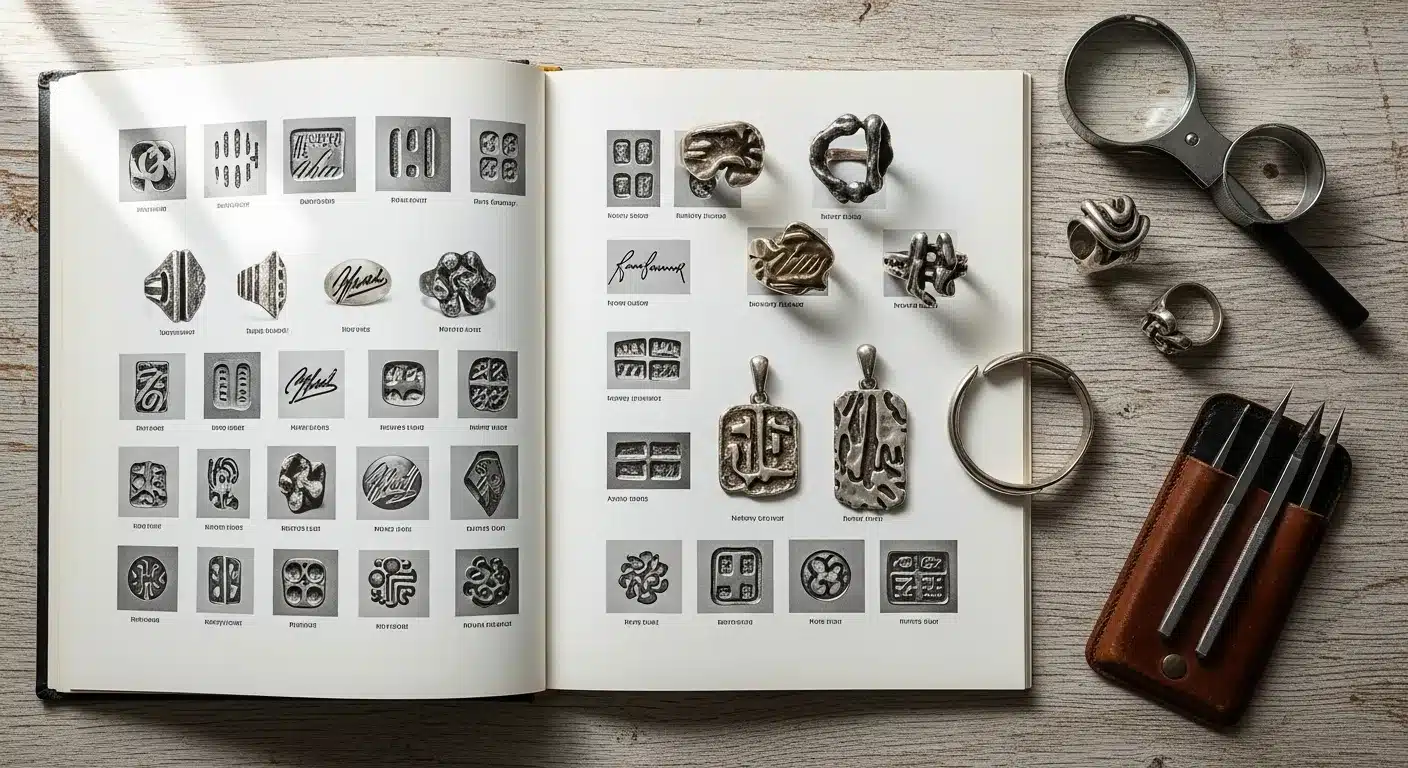
Many brutalist designers signed their work, making authentication easier for collectors. Guy Vidal used multiple marks: a circular plaque with a three-piece “macaroni” symbol, a rectangular “VIDAL” stamp, handwritten “G. Vidal,” or a stylized “gv” within a “V.” Robert Larin pieces bear his distinctive signature. Andrew Grima marked pieces with his name. Jacob Hull signed his work. Walter Schluep’s pieces show hallmarks plus his name. Unsigned pieces require evaluation based on construction quality, materials, and stylistic consistency with known designers.
Period-Appropriate Materials Check
Brutalist jewelry from the 1960s-1970s typically uses specific materials. Metals include sterling silver, pewter, brass, copper, bronze, 14k gold, and occasionally platinum. Gemstones favor amethyst, aventurine, lapis lazuli, tiger’s eye, onyx, rough quartz, and amber—often left unpolished. Modern reproductions sometimes use materials unavailable during brutalism’s original period, like rhodium plating or synthetic stones, which can help identify fakes.
Common Reproductions & Fakes
Contemporary jewelers create brutalist-inspired pieces that can confuse buyers seeking vintage originals. Modern pieces often feature too-perfect construction, consistent textures achieved through mechanical processes, and lightweight materials. Genuine period pieces show hand-crafted irregularities, weight appropriate to solid metal construction, and patina consistent with 50+ years of age. Be particularly cautious with unsigned pieces priced suspiciously low.
Condition Assessment Tips
Brutalist jewelry’s rough aesthetic complicates condition assessment. Some wear is expected and acceptable—natural patina on copper or brass, minor surface scratches on textured finishes. However, structural damage like broken elements, missing stones, or failed joints significantly impacts value. For collectible pieces, original condition matters—aggressive cleaning that removes intentional patina or repairs using inappropriate techniques can reduce value more than leaving patina and minor damage intact.
Value Guide & Market Pricing (2025)
Entry-Level Pieces ($150-$500)
Unsigned brutalist pieces in common metals (brass, copper, pewter) typically sell for $150-$300. Small brooches and earrings by lesser-known designers fall into this range. Guy Vidal pewter pendants generally sell for $150-$250. Simple Robert Larin brooches start around $200. These pieces offer excellent entry points for new collectors and demonstrate authentic brutalist characteristics without premium pricing.
Mid-Range Signed Works ($500-$2,000)
Signed pieces by recognized designers occupy this tier. Robert Larin statement necklaces sell for $600-$800. Rafael Alfandary complex kinetic pieces reach $400-$600. Walter Schluep gold pieces start around $800 and climb based on karat and size. Jacob Hull bronze jewelry ranges from $400-$1,500 depending on size and complexity. Pieces in this range represent solid investment-grade brutalist jewelry.
High-End Designer Masterpieces ($2,000-$10,000+)
Museum-quality pieces by celebrated designers command premium prices. Andrew Grima authenticated pieces sell for $3,000-$15,000+ depending on materials and provenance. David Yurman’s early brutalist work, when it appears, can exceed $5,000. Exceptional Walter Schluep gold pieces reach $3,000-$8,000. Pieces with royal or celebrity provenance, museum exhibition history, or exceptional artistic merit can surpass $10,000.
Factors Affecting Value
Multiple factors influence brutalist jewelry value: designer attribution (signed pieces command premiums), materials (gold pieces worth more than pewter), size (larger statement pieces typically more valuable), condition (original surface treatments preferred), rarity (limited production or unique designs), and provenance (documented history, celebrity ownership, exhibition records). Market availability also matters—currently, brutalist jewelry on 1stDibs averages $1,250, with range from $175 to $48,000.
Investment Potential Analysis
Brutalist jewelry markets show strong upward trajectory. Prices for authenticated designer pieces have increased 200-400% over the past decade. Growing collector interest, limited supply of vintage pieces, and renewed cultural appreciation drive values higher. However, investment success requires careful authentication, focus on recognized designers, and patience—brutalist jewelry rewards long-term holding better than quick flipping. The market favors quality over quantity, making three exceptional pieces a better investment than ten mediocre ones.
Care & Preservation Best Practices
Cleaning Different Metals
Each metal requires specific care. Sterling silver pieces can be cleaned with commercial silver polish, but avoid aggressive scrubbing on textured surfaces. Pewter requires gentle cleaning with mild soap and water—harsh chemicals can damage the surface. Brass and copper develop natural patina that many collectors value; removal should be considered carefully. For mixed-metal pieces, use the gentlest method appropriate for the most delicate metal present.
### 🧼 Recommended Metal Polish
**Wright’s Copper & Brass Cream**
* ✓ Safe for brutalist finishes
* ✓ Can preserve intentional patina
* ✓ Professional jeweler recommended
* ✓ Works on copper, brass, bronze
Patina Preservation vs Tarnish Removal
Understanding the difference between desirable patina and problematic tarnish is crucial. Original patina—the natural darkening and color changes that develop over decades—adds authenticity and can enhance value. Aggressive cleaning that removes all patina may damage value and character. However, active corrosion or thick tarnish obscuring design details should be addressed. When in doubt, consult with a jewelry professional experienced in vintage pieces before cleaning.
Storage Recommendations
Store brutalist jewelry individually to prevent scratching and tangling. Soft cloth pouches work well, providing protection while allowing air circulation. Anti-tarnish storage is appropriate for silver pieces but unnecessary for brass or copper if natural patina is acceptable. Keep pieces away from excessive humidity, which accelerates tarnishing. For valuable collections, consider museum-quality storage with archival materials.
### 📦 Recommended Storage Solution
**Anti-Tarnish Jewelry Pouches**
* ✓ Prevents tarnish on silver pieces
* ✓ Individual compartments avoid scratching
* ✓ Soft microfiber protection
* ✓ Museum-quality materials
Restoration Considerations
Restoration of brutalist jewelry requires careful consideration. Missing stones can be replaced if done with period-appropriate materials and techniques. Structural repairs to broken elements are generally acceptable if executed competently. However, extensive restoration can reduce value, particularly if it involves altering original surface treatments or construction. For valuable pieces, always consult specialist jewelers experienced with brutalist work before authorizing restoration.
Contemporary Revival (2010-Present)
Modern Interpretations
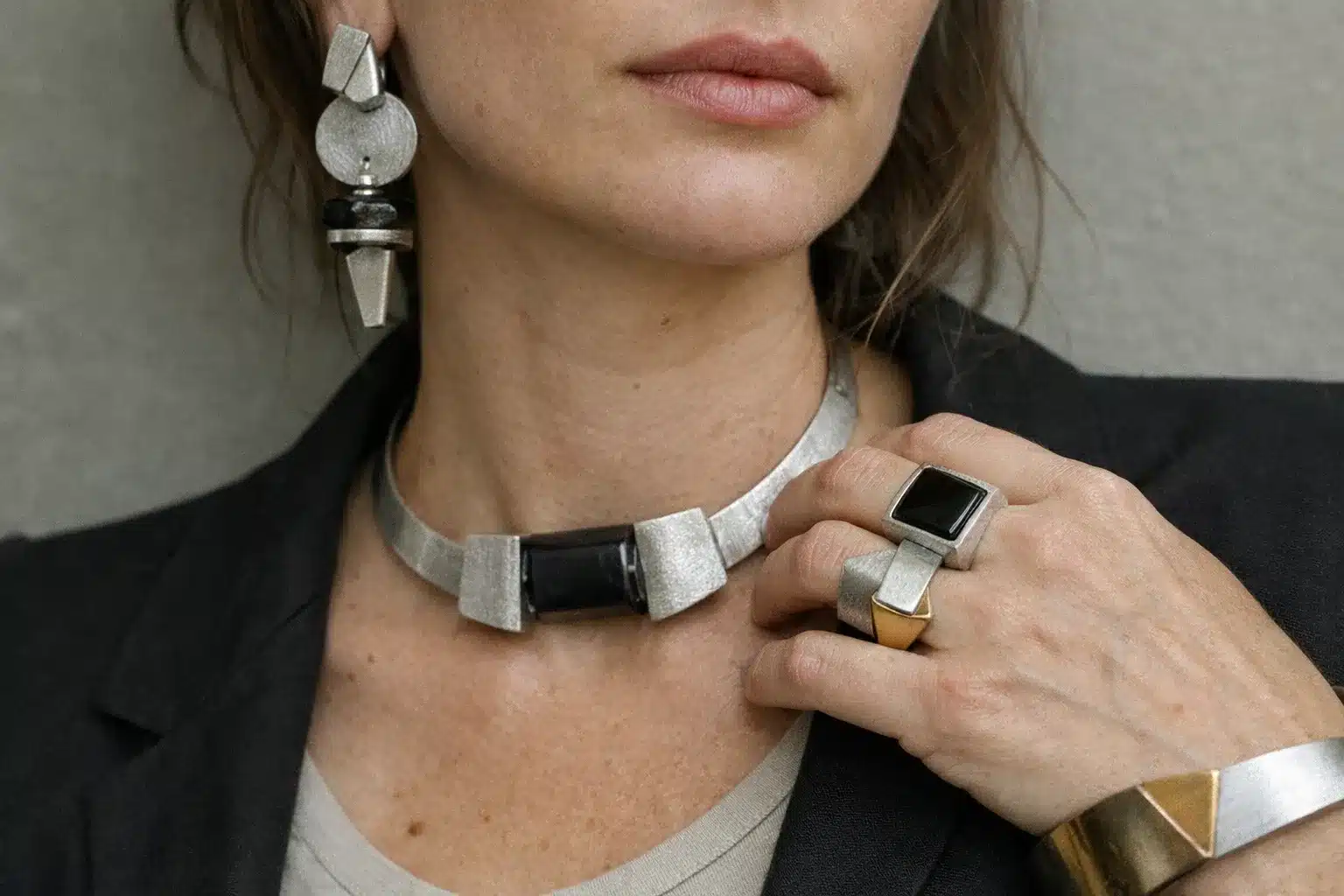
Since 2010, brutalist jewelry has experienced remarkable revival. Contemporary designers like Belgrade’s Morf Studio translate brutalist architecture into sophisticated jewelry using concrete with specialized formulas. Kirsten Muenster creates brutalist-inspired pieces exploring raw textures and monolithic forms. These modern interpretations respect brutalism’s core philosophy while incorporating contemporary techniques and sustainability considerations.
Vintage Market Explosion
The vintage brutalist jewelry market has exploded since 2015. Platforms like 1stDibs, Etsy, eBay, and specialized dealers report surging interest and prices. Authenticated pieces by recognized designers now command serious collector premiums. Museum exhibitions have featured brutalist jewelry, lending institutional validation. Fashion magazines regularly feature brutalist pieces in editorial spreads, introducing the aesthetic to new audiences.
Celebrity Influence & Fashion Week Appearances
High-profile celebrity appearances wearing brutalist jewelry have accelerated the revival. When major fashion designers incorporate brutalist-inspired pieces into runway shows, it signals the aesthetic’s return to cultural relevance. The 2024 film The Brutalist brought unprecedented mainstream attention to the movement, introducing brutalist philosophy to audiences previously unfamiliar with the term.
Where to Find Authentic Pieces Today
Collectors can find authentic brutalist jewelry through multiple channels. Online platforms like 1stDibs offer curated selections with authentication, though at premium prices. eBay provides broader selection at various price points but requires careful buyer diligence. Etsy features both vintage pieces and contemporary interpretations. Specialized vintage jewelry dealers often stock brutalist pieces. Estate sales and auctions occasionally yield discoveries, particularly in cities where brutalist designers worked.
Frequently Asked Questions About Brutalist Jewelry
What makes jewelry “brutalist” vs just modernist or chunky?
Brutalist jewelry is distinguished by specific characteristics beyond simple size or boldness. True brutalist pieces embrace deliberately raw, unfinished aesthetics with visible tool marks, rough textures, and asymmetric forms inspired by brutalist architecture. They often combine unexpected materials without regard for traditional value hierarchies—pewter next to gold, rough crystals beside faceted gems. Modernist jewelry, while also experimental, tends toward smoother finishes and more refined construction. Simply being large or geometric doesn’t make jewelry brutalist; the defining element is that uncompromising embrace of raw materiality and architectural severity that characterized the broader brutalist movement in art and architecture.
The philosophical foundation also matters. Brutalist jewelry rejects conventional beauty standards completely, creating pieces that are intentionally challenging rather than traditionally attractive. This rebellious spirit distinguishes it from other bold jewelry styles that merely push boundaries while still operating within established aesthetic frameworks.
How can I tell if my brutalist jewelry is authentic or a reproduction?
Authentication requires examining multiple factors. First, check for designer signatures or hallmarks—many brutalist artists signed their work with distinctive marks. Guy Vidal used several different signatures including a three-piece macaroni symbol; Robert Larin signed pieces with his name; Andrew Grima marked his work clearly. Weight is another crucial indicator—authentic period pieces use solid metal construction and feel heavy for their size, while modern reproductions often use lighter materials or hollow construction.
Examine construction techniques closely. Genuine brutalist jewelry shows hand-worked surfaces with irregularities from hammering, chiseling, or texturing. Soldered joints appear deliberately crude rather than invisibly finished. Patina should be consistent with 50+ years of age if the piece claims to be vintage. Modern reproductions frequently show too-perfect construction, mechanically-produced textures, and materials that weren’t used during brutalism’s original period. When in doubt, consulting with a jewelry professional experienced in vintage pieces can provide definitive authentication.
How much is vintage brutalist jewelry worth today?
Brutalist jewelry values vary dramatically based on designer attribution, materials, size, and condition. Entry-level unsigned pieces in common metals like brass or pewter typically sell for $150-$300. Signed pieces by recognized designers like Guy Vidal or Robert Larin range from $400-$800 for mid-sized works. High-end designer pieces by celebrated artists like Andrew Grima command $3,000-$15,000 or more. The current market shows brutalist jewelry averaging around $1,250 on premium platforms, with a range from $175 to $48,000 for exceptional pieces.
Pricing trends over the past decade show significant appreciation, with authenticated designer pieces increasing 200-400% in value. This upward trajectory reflects growing collector interest, limited supply of authentic vintage pieces, and renewed cultural appreciation for brutalist aesthetics. However, the market strongly favors quality over quantity—three exceptional signed pieces represent better investment than ten unsigned generic examples. Materials also significantly impact value, with pieces in 14k or 18k gold worth substantially more than similar designs in pewter or brass.
Who are the most collectible brutalist jewelry designers?
Andrew Grima stands as brutalist jewelry’s most celebrated designer, particularly after being appointed Crown Jeweller to the British Royal Family in 1970. His pieces command premium prices from $3,000 to $15,000+. Among Canadian designers, Robert Larin (working 1968-1972 in pewter), Guy Vidal (1970s mixed metals), and Rafael Alfandary (kinetic copper and brass pieces) are highly collectible, with Alfandary achieving particular fame after Prince wore one of his designs publicly.
American pioneers Sam Kramer and Art Smith, working from Greenwich Village studios since the 1930s-1940s, created foundational brutalist work that’s museum-quality when it appears on market. David Yurman’s early 1960s-1970s brutalist work, before his cable bracelet era, commands strong collector interest. Scandinavian designers like Jacob Hull (Denmark), known for bronze “spore and bubble” jewelry, also attract serious collectors. Walter Schluep’s high-karat gold brutalist pieces bridge studio art and fine jewelry, making them particularly investment-worthy at $2,000-$8,000+ range.
Is brutalist jewelry a good investment in 2025?
Current market indicators suggest brutalist jewelry offers strong investment potential for informed buyers. Prices for authenticated designer pieces have appreciated 200-400% over the past decade, significantly outperforming many traditional jewelry categories. Growing collector interest, museum exhibitions, celebrity endorsements, and the 2024 film The Brutalist bringing mainstream attention all support continued value growth. Limited supply of authentic vintage pieces creates favorable supply-demand dynamics.
However, investment success requires strategic approach. Focus on signed pieces by recognized designers rather than unsigned generic works. Quality trumps quantity—better to own three exceptional Andrew Grima or Robert Larin pieces than fifteen unsigned brass brooches. Authentication is crucial, as reproduction market is active. Patience is essential; brutalist jewelry rewards long-term holding better than quick flipping. The market values museum-quality pieces dramatically higher than mediocre examples, so investment should prioritize exceptional condition, documented provenance, and artistic significance. For collectors willing to educate themselves and buy strategically, brutalist jewelry presents compelling investment opportunity in 2025.
How should I care for and clean brutalist jewelry pieces?
Caring for brutalist jewelry requires understanding that rough, textured surfaces and natural patina are often desirable features rather than problems to fix. For sterling silver pieces, gentle cleaning with commercial silver polish is appropriate, but avoid aggressive scrubbing on textured areas that could damage intentional surface treatments. Pewter requires only mild soap and water—harsh chemicals can damage the surface permanently. Brass and copper develop natural patina that many collectors value; removing it can actually decrease value and aesthetic appeal.
Storage should protect pieces while allowing appropriate air circulation. Individual soft cloth pouches prevent scratching and tangling. Anti-tarnish storage works well for silver pieces but isn’t necessary for brass or copper if natural patina is acceptable. Keep jewelry away from excessive humidity and store in stable temperature environments. When considering restoration or aggressive cleaning, consult with jewelry professionals experienced in vintage brutalist pieces—removing original patina or altering surface treatments can significantly reduce both aesthetic appeal and market value. For valuable pieces, preservation of original condition should be priority over achieving “like new” appearance.
Conclusion
The history of brutalist jewelry reveals a movement that challenged every convention of traditional adornment, creating wearable art that remains as provocative today as when first forged in 1960s studios. From Andrew Grima’s royal commissions to Robert Larin’s pewter masterpieces, from David Yurman’s early experiments to Rafael Alfandary’s kinetic copper designs, brutalist jewelry represented artistic rebellion that transformed precious metals into architectural statements.
Today’s robust collector market, with authenticated pieces commanding premium prices and museum exhibitions celebrating brutalism’s artistic significance, confirms that this once-controversial style has achieved lasting recognition. Whether you’re drawn to brutalism’s raw aesthetic power, its anti-establishment philosophy, or its investment potential, these pieces offer connection to a revolutionary moment when jewelry dared to be deliberately unbeautiful—and became beautiful precisely because of that courage.
For those ready to explore brutalist jewelry’s compelling world, the journey begins with education. Study designer signatures, examine construction techniques, and develop eye for distinguishing authentic period pieces from modern reproductions. The rewards—both aesthetic and potentially financial—await collectors willing to embrace jewelry that refuses to fade politely into the background.
Continue your exploration of vintage jewelry history with our comprehensive guides to other groundbreaking movements. Discover how Art Deco jewelry revolutionized design in its own era, or explore the gold working techniques that make brutalist textures possible.

Hi, I’m Sara Hein, a passionate jewelry researcher and educator. I created Jewelry Carats to share well-researched insights on gemstones, precious metals, and jewelry care. My goal is making expert jewelry knowledge accessible to everyone.