
Complete Guide
Discovering the maker behind your vintage costume jewelry piece transforms it from a beautiful accessory into a valuable collectible with a story. Costume jewelry makers marks serve as the signature of these designers, revealing the piece’s origin, era, and authenticity. Whether you’ve inherited grandmother’s jewelry box or hunt treasures at estate sales, learning to identify these tiny stamps unlocks the history hidden in plain sight.
What Are Costume Jewelry Makers Marks?
Costume jewelry makers marks are stamps, engravings, or symbols placed on jewelry pieces to identify the manufacturer, designer, or company that created them. Unlike hallmarks on fine jewelry that indicate metal content and purity, costume jewelry marks primarily serve as brand signatures and authentication tools.
These marks typically appear as the company name, initials, logos, or distinctive symbols stamped into the metal backing of brooches, the inside of bracelet clasps, earring backs, or pendant bails. The location varies by jewelry type, but manufacturers strategically placed marks where they remain visible yet discreet.
The History Behind Jewelry Marking
The practice of marking costume jewelry evolved throughout the 20th century. Early pieces from the 1920s and 1930s often went unmarked, as manufacturers hadn’t yet established the branding importance that later defined the industry. By the 1940s, leading designers began consistently marking their work to build brand recognition and prevent counterfeiting.
A significant milestone occurred in 1955 when the United States copyright law expanded to protect jewelry designs. After this date, many manufacturers added the copyright symbol (©) to their marks, making any piece bearing this symbol definitively post-1955. This detail alone helps collectors accurately date pieces and distinguish original designs from later reproductions.
How to Find and Identify Makers Marks on Costume Jewelry
Successfully identifying costume jewelry marks begins with knowing where to look and having the right tools. Most marks measure only a few millimeters, requiring careful examination and often magnification to read clearly.
Essential Tools for Mark Identification
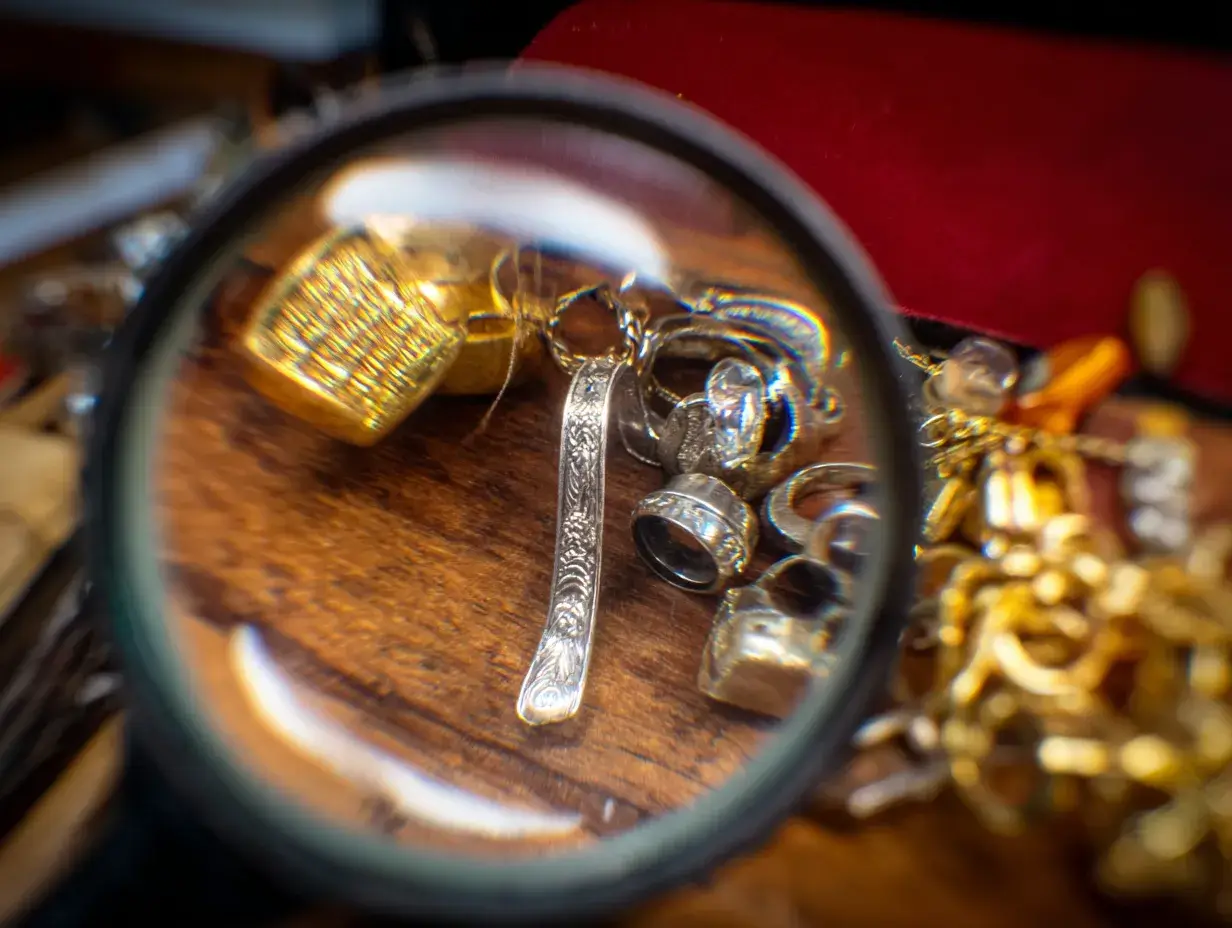
Professional collectors and appraisers rely on several key tools when examining costume jewelry marks. A jeweler’s loupe with 10x magnification represents the minimum standard, though many experts prefer 15x or 20x for examining particularly small or worn marks. Good lighting proves equally crucial—natural daylight or a bright LED light helps reveal faint stampings that overhead lighting might miss.
For documenting your finds, a smartphone with macro photography capability or a digital microscope allows you to capture clear images of marks for research and reference. These photos prove invaluable when consulting reference guides or seeking expert opinions online.
Where Marks Hide on Different Jewelry Types
Brooches and Pins: Check the flat back surface near the pin stem or safety catch. Marks typically appear in the center or along the edge of the backing plate. Some manufacturers placed marks on the actual pin stem itself.
Necklaces and Bracelets: Examine the clasp mechanism thoroughly, including both the hook and eye components. Many designers stamped marks on small metal tags attached near the clasp. For chain pieces, check any connecting rings or decorative elements.
Earrings: Screw-back and clip-on earrings usually bear marks on the back of the earring near the finding mechanism. Pierced earrings may have marks on the post or backing, though these are often the smallest and most challenging to read.
Rings: While less common in costume jewelry than fine jewelry, marks on rings typically appear on the inner band. Some statement cocktail rings feature marks on the underside of large decorative elements.
Reading Worn and Partial Marks
Time and wear often compromise mark visibility. A mark that once read clearly may now appear as partial letters or a faint impression. When facing worn marks, photograph the mark under various lighting angles—raking light from the side often reveals details invisible under direct lighting. Compare your partial mark against reference images, paying attention to distinctive letter shapes, spacing, and any accompanying symbols that might help confirm the maker.
Complete Database of Costume Jewelry Makers Marks
This comprehensive database covers the most collectible and commonly found costume jewelry manufacturers from the 1920s through today. Each entry includes the company’s history, mark variations, and dating information to help you identify and value your pieces.
American Costume Jewelry Makers (1920s-1960s Golden Age)
Miriam Haskell (1920s-Present): One of the most sought-after names in vintage costume jewelry, Miriam Haskell pieces command premium prices. Early pieces (1920s-late 1940s) often went unmarked but feature distinctive construction with layered baroque pearls and seed beads on filigree. The horseshoe mark appeared briefly 1948-1950. The classic oval “Miriam Haskell” mark in an oval cartouche became standard after 1950 and remains the most recognizable signature.
Eisenberg (1930s-1970s): Chicago-based Eisenberg evolved from a clothing manufacturer to jewelry design powerhouse. Marks evolved significantly: script “E” or “Eisenberg Original” (1935-1948), bold “EISENBERG” in all capitals (1945-1958), “EISENBERG” with copyright symbol (after 1955), and “Eisenberg Ice” for their diamond-look line (1960s-1970s). Sterling pieces marked “Eisenberg Sterling” are particularly valuable.
Coro/Corocraft (1901-1979): One of the largest costume jewelry manufacturers, Coro produced enormous quantities under multiple brand names. Primary marks include “Coro” in script or block letters, “Corocraft” for higher-end lines, “Vendome” for their prestige collection, and “Francois” for specific designs. Dating Coro pieces requires examining mark style and construction methods as the company operated for eight decades.
Trifari (1910s-Present): Known for exceptional quality and innovative designs, Trifari pieces remain highly collectible. Key marks include “Trifari” in block letters, the crown over “T” symbol (called the “crown Trifari” mark), “Trifari ©” (post-1955), and “KTF” (Krussman, Trifari, Fishel) on earliest pieces. Alfred Philippe designed many iconic Trifari pieces during the 1930s-1960s golden era.
Ciner (1931-Present): Founded as a fine jewelry company, Ciner transitioned to high-end costume jewelry during the Depression. Early 1930s pieces used sterling silver and often went unmarked. By the 1940s, pieces clearly marked “Ciner” with copyright symbols becoming standard. The 1960s introduced distinctive matte gold plating, shifting to shiny bright plating in the 1980s-1990s. Ciner’s bold designs and quality materials make pieces consistently valuable.
Kramer (1943-1980): New York-based Kramer specialized in high-quality rhinestone sets and parures. Marks include “Kramer,” “Kramer of NY,” and “Kramer of New York.” Special lines marked “Kramer Austria” (for Austrian-made pieces) and “Kramer Sterling” are rarer. Designer Frank Hess joined from Miriam Haskell in the 1960s, creating the popular “Amourelle” line.
Weiss (1942-1971): Albert Weiss created jewelry known for exceptional Austrian rhinestones and intricate designs. All authentic Weiss pieces should be marked, typically “Weiss” in block letters or with copyright symbol. The market contains many Weiss fakes—authentic pieces feature superior stone quality and construction compared to reproductions.
Schreiner (1932-1970s): Henry Schreiner established a reputation for innovative construction and stunning visual effects. Pieces marked “Schreiner,” “Schreiner New York,” or “Schreiner N.Y.C.” feature distinctive inverted stone settings, unusual glass shapes, and bold color combinations. Many high-end designers, including Christian Dior, used Schreiner pieces in their runway shows. Unsigned Schreiner pieces can be identified by construction techniques: unfoiled inverted-set stones and layered dimensional designs.
Boucher (1937-1971): Marcel Boucher, who previously designed for Cartier, created costume jewelry with fine jewelry quality standards. Early pieces marked “MB” or “Marboux,” later pieces “Marcel Boucher” or simply “Boucher.” Boucher used sterling silver 1942-1947 and assigned inventory numbers to designs. The four-digit code on pieces helps date them, with numbers sometimes accompanied by “P” (pin) or “E” (earring). After Boucher’s death in 1965, his wife Sandra ran the company until 1972.
Hattie Carnegie (1918-1970s): More than a jewelry designer, Hattie Carnegie was a fashion empire. Her costume jewelry complemented clothing lines and featured both in-house designs and pieces made by other manufacturers like Trifari. Marks include “Hattie Carnegie” in script, “Carnegie” alone, and “HC” initials. Carnegie jewelry often features distinctive styling and premium materials, commanding strong collector interest.
Mid-Century Modern Designers (1950s-1970s)
Kenneth Jay Lane (1963-Present): Known for bold, glamorous designs worn by celebrities and socialites, Kenneth Jay Lane built his reputation on “faux” jewelry that rivaled fine pieces in visual impact. Early pieces (pre-1970) marked “K.J.L.,” later pieces “Kenneth Jay Lane” or “Kenneth Lane.” Lane’s philosophy of creating beautiful costume jewelry without apology resonated with clients from Elizabeth Taylor to Audrey Hepburn. His animal bracelets and dramatic statement necklaces remain iconic.
Lisner (1904-1985): Founded as a finding manufacturer, Lisner expanded into complete jewelry designs. Pieces marked “Lisner” or “Lisner ©” span from delicate floral designs to bold modernist pieces. The company’s long production period means mark styles and quality vary significantly across decades.
Judy Lee (1960s-1990s): Judy Lee produced affordable but well-designed pieces sold primarily through home party plans and catalogs. Pieces consistently marked “Judy Lee,” sometimes with copyright symbol. While not commanding premium prices, Judy Lee jewelry offers solid construction and attractive designs appealing to beginning collectors.
Sarah Coventry (1949-1984): Like Judy Lee, Sarah Coventry sold through home parties, bringing jewelry directly to suburban homes. Marks include “Sarah Cov,” “Sarah Coventry,” and “Sarcov.” The company commissioned designs from major manufacturers, resulting in quality variations. Despite modest values, Sarah Coventry pieces represent important mid-century American costume jewelry history.
Monet (1929-Present): Specializing in classic, wearable designs, Monet built a reputation for quality gold-tone jewelry. Early pieces marked with “Monocraft” (1930s-1940s), transitioning to “Monet” by the 1950s. Later marks include “Monet ©” and “Monet Jewelers.” Monet’s timeless aesthetic means pieces remain wearable today, sustaining steady collector demand.
European Costume Jewelry Designers
Christian Dior (1947-Present): Dior’s costume jewelry complemented haute couture collections, with early pieces made by Mitchel Maer and later by Kramer and Henkel & Grosse in Germany. Marks include “Chr. Dior,” “Christian Dior,” “Dior,” and “Germany” (for Henkel & Grosse productions). Dior costume jewelry maintains strong value due to fashion house prestige and limited production runs.
Chanel (1920s-Present): Coco Chanel revolutionized costume jewelry by making it fashionable to wear “faux” pieces with confidence. Authentic vintage Chanel jewelry is rare and valuable, marked “Chanel,” “Coco Chanel,” or with the interlocking “CC” logo. From the 1990s forward, pieces marked “Histoire de Verre” indicated glass elements. The massive reproduction market makes authentication crucial—authentic pieces show superior construction and materials.
Yves Saint Laurent (YSL) (1961-Present): YSL costume jewelry featured bold, artistic designs reflecting the fashion house’s innovative spirit. Pieces marked “YSL,” “Yves Saint Laurent,” or “Yves Saint Laurent Paris.” Collections varied from ethnic-inspired pieces to dramatic modernist designs, with 1970s-1980s pieces particularly sought after.
Butler & Wilson (1972-Present): British designers Nicky Butler and Simon Wilson created distinctive jewelry combining Victorian inspiration with punk edge. Early pieces featured antique-finish settings and dramatic designs. Marks include “Butler & Wilson” and later “B&W” after the partnership dissolved in the 1980s, with Butler continuing the brand.
Contemporary and Designer Collaborations
Joan Rivers (1990s-2000s): Comedian Joan Rivers built a successful jewelry collection for QVC, bringing costume jewelry to home shopping audiences. Pieces clearly marked “Joan Rivers” feature her signature style: glamorous, often humorous designs with quality construction. Limited edition pieces and those designed for specific QVC shows command higher prices.
Avon (1963-Present): While Avon produced jewelry since the 1960s, designer collaborations in the 1980s-1990s elevated the brand. Kenneth Jay Lane designed for Avon 1986-2005 (marked “K.J.L. for Avon”), and various other designers created special collections. Earlier Avon jewelry may be unmarked or feature simple “Avon” stamps.
Napier (1922-1999): Originally founded as Napier-Bliss, the Napier Company created sophisticated, classic designs marketed to mature, affluent customers. Marks include a triangle with “*A*” inside (early mark), “Napier,” and “Napier ©.” The company’s long history and consistent quality make Napier pieces reliably collectible, though not commanding premium prices like Haskell or Eisenberg.
How to Avoid Common Maker’s Mark Mistakes
Even experienced collectors sometimes misidentify marks or draw incorrect conclusions from markings. Understanding common pitfalls helps avoid costly mistakes when buying or researching costume jewelry.
Understanding Patent Numbers
Many costume jewelry pieces bear numbers that collectors mistakenly interpret as maker’s marks or date codes. Patent numbers fall into two categories: design patents (typically beginning with “D” followed by numbers) and utility patents (numbers only). Design patents protect the ornamental design of a piece, while utility patents cover functional mechanisms like clasps or safety catches.
Crucially, patent numbers don’t identify the manufacturer unless accompanied by a maker’s mark. The patented design might have been sold to multiple companies, or the patent holder might have been a findings manufacturer rather than the jewelry designer. Always search for additional marks beyond patent numbers when identifying pieces.
The DRGM Confusion
One of the most common identification errors involves “DRGM,” which stands for “Deutsches Reichsgebrauchsmuster” (German Reich Registered Design). This is NOT a company name or maker’s mark—it’s a German term indicating a registered design or utility patent. Pieces marked “DRGM” followed by numbers were made in Germany, but the letters don’t identify the specific manufacturer.
Some German companies used DRGM marks, with Schreiber & Hiller particularly associated with “DRGM 1138525” on their pieces. However, hundreds of German manufacturers used DRGM marks, making the letters alone insufficient for identification. Never attribute jewelry to “DRGM” as if it were a brand name.
Reproduction and Fantasy Marks
The vintage costume jewelry market’s popularity has spawned numerous reproductions bearing fake marks of famous designers. Modern manufacturers in China and elsewhere produce pieces stamped with “Weiss,” “Haskell,” “Eisenberg,” and other valuable names. These reproductions often exhibit telltale signs: inferior rhinestone quality, modern construction techniques, artificially aged finishes, and marks that don’t match authentic examples.
Authentic vintage costume jewelry shows age-appropriate wear patterns, period-correct construction methods, and materials consistent with the supposed era. When a “Miriam Haskell” piece uses modern findings or bead types unavailable in the 1940s, suspect a reproduction regardless of the mark.
Company Names vs. Line Names
Many manufacturers created multiple lines under different names, causing confusion when researching marks. Coro, for instance, marketed pieces as “Corocraft,” “Vendome,” and “Francois”—all actually Coro products. Similarly, Trifari owned “Trifanium” and designed “Astro Gems” lines. Understanding these relationships prevents mistakenly treating subsidiary marks as separate manufacturers and helps accurately assess rarity and value.
Dating Costume Jewelry by Makers Marks
Makers marks provide crucial dating evidence when combined with knowledge of marking practices and company history. Several key indicators help narrow a piece’s age range.
The Copyright Symbol Rule
As mentioned earlier, the copyright symbol (©) on costume jewelry marks indicates post-1955 manufacture. Before 1955, jewelry designs couldn’t be copyrighted, so any mark featuring © dates to 1955 or later. This simple rule eliminates decades of possibilities and provides a definitive terminus post quem (earliest possible date).
Mark Evolution and Style Changes
Many manufacturers changed their marking styles over time, and these variations help pinpoint manufacture dates. Eisenberg’s progression from script marks (1935-1948) to block capitals (1945-1958) to copyright marks (post-1955) exemplifies this evolution. Similarly, Miriam Haskell’s shift from unmarked pieces to horseshoe marks to oval cartouches traces the company’s development.
Researching specific manufacturers reveals their marking timelines. Reference books like “Warman’s Jewelry” by Kathy Flood or “Collecting Costume Jewelry 101” by Julia Carroll provide detailed marking chronologies for major designers. Online resources including the Costume Jewelry Collectors Int’l website maintain extensive mark databases with dating information.
Material and Construction Dating
Even with an identifiable maker’s mark, examining materials and construction techniques confirms or refines dating. Bakelite and early plastics date pieces to the 1920s-1940s. Rhodium plating became common in the 1940s-1950s. Specific rhinestone cuts, metal alloys, and assembly methods all signal different eras. A mark might indicate a company’s entire production period, but construction details narrow the date range within that period.
Building Your Makers Mark Reference Collection
Successful costume jewelry identification requires developing personal expertise through hands-on study and research. Building a comprehensive reference collection—whether physical examples or documented images—accelerates your learning and improves identification accuracy.
Essential Reference Books
Several authoritative references should form the foundation of any serious collector’s library. “Warman’s Jewelry” provides extensive mark listings with images. “Collecting Costume Jewelry” series by Julia Carroll offers detailed manufacturer histories. “Signed Beauties of Costume Jewelry” by Marcia Brown and “Masterpieces of Costume Jewelry” by Deanna Farneti Cera showcase premium examples with clear mark photographs.
For specific designers, dedicated books offer deeper insights: “The Napier Co.: Defining 20th Century American Costume Jewelry” by Melinda Lewis, “Miriam Haskell Jewelry” by Cathy Gordon, and company-specific references provide exhaustive detail beyond general guides.
Online Resources and Databases
Digital resources complement print references with searchability and regular updates. The Costume Jewelry Collectors Int’l website hosts the comprehensive “Researching Costume Jewelry” database created by Dotty Stringfield, featuring alphabetized listings with mark photographs. Antique Jewelry University’s Makers Mark Database offers searchable tools filtering by letters, symbols, shapes, and countries.
The Online Encyclopedia of Silver Marks, Hallmarks & Makers’ Marks covers both fine and costume jewelry marks with extensive international coverage. Forums like Jewelry Loupe and Collectors Weekly provide community expertise for difficult identifications.
Photographing Your Finds
Creating a personal reference database of identified pieces builds institutional knowledge impossible to replicate from books alone. Photograph every mark you encounter, storing images with detailed notes: maker, era, jewelry type, materials, and any distinguishing construction features. Over time, this personal database becomes your most valuable reference, containing real-world examples of mark variations, wear patterns, and construction details specific to your collecting interests.
The Value of Signed vs. Unsigned Costume Jewelry
A maker’s mark dramatically impacts costume jewelry value, but understanding the nuances of signed versus unsigned pieces reveals a more complex picture than simple “marked = valuable” equations.
Premium for Signed Pieces
Generally, signed costume jewelry from collectible designers commands 2-10 times higher prices than comparable unsigned pieces. A signed Miriam Haskell brooch might sell for $200-500, while a similar unsigned piece in the same style might fetch $50-100. The mark provides authentication, brand prestige, and a definitive attribution that unsigned pieces lack, regardless of their quality or beauty.
Premium designers like Haskell, Eisenberg, Schreiner, and Boucher command the highest mark premiums. Mid-tier designers like Kramer, Weiss, and Coro offer more modest but still significant value increases for signed pieces. Mass-market brands like Sarah Coventry or Avon show smaller mark premiums since their pieces were widely produced and remain relatively common.
When Unsigned Pieces Hold Value
Not all valuable costume jewelry bears makers marks. High-quality unsigned pieces from the 1920s-early 1940s, when marking wasn’t yet standard practice, can be extremely valuable when construction and materials indicate significant designer work. Some manufacturers never marked pieces sold as component jewelry to clothiers or made for other companies under private label.
Advanced collectors develop eyes for quality beyond marks, recognizing superior craftsmanship, unusual materials, or distinctive design approaches that signal important pieces regardless of marking. Unsigned pieces attributed to known makers through construction analysis sometimes sell at auction for substantial sums when provenance and attribution are convincingly documented.
Condition vs. Mark in Value Determination
While a maker’s mark adds value, condition often matters more. A signed piece in poor condition—missing stones, broken findings, heavy wear—might be worth less than an unsigned piece in pristine condition. Collectors should evaluate the total package: mark, condition, design quality, materials, rarity, and current market demand all influence value in interconnected ways that resist simple formulas.
Frequently Asked Questions About Costume Jewelry Makers Marks
Conclusion: Unlocking the Stories Behind the Marks
Every costume jewelry maker’s mark represents more than simple authentication—it connects you to a specific moment in design history, a particular designer’s vision, and the craftsmanship that transformed base metals and glass into wearable art. Learning to identify these marks opens doors to understanding broader decorative arts movements, fashion history, and American manufacturing heritage.
Whether you’re researching a cherished family heirloom, hunting treasures at estate sales, or building a serious collection, developing maker’s mark expertise enhances every interaction with costume jewelry. Start with the major names—Miriam Haskell, Eisenberg, Trifari, Weiss—and expand your knowledge through hands-on study. Each correctly identified mark builds pattern recognition that accelerates future identifications.
The costume jewelry world continues evolving, with new discoveries, market shifts, and emerging collector interests constantly reshaping the field. Staying current through collector organizations, online communities, and continued research keeps your knowledge relevant and your collection valuable.
For more insights into vintage jewelry identification and valuation, explore our comprehensive guides on vintage and antique jewelry identification, learn about specific pieces through our fashion jewelry collection, and discover cleaning and care techniques in our jewelry care guide to preserve your costume jewelry treasures for future generations.
For information on fine jewelry marks (gold, silver, platinum), see our Complete Guide to Jewelry Marks.

Hi, I’m Sara Hein, a passionate jewelry researcher and educator. I created Jewelry Carats to share well-researched insights on gemstones, precious metals, and jewelry care. My goal is making expert jewelry knowledge accessible to everyone.