
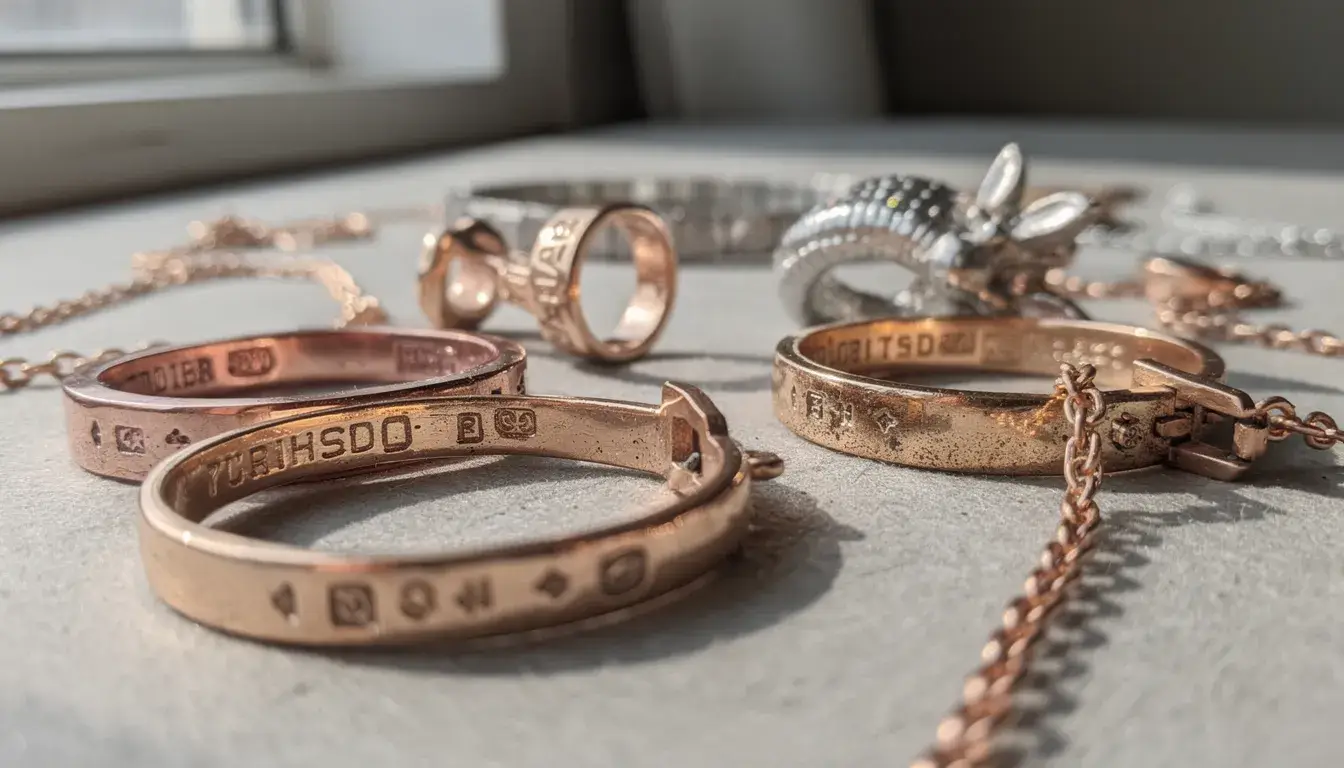
Why Fake Marks Exist: Understanding the Fraud
Jewelry fraud is a multi-billion dollar problem. Counterfeiters stamp fake marks because:
The Profit Motive
Cost to produce fake: Gold-plated brass bracelet = $5-10 in materials
Sold as “14K gold” with fake marks: $200-500
Profit margin: 2,000-5,000%
The enormous profit from selling plated metal as solid gold drives a massive counterfeit industry.
Common Fraud Scenarios
- Plated marked as solid: Gold/silver plating with authentic-looking purity marks
- Low karat marked higher: 10K marked as 18K
- Base metal marked as precious: Brass stamped “925” or “14K”
- Designer knockoffs: Cheap jewelry stamped with luxury brand names
- Frankenstein pieces: Authentic marks removed from one piece, added to fake pieces
Where Fakes Appear
- Street vendors and flea markets
- Unreliable online sellers (marketplace platforms, social media)
- Tourist areas selling “authentic” local jewelry
- Estate sales (unknowing sellers with inherited fakes)
- Even occasionally in legitimate-looking shops
Bottom line: Fake marks are everywhere. Vigilance protects you.
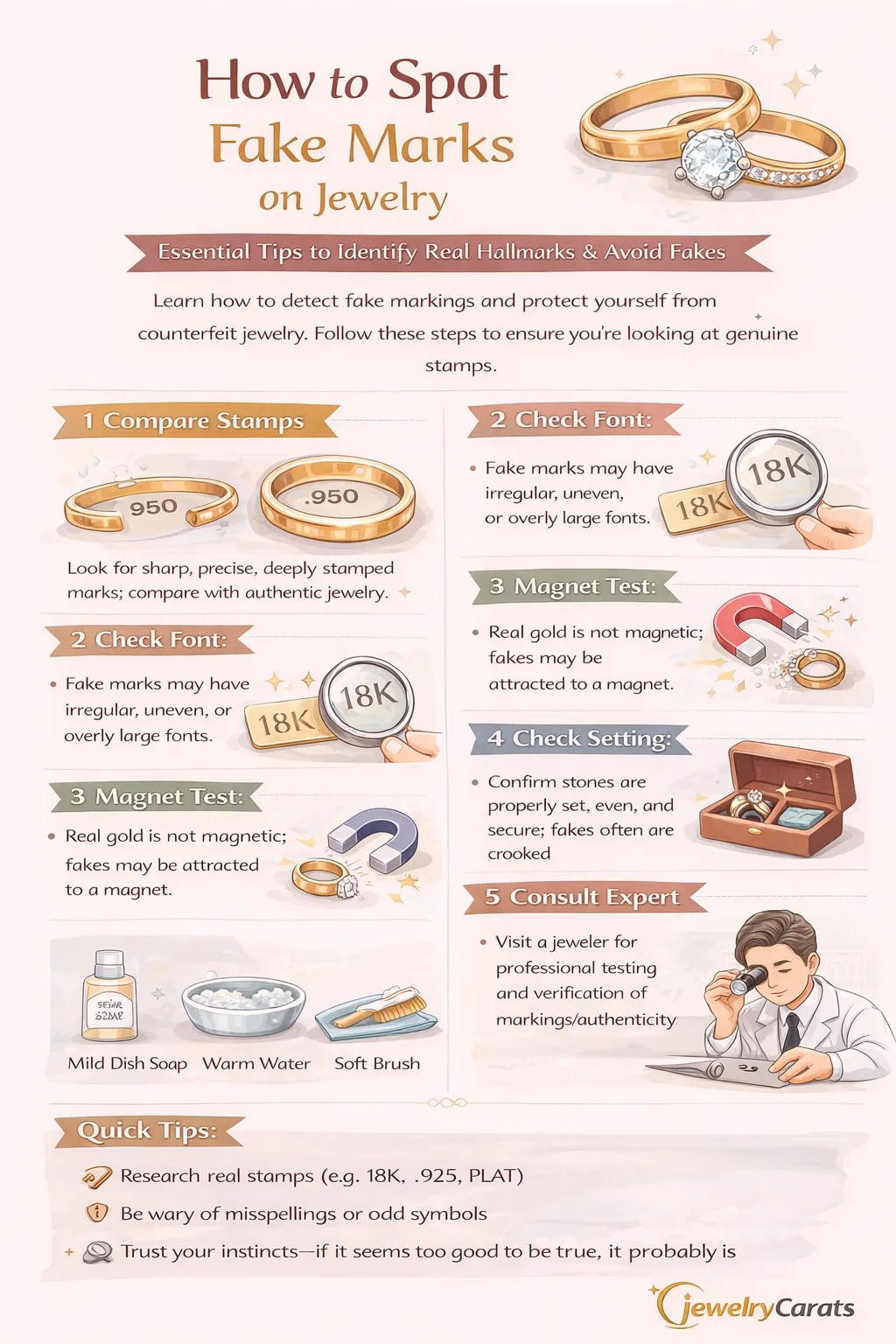
10 Red Flags of Fake Jewelry Marks
1. Poor Stamping Quality
Authentic marks:
- Sharp, clean edges
- Consistent depth
- Professional appearance
- Precisely formed numbers/letters
Fake marks:
- Blurry or fuzzy edges
- Uneven depth (some parts deeper than others)
- Hand-scratched appearance
- Crooked or poorly aligned
- Letters/numbers poorly formed
How to check: Use a 10x jeweler’s loupe. Examine mark edges carefully. Genuine marks are machine-stamped with precision—fakes often look amateur.
2. Wrong Location for Mark
Standard locations:
- Rings: inside band
- Necklaces: near clasp
- Earrings: post or back
Red flag locations:
- Marks on the front/visible surface (unusual—marks should be discreet)
- Multiple identical marks (one mark is standard, not three)
- Marks in impossible locations (too small or fragile to stamp)
3. Impossible Mark Combinations
Examples of impossible combinations:
- “24K White Gold”: Impossible—24K is pure gold, which is yellow, not white
- “925 Gold”: Impossible—925 is sterling silver, not gold
- “14K Platinum”: Impossible—karat marks are for gold only, not platinum
- “PLAT 585”: Impossible—585 is 14K gold, not platinum
- UK hallmarks with wrong date letter for style: Victorian-style ring with 1990s date letter
Knowledge protects you: Understanding what marks mean reveals impossible combinations instantly.
4. Misspellings
Counterfeiters frequently misspell brand names or use similar-looking letters.
Common misspellings:
| Authentic | Common Fakes |
|---|---|
| TIFFANY & CO | TIFFINY, TIFFANI, TIFFANY CO (missing &) |
| CARTIER | CARTERE, CARTIAR, CARTIER (with extra spaces) |
| BVLGARI | BULGARI (uses U instead of V) |
| VAN CLEEF & ARPELS | VAN CLEEF ARPELS (missing &) |
| PLATINUM | PLATINIUM (extra I) |
Always verify spelling: Use magnification and double-check every letter. Even one wrong letter means fake.
5. Modern Marks on Antique Styles
Red flag example: Georgian-era design (1800s style) with laser-engraved crisp modern marks
Why it’s suspicious: Laser engraving didn’t exist in 1800. Antique pieces should have period-appropriate mark styles—hand-stamped, sometimes worn or irregular.
What to look for:
- Do mark quality and style match the jewelry’s claimed era?
- Victorian piece with sharp modern stamping = reproduction
- Art Deco style with brand-new looking marks = likely modern copy
6. Weight Discrepancy
The test: Does the piece’s weight match its marked metal?
Gold is heavy: 14K gold ring should have substantial weight. If it feels light like costume jewelry, it’s probably plated.
Platinum is very heavy: Marked “PLAT” but feels light? It’s fake—probably white gold or silver.
Silver has moderate weight: Marked “925” but extremely light? Likely aluminum or other base metal.
Home test: Compare to a piece you know is authentic. Weight difference is often obvious when held side-by-side.
7. Missing Secondary Marks
High-end jewelry typically has multiple marks. Absence raises suspicion.
Expected marks on luxury pieces:
- Purity mark (14K, 925, PLAT)
- Maker’s mark (brand name or logo)
- Sometimes: serial number, copyright symbol, patent number
Red flag examples:
- “Cartier” mark but no purity mark or serial number
- “18K” but no maker’s mark on supposedly designer piece
- Tiffany signature but ring design doesn’t match any Tiffany collection
8. Too-Good-To-Be-True Price
Market reality check:
- 14K gold bracelet, 10 grams: Minimum $400-600 (gold value alone ~$300)
- Tiffany sterling silver bracelet: Minimum $200-500
- Platinum engagement ring setting: Minimum $1,500-2,500
If someone offers “18K gold bracelet” for $50: It’s fake. No legitimate seller loses money—pricing reveals authenticity.
Online red flags:
- “Designer inspired” or “style of” = admission it’s fake
- Prices 80-90% below retail = counterfeit
- Shipping from known counterfeit hubs (certain overseas locations)
9. Discoloration or Wear Revealing Different Metal
The telltale sign: Different colored metal showing through worn areas
What to check:
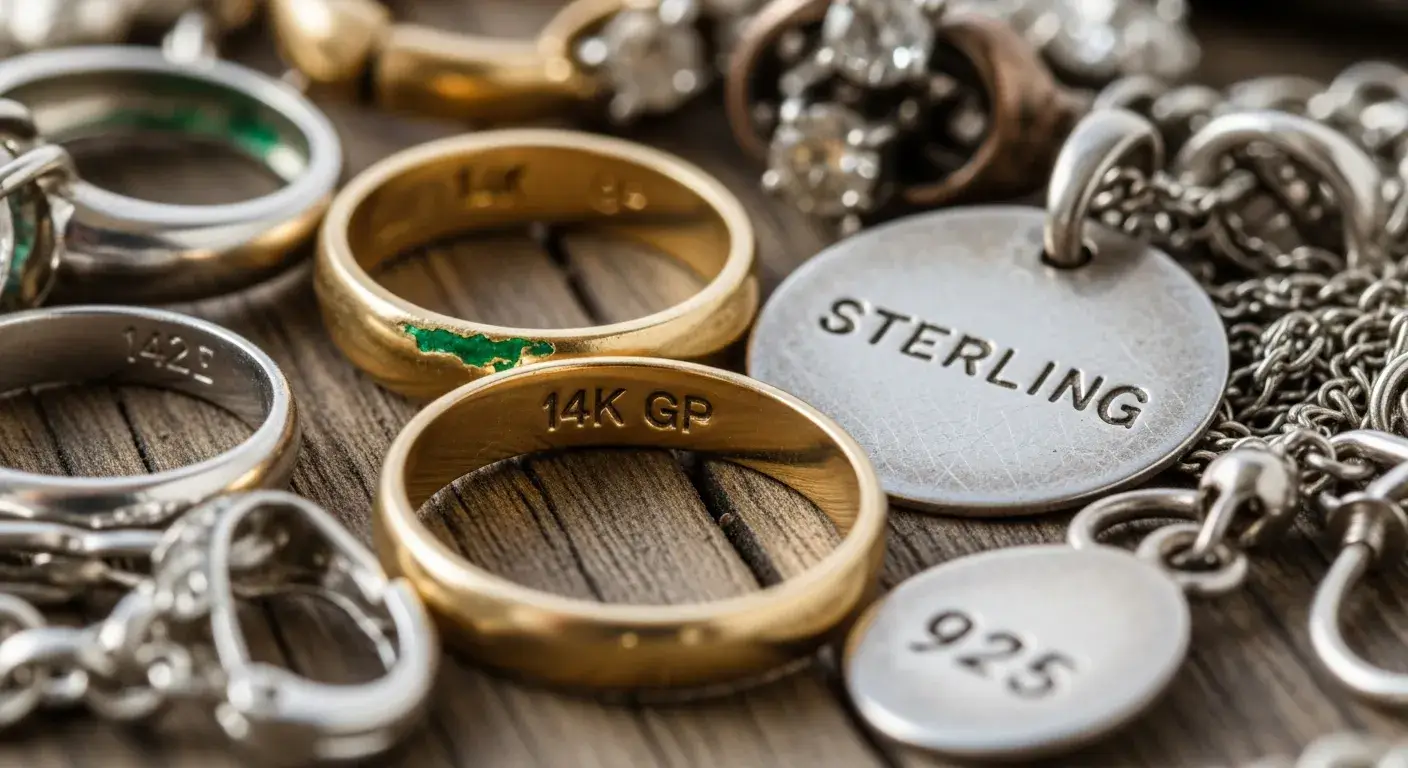
- Ring interior—copper or brass showing through “gold”?
- Bracelet clasp—yellowish tint under “platinum”?
- Chain links—different color where rubbed?
- Prong tips—base metal visible?
Solid gold/silver/platinum: Same color all the way through, even when worn
Plated with fake marks: Base metal revealed in worn spots
10. Seller Can’t/Won’t Answer Questions
Legitimate sellers:
- Explain marks clearly
- Provide certification/documentation
- Allow professional testing
- Offer returns and guarantees
- Have verifiable business history
Red flag sellers:
- Vague about origins
- No documentation
- Refuse testing
- No returns/guarantees
- Pressure tactics (“deal expires today!”)
- Cash-only transactions
Most Commonly Faked Jewelry Marks
Fake Gold Marks
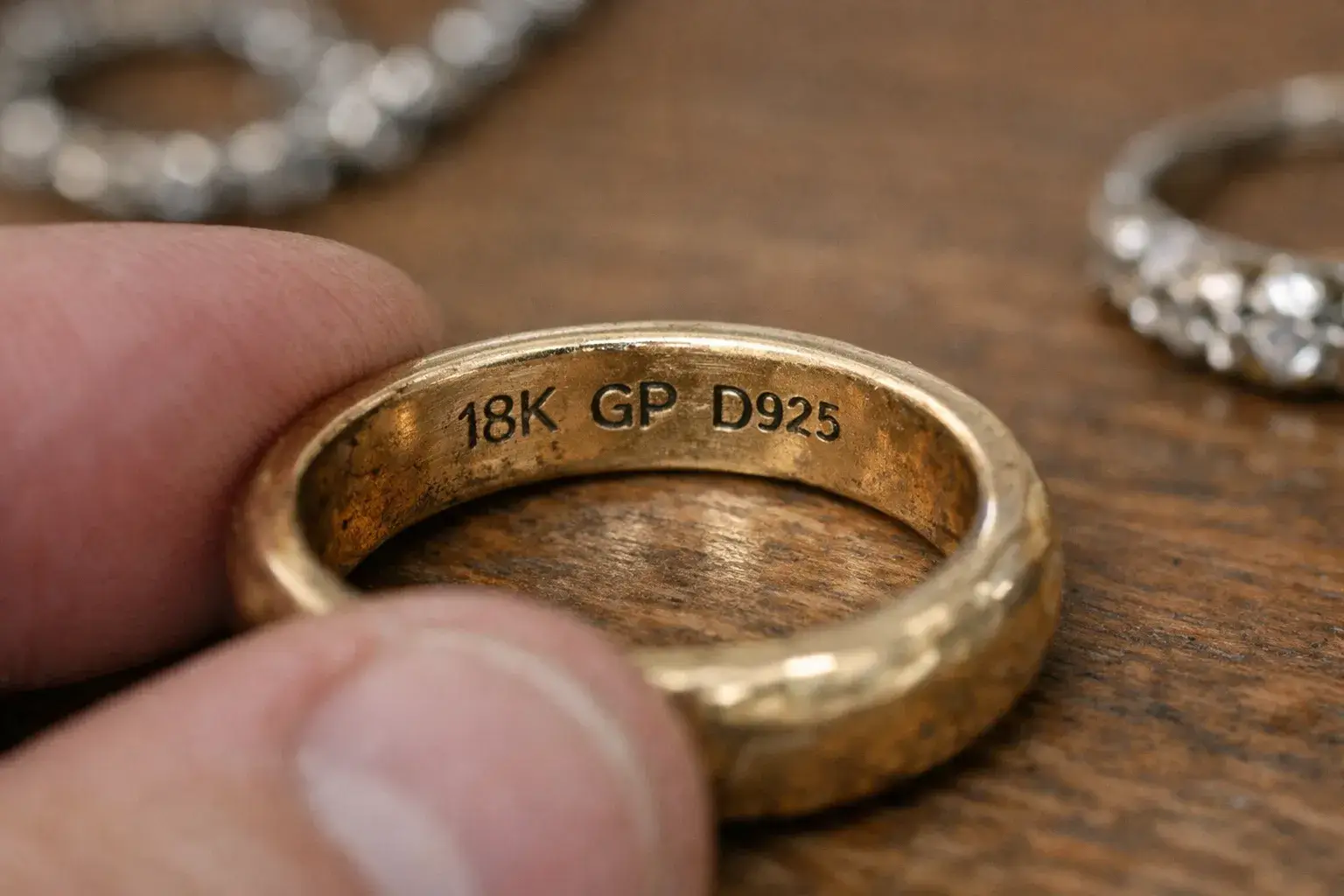
Most common: “14K” and “18K” stamped on gold-plated brass or copper
How to spot:
- Test weight (should be heavy)
- Magnet test (gold isn’t magnetic)
- Check for wear revealing different metal
- Acid test by professional jeweler
Fake Sterling Silver Marks
Most common: “925” on silver-plated base metal or “nickel silver” (no silver content)
How to spot:
- Check for tarnish (real silver tarnishes in crevices)
- Ice test (silver melts ice fast)
- Bleach test (silver darkens immediately—destructive test)
- Weight check
Fake Platinum Marks
Most common: “PLAT” or “950” on white gold or silver
How to spot:
- Weight test (platinum extremely heavy—most reliable)
- Compare to known white gold
- Check for rhodium plating wear (platinum doesn’t need plating)
- Professional XRF testing
Fake Designer Marks
Most faked brands:
- Tiffany & Co.
- Cartier
- David Yurman
- Pandora
- Van Cleef & Arpels
How to spot:
- Verify spelling (misspellings extremely common)
- Check font/logo accuracy (compare to official images)
- Look for serial numbers (most luxury brands include them)
- Examine craftsmanship quality (fakes are usually poorly made)
- Authenticate through brand (Tiffany, Cartier offer authentication services)
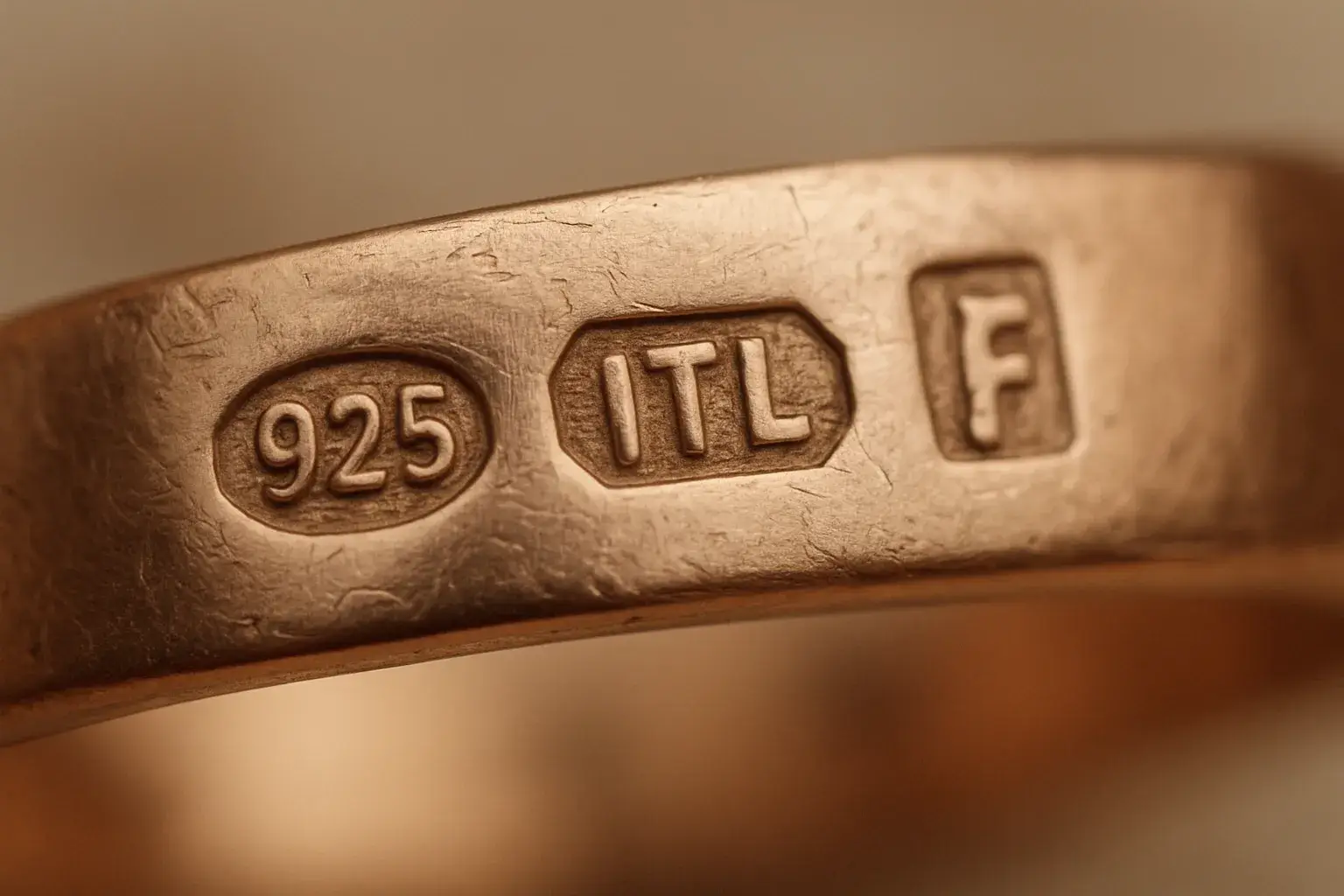
🔍 Essential examination tool: 10x Jeweler’s Loupe with LED – First step in detecting fake marks is close inspection. Examine stamping quality, spelling, and placement. (~$15-20)
Testing Methods to Verify Marks
Home Tests (Non-Destructive)
1. Magnet Test
Pass/Fail: Gold, silver, platinum are NOT magnetic. If attracted to magnet = fake.
Limitation: Some base metals also aren’t magnetic, so passing doesn’t guarantee authentic.
2. Weight Test
Method: Compare weight to known authentic piece or use jeweler’s scale
Most reliable home test for identifying gold-plated vs. solid gold
⚖️ Weight verification: Digital Jewelry Scale 0.01g – Fake gold/platinum pieces are noticeably lighter. Precise weight measurement reveals plated jewelry. (~$15-20)
3. Visual Inspection with Loupe
Check for:
- Mark quality and sharpness
- Spelling accuracy
- Wear spots revealing different metal
- Consistency of color throughout
4. Ice Test (Silver)
Method: Place ice cube on flat silver surface
Real silver: Ice melts rapidly due to high thermal conductivity
Professional Tests
1. Acid Test
Performed by: Jewelers, pawn shops
How it works: Different acids react differently with different metals/purities
Accuracy: Very high for surface testing
Drawback: Leaves small mark on jewelry, can’t detect thick plating
2. XRF Analysis (Best)
Performed by: Professional appraisers, high-end jewelers
How it works: X-ray fluorescence reads exact metal composition
Accuracy: Extremely high—identifies metal and purity precisely
Advantages: Non-destructive, fast, definitive
Cost: $50-100 per piece
3. Electrical Conductivity Test
Performed by: Some jewelers
How it works: Measures electrical conductivity (different for each metal)
Advantages: Non-destructive, fairly accurate
⚡ Non-destructive testing: Electronic Metal Tester – Instantly identifies metal type without damage. Detects gold, silver, platinum authenticity. Professional-grade. (~$100-150)
4. Specific Gravity Test
How it works: Measures density by weighing in air and water
Calculation: Gold, silver, platinum have specific densities
Accuracy: High if performed correctly
Spotting Fake Designer Marks: Brand-Specific Tips
Tiffany & Co. Authentication
Authentic Tiffany marks include:
- “Tiffany & Co.” (note the ampersand &)
- Metal purity mark (925, SILVER, or gold karat)
- Sometimes includes “T&CO”
- Serial number on many modern pieces
Red flags:
- Missing ampersand (“Tiffany Co”)
- Misspelling (“Tiffiny”)
- Poor quality stamping
- No purity mark alongside signature
- Design not found in Tiffany catalogs
Verification: Tiffany & Co. stores authenticate pieces free of charge
Cartier Authentication
Authentic Cartier marks include:
- “Cartier” signature
- Purity mark (750 for 18K, PLAT for platinum)
- Serial number (modern pieces)
- Sometimes includes French hallmarks
Red flags:
- Misspelling variations
- Signature without serial number (modern pieces should have both)
- Wrong font style (Cartier uses specific fonts)
David Yurman Authentication
Authentic David Yurman marks:
- “David Yurman” signature
- “D.Y.” on some pieces
- Purity mark (925, Sterling)
- Copyright symbol © on many pieces
Red flags:
- Poor cable twist quality (signature design)
- Missing copyright symbol
- Cheap-looking finish
Pandora Authentication
Authentic Pandora marks:
- “PANDORA” with crown logo
- “S925 ALE” or “S925 ALE 54” (ALE = founder’s initials, 54 = Thailand production)
- Very precise, clean stamping
Red flags:
- Missing ALE designation
- Poor stamping quality
- Incorrect logo placement
Real Examples: Detecting Fakes
Case 1: “18K Gold” Bracelet ($150 Online)
Claimed: 18K gold bracelet, 15 grams
Investigation:
- Price check: 15g × 75% gold = 11.25g pure gold × $65/g = $731 gold value alone
- Retail should be $900-1,200 minimum
- Selling at $150 = impossible unless fake
Testing:
- Weight: Only 8 grams (not 15 as claimed)
- Mark inspection: “18K” stamped but blurry edges
- Magnet test: Not magnetic (passes this test)
- Wear check: Yellowish-copper color visible in clasp area
Conclusion: Gold-plated brass with fake 18K mark. Worth ~$5.
Case 2: “Tiffany” Silver Necklace
Claimed: Tiffany & Co. sterling silver necklace
Investigation:
- Mark reads: “TIFFANY CO 925” (missing ampersand)
- Font doesn’t match authentic Tiffany font
- Stamping quality poor—blurry
- Design not found in any Tiffany catalog
- Packaging generic (authentic comes in specific Tiffany blue box)
Conclusion: Counterfeit. Real silver (925 accurate) but fake Tiffany marking. Worth silver melt value only, no Tiffany premium.
Case 3: “Platinum” Ring
Claimed: Platinum wedding band
Investigation:
- Marked “PLAT”
- Weight test: Surprisingly light for claimed 4mm width
- Comparison to known platinum: 40% lighter
- Close inspection: Areas show slight yellowish tint (rhodium plating wearing off)
Testing:
- XRF analysis: 75% gold (18K white gold), 0% platinum
Conclusion: 18K white gold fraudulently marked as platinum. Still valuable (as gold), but worth $800 not $2,000.
What to Do If You Find Fake Marks
If You’re Considering Buying
Don’t buy. Walk away. No legitimate reason exists for fake marks on jewelry.
If seller claims ignorance: Still don’t buy—you can’t verify their claims, and you assume all risk.
If You Already Bought
Document everything:
- Take clear photos of marks
- Save all receipts and communications
- Get professional authentication report
Contact seller immediately:
- Request full refund
- Explain fraud
- Give deadline for response
If seller refuses:
- Credit card chargeback (if paid by card)
- Platform complaint (eBay, Etsy, etc.)
- Better Business Bureau complaint
- Small claims court (for high-value items)
- Police report (for clear fraud/misrepresentation)
Reporting Fraud
FTC (Federal Trade Commission): ReportFraud.ftc.gov
Local law enforcement: For significant fraud amounts
State Attorney General: Consumer protection divisions
Online platform: Report counterfeit to eBay, Amazon, Etsy, etc.
Fake Jewelry Marks FAQ
Can fake marks look exactly like real marks?
Sophisticated fakes can look very similar, but close inspection with magnification usually reveals differences in stamping quality, font, or placement. Professional testing (XRF, acid) definitively identifies fakes regardless of mark appearance.
Is it illegal to sell jewelry with fake marks?
Yes, absolutely. Falsely marking jewelry is fraud and violates federal law (National Stamping Act in US). It’s both civil and criminal fraud. However, enforcement varies and many counterfeiters operate illegally.
What if I inherited jewelry with suspicious marks?
Have it professionally tested before assuming value. Family members may have been deceived when purchasing, or marks may have worn/faded making authentic marks look suspicious. Professional appraisal provides clarity.
Do pawn shops sell jewelry with fake marks?
Reputable pawn shops test jewelry before buying and should not knowingly sell fakes. However, mistakes happen. Always verify marks yourself and request documentation/guarantees. Better pawn shops offer return policies.
Can I trust “certified” or “authenticated” jewelry online?
Depends on who certified it. Legitimate certifications from GIA, AGS, or reputable appraisers are trustworthy. Generic “certificates of authenticity” printed by sellers mean nothing. Verify certifying organization independently.
Are estate sale jewelry marks usually authentic?
Usually yes, but not always. Estate sale organizers often don’t test jewelry—they assume marks are authentic. Treat estate sales like any other purchase: verify before buying.
How common are fake marks?
Very common, especially online and in certain venues (flea markets, tourist areas, street vendors). Studies suggest 20-30% of “gold” jewelry tested in some markets is fake or mismarked. Vigilance is essential.
What’s the most reliable way to verify marks?
XRF analysis by a professional appraiser. It’s non-destructive, extremely accurate, and provides definitive metal identification and purity. Costs $50-100 but worth it for valuable pieces.
Key Takeaways: Protecting Yourself from Fake Marks
- Examine marks closely with 10x magnification—check quality, spelling, placement
- Weight test is most reliable home verification
- Price reality check—too cheap = fake
- Multiple red flags together = almost certainly fake
- Buy from reputable sellers with return policies and guarantees
- Professional testing for valuable pieces—worth the cost
- If suspicious, walk away—better to miss a deal than buy a fake
🔬 Higher magnification: 30x-60x LED Magnifier – For detailed examination of stamping quality, edge sharpness, and detecting poor counterfeits. (~$20-30)
When buying jewelry, verify first, trust second. Fake marks are common, but knowledge and vigilance protect you from costly mistakes.
Complete your jewelry marks education:
- Complete Guide to Jewelry Marks & Identification
- Understanding Gold Hallmarks
- Sterling Silver Marks Guide
- Platinum Jewelry Marks
- Dating Antique Jewelry by Marks