
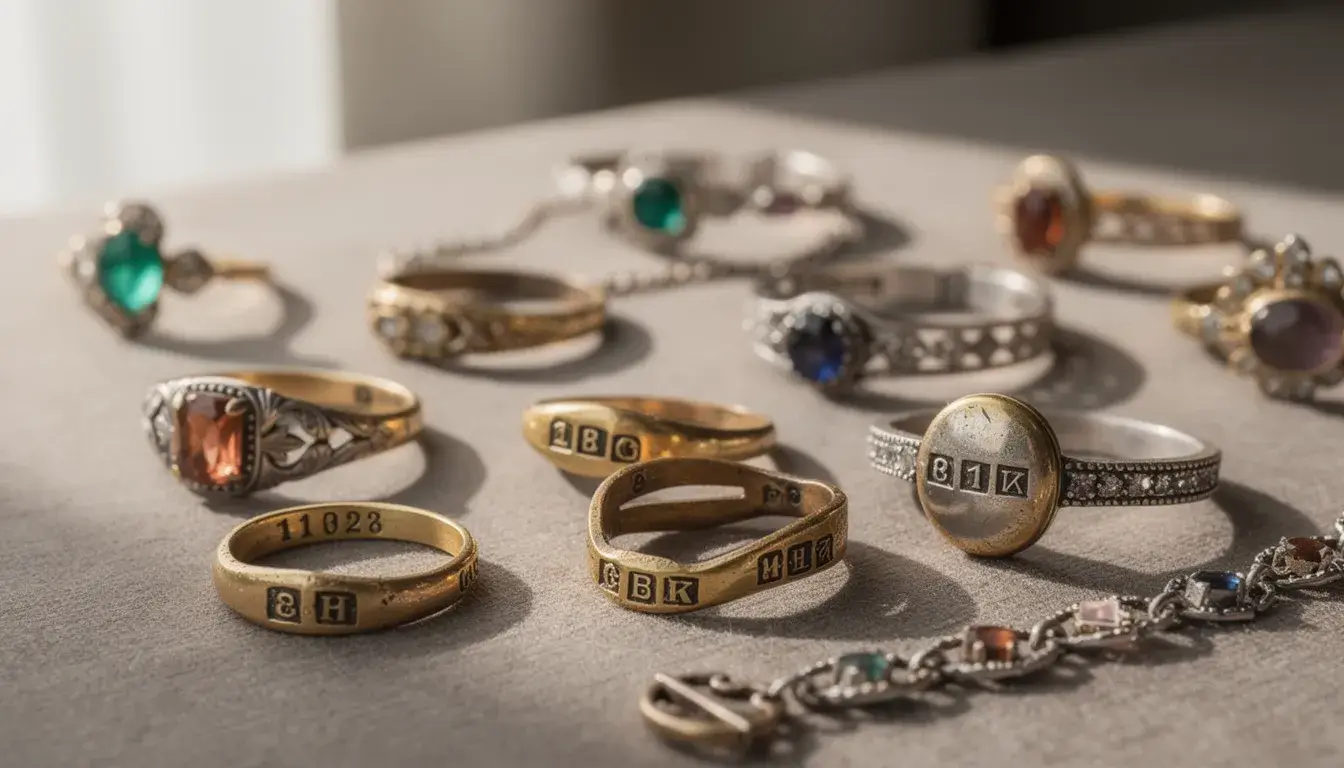
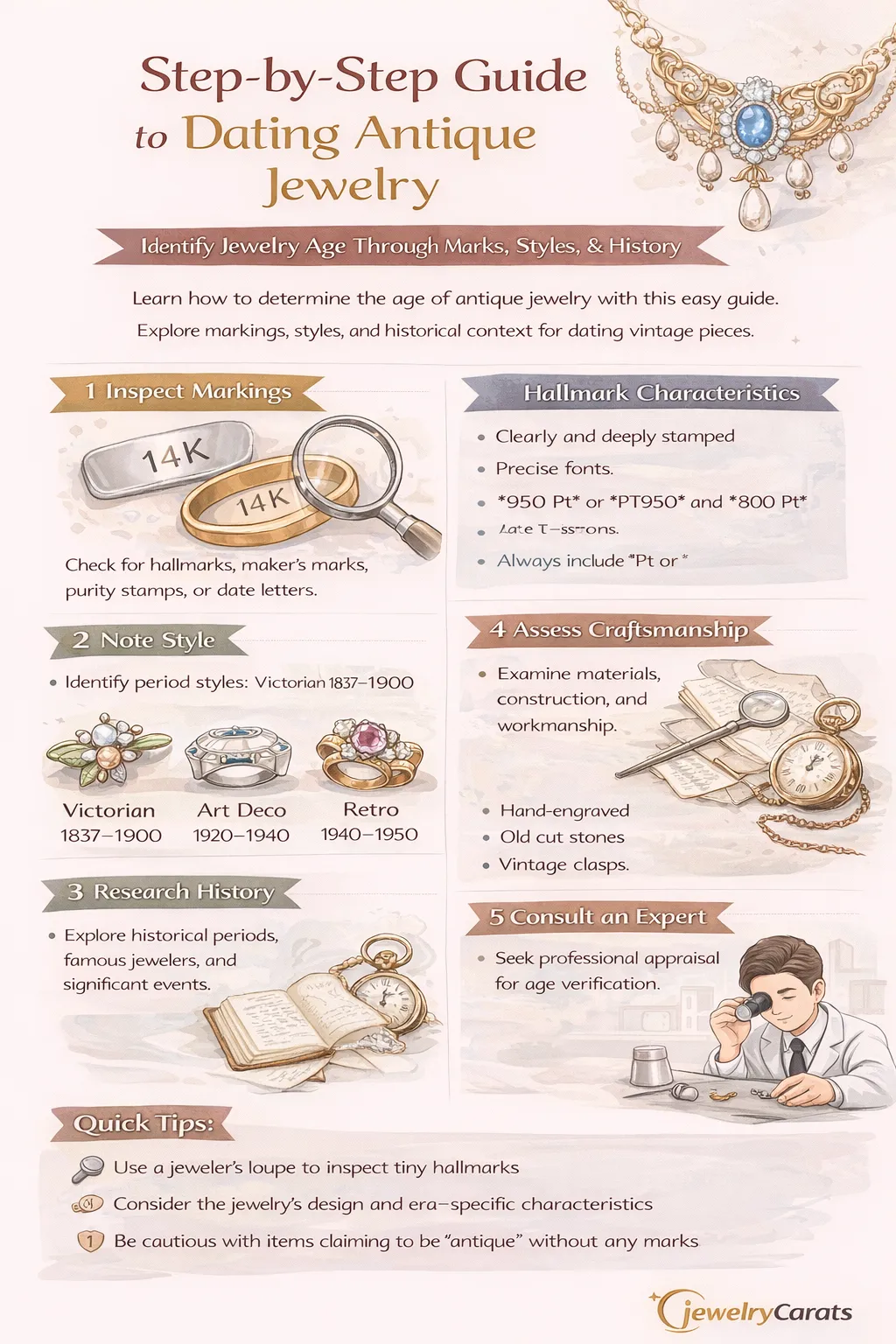
Why Dating Jewelry Matters
Accurately dating jewelry serves multiple critical purposes beyond satisfying curiosity.
Authentication & Value
A genuine Georgian mourning ring from 1820 might be worth $3,000-$5,000. A Victorian revival piece from 1920 copying Georgian style might be worth $300-$500. Same style, vastly different value—and dating makes the difference.
Example: Art Deco jewelry from the actual 1920s-1930s period commands premiums over later reproductions. Collectors pay for authentic period pieces.
Historical Context
Knowing when jewelry was made connects it to historical events, cultural movements, and technological developments. A ring from 1914-1918 might be WWI trench art. A 1960s piece reflects mod fashion revolution.
Maker Identification
Many jewelers used different marks during different periods. Dating the piece helps identify which mark variation to research, leading to maker identification.
Collection Organization
For collectors, accurate dating helps organize collections chronologically and identify gaps worth filling.
Insurance & Estate Planning
Insurance appraisals require accurate dating. Estate division benefits from knowing which pieces are genuinely antique (100+ years) versus vintage (20-100 years).
UK Date Letters: Dating Jewelry to the Exact Year
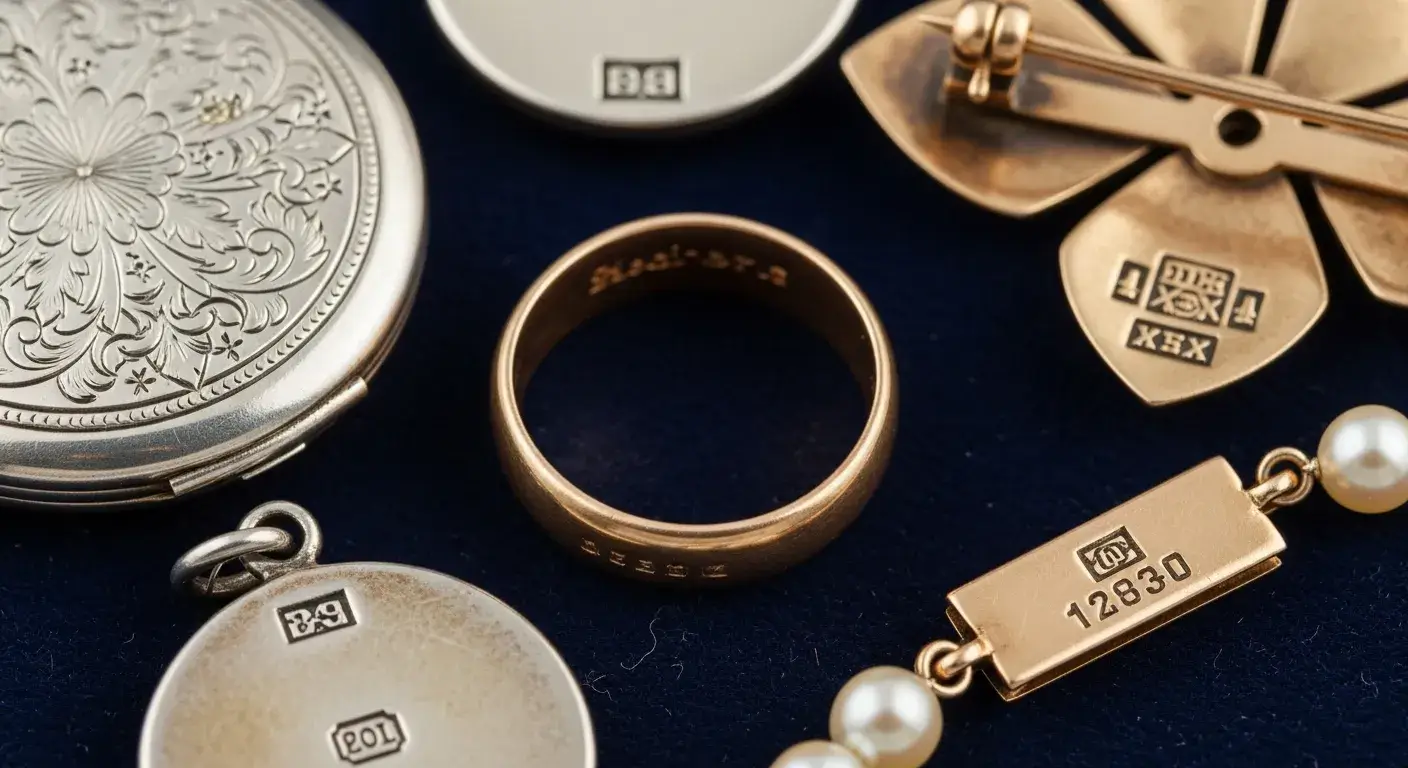
British hallmarks include date letters—a coded alphabetical system that reveals the precise year your jewelry was assayed (tested and marked). This system is unique to UK jewelry and incredibly valuable.
How Date Letters Work
Each UK assay office cycled through the alphabet, using a different letter each year. After completing the cycle (typically 20-25 years), they started over with a new font style and shield shape.
Components that combine to indicate the year:
- The letter itself: A through U (usually—J, V, W, X, Y, Z sometimes skipped)
- Letter case: Uppercase vs. lowercase
- Font: Roman, italic, Gothic, Old English, etc.
- Shield shape: Square, rounded, pointed, crowned variations
- Assay office: Each office used different cycles
Example: A London piece with lowercase italic “k” in a squared shield means 1885. The same lowercase “k” in a different font and shield shape means 1905 or 1960—context matters.
Reading Date Letters Step-by-Step
Step 1: Identify the assay office mark
- Leopard’s head = London
- Anchor = Birmingham
- Rose = Sheffield
- Castle = Edinburgh
Step 2: Examine the date letter carefully
- Is it uppercase or lowercase?
- What font style? (serif, sans-serif, italic)
- What shape is the shield surrounding it?
Step 3: Consult date letter tables
Use references like:
- UK Assay Office website (comprehensive tables)
- “Jackson’s Hallmarks” book (definitive reference)
- Hallmark identification apps
Step 4: Cross-reference with style
Does the jewelry style match the date? A piece marked 1875 should look Victorian, not Art Deco. Mismatches suggest reproductions or frankenstein pieces.
📖 Essential reference: “Jackson’s Hallmarks: English, Scottish & Irish Silver” – Complete date letter tables for all UK assay offices from 1544 to present. The definitive hallmark reference. (~$50-70)
Example Date Letter Cycles (London)
| Years | Letter Style | Shield Shape | Example |
|---|---|---|---|
| 1876-1895 | Lowercase italic | Round bottom | a = 1876, b = 1877, etc. |
| 1896-1915 | Lowercase Roman | Square | a = 1896, b = 1897, etc. |
| 1916-1935 | Uppercase Roman | Square | A = 1916, B = 1917, etc. |
| 1936-1955 | Lowercase sans-serif | Square | a = 1936, b = 1937, etc. |
| 1956-1974 | Lowercase italic serif | Square cut corners | a = 1956, b = 1957, etc. |
| 1975-1999 | Lowercase sans-serif | Square | a = 1975, b = 1976, etc. |
Modern simplification: Since 1975, all UK assay offices use the same date letter system, making identification easier.
Special Marks & Variations
Duty Marks (1784-1890)
Pieces from this period show the reigning monarch’s head, indicating luxury tax was paid:
- George III (1784-1820)
- George IV (1820-1830)
- William IV (1830-1837)
- Victoria (1837-1890)
Finding a duty mark narrows dating to pre-1890 and identifies the monarch’s reign.
Jubilee Marks
Special commemorative marks for royal jubilees:
- 1935: George V Silver Jubilee
- 1953: Elizabeth II Coronation
- 1977: Elizabeth II Silver Jubilee
- 2002: Elizabeth II Golden Jubilee
- 2012: Elizabeth II Diamond Jubilee
Non-UK Jewelry: Alternative Dating Methods
Most countries don’t use date letters. For non-UK jewelry, rely on:
- Style analysis (see next section)
- Manufacturing techniques
- Maker’s mark research (when marks changed)
- Patent numbers (US jewelry)
- Material analysis (synthetic stones appeared in specific years)
Jewelry Style Periods & Era Identification
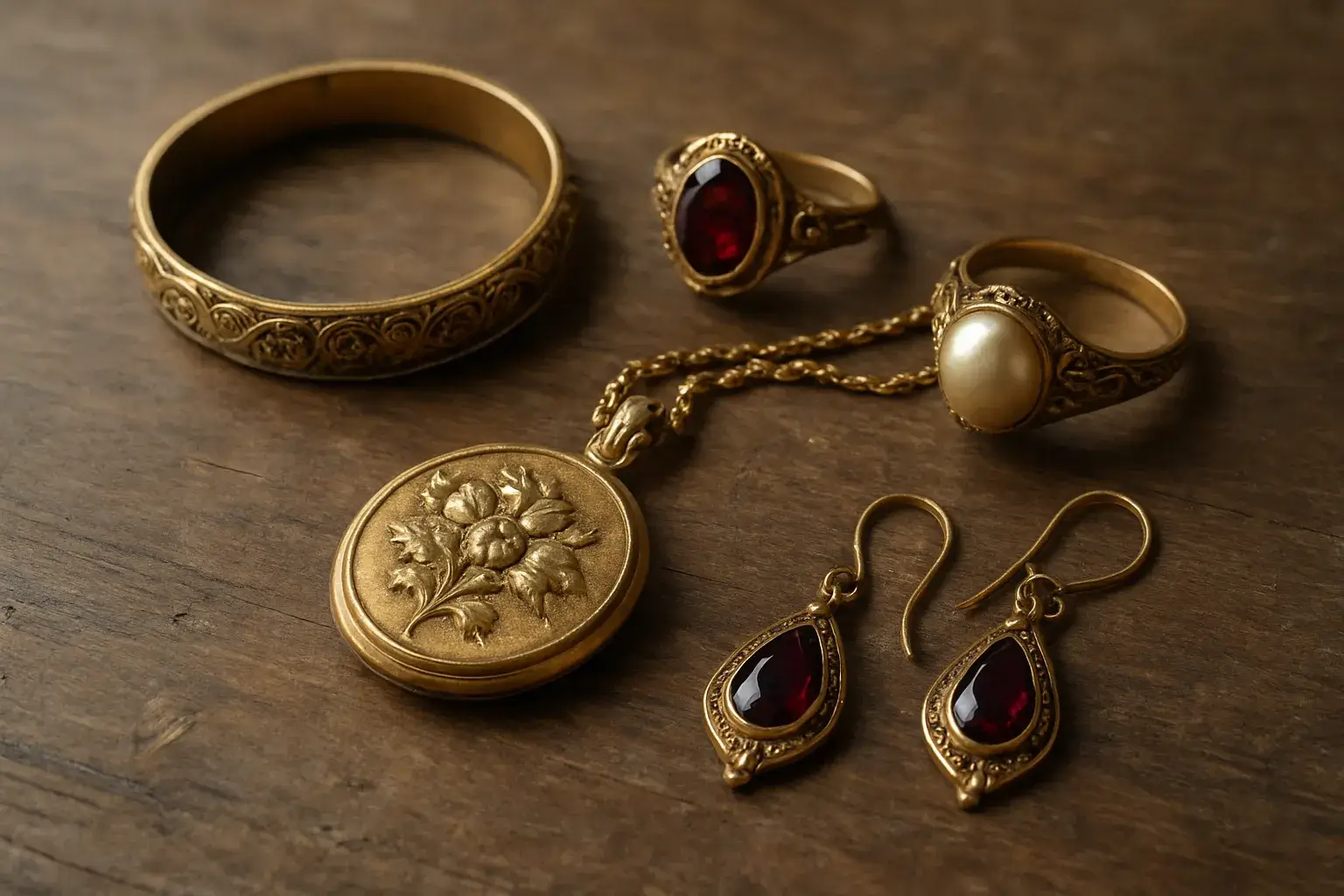
Even without hallmarks, jewelry style reveals approximate age. Each era had distinctive characteristics.
Georgian Era (1714-1837)
Named for: Four British King Georges
Characteristics:
- Handmade—no two pieces identical
- Closed-back settings (foil backing for gemstones)
- Silver topped gold (silver on front, gold back)
- Cannetille work (fine gold wire scrollwork)
- Rose-cut and old mine-cut diamonds
- Symbolic motifs (love, mourning, nature)
- Paste (glass) jewelry common for middle class
Rare factor: Georgian jewelry is extremely rare—most was melted down for the metal. Finding genuine pieces is difficult.
Victorian Era (1837-1901)
Named for: Queen Victoria’s reign
Subdivided into three periods with distinct styles:
Early Victorian/Romantic (1837-1860)
- Nature motifs (flowers, leaves, serpents)
- Sentimental jewelry (lockets, mourning jewelry)
- Colored gemstones popular
- Seed pearls common
- Delicate, romantic aesthetic
Mid-Victorian/Grand (1860-1885)
- Mourning jewelry dominant (after Prince Albert’s death 1861)
- Jet, onyx, dark garnets
- Heavier, more somber designs
- Etruscan revival styles
- Archaeological motifs
Late Victorian/Aesthetic (1885-1901)
- Lighter, more optimistic designs
- Star and crescent moon motifs
- Diamonds increasingly popular
- Choker necklaces fashionable
- Machine-made jewelry more common
Edwardian Era (1901-1915)
Named for: King Edward VII
Characteristics:
- Platinum becomes jewelry metal (newly workable)
- Extremely delicate, lacy appearance
- Diamonds and pearls dominant
- Millegrain detail (tiny beaded edges)
- Garland and bow motifs
- Filigree work
- “White-on-white” look (platinum + diamonds)
Dating tip: Platinum use suggests post-1900. If it looks delicate and lacy with millegrain, likely Edwardian.
Art Nouveau (1890-1910)
Artistic movement (overlaps Victorian/Edwardian)
Characteristics:
- Flowing, organic lines
- Nature motifs (flowers, insects, women with flowing hair)
- Enamel work prominent
- Asymmetrical designs
- Semi-precious colored stones
- Emphasis on artistry over gem value
- Plique-à-jour enamel (translucent, stained-glass effect)
Famous makers: Lalique, Tiffany (especially Tiffany glass)
Art Deco (1920s-1930s)
Peak period: 1920-1935
Characteristics:
- Geometric patterns (straight lines, angles, symmetry)
- Bold, architectural designs
- Platinum with diamonds and colored stones
- Calibré-cut stones (precision-cut to fit geometric patterns)
- Black onyx or enamel with diamonds (contrast)
- Egyptian motifs (after Tutankhamun’s tomb discovery 1922)
- Modernist aesthetic
Dating tip: Geometric, angular design + platinum = probably Art Deco 1920s-30s
Retro Era (1935-1950)
Also called: Retro Modern, 1940s style
Characteristics:
- Large, bold, chunky designs (opposite of delicate Edwardian)
- Yellow and rose gold dominant (platinum reserved for war effort)
- Synthetic rubies and sapphires common
- Cocktail rings (large statement pieces)
- Tank bracelets
- Scroll and buckle motifs
- Machine-made, less handwork
Dating tip: Large yellow gold pieces with synthetic colored stones = likely 1940s
Mid-Century Modern (1950s-1960s)
Characteristics:
- Abstract, organic forms
- Textured gold surfaces
- Space-age motifs (atomic, sputnik designs)
- Modernist Scandinavian influence
- Experimenting with unconventional materials
- Less emphasis on gemstones, more on design
Quick Style Dating Reference
| If You See… | Likely Era |
|---|---|
| Closed-back settings, cannetille | Georgian (1714-1837) |
| Mourning jewelry, jet | Mid-Victorian (1860-1880s) |
| Delicate platinum filigree | Edwardian (1901-1915) |
| Flowing organic lines, enamel | Art Nouveau (1890-1910) |
| Geometric patterns, angular | Art Deco (1920s-30s) |
| Large chunky yellow gold | Retro (1940s) |
| Abstract organic forms | Mid-Century (1950s-60s) |
Manufacturing Technique Clues by Period
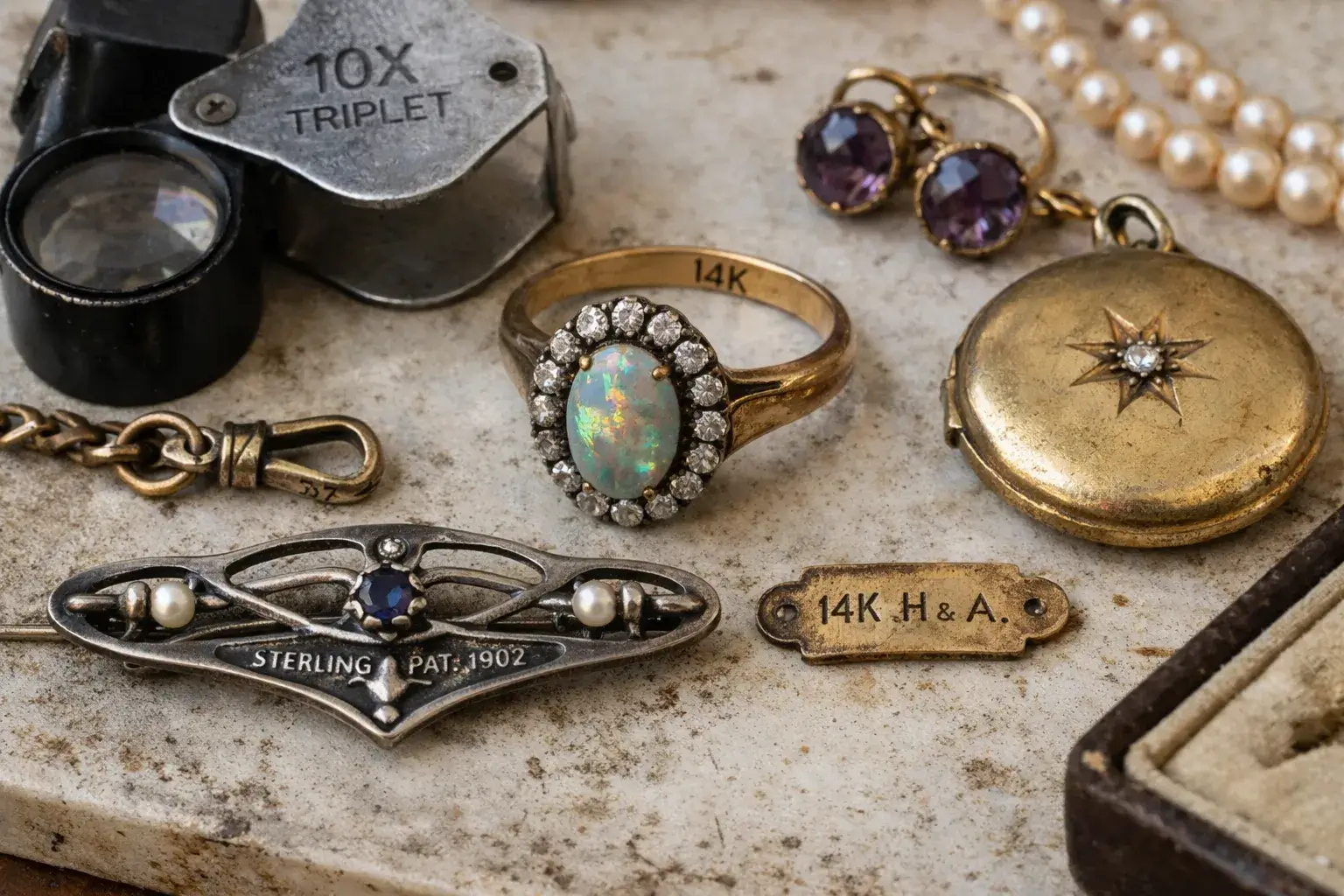
How jewelry was made reveals its age. Manufacturing techniques evolved significantly over time.
Hand vs. Machine Made
Pre-1840s: Entirely handmade
- Slight irregularities in patterns
- No two pieces exactly identical
- Tool marks visible under magnification
- Uneven metal thickness
1840s-1900: Semi-mechanization
- Some components machine-stamped
- Hand assembly and finishing
- More uniformity but still individual variations
1900+: Increasing mechanization
- Mass production possible
- Identical multiples common
- Precise, uniform patterns
- Less individual character
Settings & Metalwork
Georgian Settings
- Closed-back: Gemstones set with foil backing to enhance color
- Silver topped gold: Silver visible surface, gold underneath
- Gemstones held with thin ribbons of metal
Victorian Settings
- Transition to open-back settings (light passes through stones)
- Prong settings become common
- More secure stone mounting
Edwardian Settings
- Platinum allows extremely thin prongs
- “Invisible” settings—minimal metal visible
- Millegrain edges (tiny bead borders)
Art Deco Settings
- Calibré-cut stones (precisely shaped to fit patterns)
- Channel settings
- Geometric prong arrangements
Solder and Joins
Modern solder (post-1900): Nearly invisible, very clean
Older solder: Sometimes visible, occasionally leaves residue or discoloration
Expert examination: Under magnification, solder type and application quality help date pieces.
Gemstone Cutting by Era: Dating Through Diamond Cuts
Diamond and gemstone cutting techniques evolved dramatically. Cut style often dates jewelry accurately.
Rose Cut (1500s-1800s)
Appearance: Flat bottom, domed top with triangular facets (resembles rosebud)
Peak use: Georgian era (1714-1837)
Dating significance: Finding rose-cut diamonds suggests pre-1850 jewelry
Old Mine Cut (1700s-1880s)
Appearance: Cushion shape, high crown, small table, large culet (visible bottom facet)
Peak use: Georgian through Victorian
Characteristics: Cut by eye/candlelight—not mathematically precise like modern cuts
Dating significance: Old mine cuts suggest pre-1890 jewelry
Old European Cut (1890s-1930s)
Appearance: Round shape, smaller culet than old mine, but still visible
Peak use: Late Victorian through Art Deco
Transition cut: Between old mine and modern brilliant cuts
Dating significance: Old European cuts suggest 1890s-1930s jewelry
Modern Brilliant Cut (1919-present)
Appearance: 57-58 facets, mathematically calculated for maximum brilliance
Invented: 1919 by Marcel Tolkowsky
Characteristics: Extremely small or no visible culet, precise proportions
Dating significance: Modern brilliant cuts suggest post-1930 (became standard post-1940s)
Emerald Cut & Baguette
Popularized: Art Deco era (1920s-30s)
Characteristics: Rectangular step-cut stones
Dating significance: Common in Art Deco pieces, though still used today
Cut Dating Quick Reference
| Diamond Cut | Era | Key Features |
|---|---|---|
| Rose Cut | Pre-1850 | Flat bottom, triangular facets |
| Old Mine Cut | 1700s-1880s | Cushion, high crown, large culet |
| Old European Cut | 1890s-1930s | Round, smaller culet |
| Modern Brilliant | 1930s-present | 57 facets, tiny/no culet |
Clasp Types Timeline: Dating by Fasteners
Clasp and fastener types evolved over time. They’re often overlooked but excellent dating clues.
C-Clasp (Georgian-Early Victorian)
Appearance: Simple C-shaped hook
Used: 1700s-1850s
Common on: Brooches, early pins
Tube Hinge Pin (Victorian)
Appearance: Pin stem slides through tube hinge
Used: 1850s-1900
Safety catch: Later Victorian pieces added safety catches
Trombone Clasp (Victorian-Edwardian)
Appearance: Sliding mechanism like trombone
Used: 1880s-1920s
Common on: Bracelets, necklaces
Box Clasp (1900s+)
Appearance: Box with hinged lid and tongue mechanism
Used: Early 1900s-present
Evolution: Earlier versions chunkier, modern ones sleek
Spring Ring (1900s-present)
Appearance: Circular with spring-loaded lever
Widely adopted: Mid-1900s
Modern standard: Most contemporary jewelry
Lobster Claw (1970s-present)
Appearance: Claw-shaped spring clasp
Invented: 1970s
Dating significance: If it has lobster claw, it’s NOT antique (post-1970)
Dating Examples: Solving Real-World Mysteries
Case Study 1: Victorian or Reproduction?
Piece: Mourning brooch with black enamel and seed pearls
Clues examined:
- Hallmarks: UK marks with date letter “m” (1888)
- Construction: Hand-fabricated with slight irregularities
- Clasp: Tube hinge pin with C-catch
- Materials: Natural seed pearls (not imitation)
- Enamel: Hand-painted with period-appropriate design
Conclusion: Genuine 1888 Victorian mourning brooch. All elements consistent with period.
Case Study 2: Art Deco or Later?
Piece: Geometric platinum ring with diamonds and sapphires
Clues examined:
- Hallmarks: “PLAT” only (no date letters—US piece)
- Style: Geometric Art Deco design
- Diamonds: Old European cut (consistent with 1920s-30s)
- Sapphires: Synthetic (color too perfect, inclusions typical of synthetic)
- Construction: Precision machine work
Conclusion: Likely 1920s-1930s American Art Deco. Synthetic sapphires were available and popular in period due to cost.
Case Study 3: Edwardian or Modern Reproduction?
Piece: Delicate filigree pendant, platinum and diamonds
Clues examined:
- Hallmarks: None visible
- Style: Edwardian-looking filigree
- Diamonds: Modern brilliant cut (red flag!)
- Clasp: Lobster claw (major red flag—invented 1970s)
- Patina: No wear or aging
Conclusion: Modern reproduction, likely 1990s-2000s. Lobster claw and modern brilliant cuts prove it’s not Edwardian despite similar style.
🔬 For detailed examination: 30x-60x Illuminated Magnifier – Higher magnification for examining worn marks, construction details, and gemstone cuts on antique pieces. (~$20-30)
Dating Antique Jewelry FAQ
How can I tell if jewelry is antique or vintage?
Antique means 100+ years old, vintage means 20-100 years old. Check hallmarks for date letters (UK), examine style characteristics, and assess manufacturing techniques. Antique jewelry shows handwork and period-specific cuts/settings. Vintage jewelry often shows transition to machine production.
Can jewelry without hallmarks be dated?
Yes, through style analysis, construction techniques, gemstone cuts, clasp types, and materials used. While less precise than hallmark dating, experienced appraisers can narrow dates to within 10-20 years using these clues.
What if the style doesn’t match the date letters?
This suggests either a reproduction using old settings/parts, later alterations, or potentially fraudulent marks. Genuine pieces should have consistent style, marks, construction, and materials from the same period.
Are old European cut diamonds always antique?
Usually, but not always. Old European cuts were standard until the 1930s-40s. However, some modern jewelers recut old stones or deliberately use old cuts for vintage-style pieces. Examine the entire piece for consistency.
How accurate is dating by style alone?
Style dating is accurate to within 10-20 years for distinctive periods (Art Deco, Georgian) but less precise for transitional periods. Combining style with construction, materials, and other clues improves accuracy.
Do all antique pieces have hallmarks?
No. Small pieces, American jewelry, handmade items, and jewelry from countries without hallmarking laws often lack marks. Unmarked doesn’t mean fake—it may just reflect different marking practices.
What does a patent number tell me?
US patent numbers (format: D followed by numbers) can be looked up on the USPTO website to find the exact year the design was patented. This dates the piece to that year or shortly after.
Can modern jewelry be made to look antique?
Yes, reproductions are common. Look for inconsistencies: modern cuts with antique settings, lobster clasps on “Victorian” pieces, perfect uniformity in supposedly handmade items, or fake patina. Compare multiple clues.
Key Takeaways: Dating Antique Jewelry
- UK date letters provide exact years—learn to read them
- Style characteristics place jewelry in approximate era
- Construction techniques evolved over time—handmade vs. machine
- Gemstone cuts changed dramatically—old cuts suggest older jewelry
- Clasp types offer quick dating clues—lobster claw = modern
- Consistency matters—all clues should point to same era
Dating jewelry combines detective work, historical knowledge, and careful observation. Start with hallmarks, confirm with style, and verify through construction—accurate dating follows.
Continue learning about jewelry identification:
- Complete Guide to Jewelry Marks & Identification
- Understanding Gold Hallmarks
- Sterling Silver Marks Guide