
From Mine to Showroom
Every year, millions of diamond rings, necklaces, and earrings move from mines to jewelry stores worldwide. But have you ever wondered how diamond jewelry is mass produced on such an enormous scale while maintaining quality and precision? The journey from rough stone to finished piece involves cutting-edge technology, skilled craftsmanship, and complex manufacturing processes that most consumers never see.
The mass production of diamond jewelry has evolved dramatically over the past decades. What once took skilled artisans weeks to complete can now be replicated efficiently through advanced manufacturing techniques, 3D modeling, and automated systems—all while maintaining the beauty and quality that make diamond jewelry so treasured.
Understanding this process reveals the fascinating intersection of geology, technology, and artistry. From the moment diamonds emerge from deep within the Earth to the instant they’re set in precious metals, each stage involves precise coordination between miners, cutters, designers, and manufacturers working across continents.
In this comprehensive guide, you’ll discover the complete journey of diamond jewelry production—from mining and sorting to cutting, setting, and quality control. Whether you’re a jewelry enthusiast, industry professional, or curious consumer, you’ll gain insider knowledge about how these stunning pieces are created at scale.
Understanding Diamond Value: The 4Cs
Before diving into mass production, it’s essential to understand what makes diamonds valuable. The diamond industry uses the 4Cs—Cut, Color, Clarity, and Carat weight—as universal standards for assessing quality. These criteria, established by the Gemological Institute of America (GIA), guide every decision in the production process.
Cut: The Key to Brilliance
Cut refers to how well a diamond has been shaped and faceted. Unlike the other Cs which are natural characteristics, cut is entirely human-controlled and dramatically affects a diamond’s beauty. A well-cut diamond reflects light internally from facet to facet and disperses it through the top, creating the sparkle we associate with quality diamonds.
The most popular cut is the round brilliant, featuring 57 or 58 facets designed to maximize light return. Other cuts include princess, emerald, cushion, and pear shapes. In mass production, cutting patterns are standardized to ensure consistency and maximize yield from rough stones.
Color: From Colorless to Yellow
Diamond color is graded on a scale from D (completely colorless) to Z (light yellow or brown). The less color a diamond contains, the more valuable it typically is. Colorless diamonds (D-F grades) allow maximum light passage, resulting in superior brilliance.
However, fancy colored diamonds—those with intense hues like blue, pink, or yellow—operate on a different scale. These rare gems command premium prices and are often featured in high-end jewelry collections.
In mass production, manufacturers typically work with diamonds in the G-J color range, which offer excellent value. These near-colorless stones appear white to the untrained eye but cost significantly less than D-F grades.
Clarity: Internal Characteristics
Clarity measures the presence of internal inclusions and external blemishes. The GIA clarity scale ranges from Flawless (FL) to Included (I3). Most inclusions are microscopic and invisible to the naked eye.
For mass production, diamonds in the VS (Very Slightly Included) to SI (Slightly Included) range are most common. These stones offer excellent value—they’re eye-clean (no visible inclusions) but cost substantially less than higher clarity grades.
Carat Weight: Size Matters
Carat is the unit measuring diamond weight. One carat equals 200 milligrams or 0.2 grams. Larger diamonds are exponentially rarer and more valuable—a 2-carat diamond costs much more than twice a 1-carat diamond of similar quality.
In mass production, certain sizes are more common: 0.25ct, 0.50ct, 0.75ct, and 1.00ct. These “magic sizes” are easier to source and match, streamlining the manufacturing process.
The Diamond Mining Process
Diamond jewelry mass production begins deep underground. Natural diamonds form 100-200 kilometers beneath Earth’s surface under extreme pressure and temperature. Volcanic eruptions bring them closer to the surface in pipes of kimberlite rock, where modern mining operations extract them.
Types of Diamond Mining
Open-pit mining is used when diamond deposits are near the surface. Large circular pits are excavated, removing layers of earth to access kimberlite pipes. Major operations like Botswana’s Jwaneng mine use this method.
Underground mining accesses deeper deposits through tunnel networks. This method is more expensive but necessary when surface deposits are exhausted. It also has a smaller environmental footprint than open-pit operations.
Alluvial mining extracts diamonds from riverbeds and beaches where water has carried them from primary deposits. This method is often used by smaller operators and artisanal miners.
Marine mining is the newest technique, recovering diamonds from the ocean floor off the coast of Namibia and South Africa. Specialized ships vacuum sediment from the seabed, processing it onboard.
From Mine to Market
After extraction, rough diamonds undergo initial sorting at the mine site. They’re separated from waste rock and other minerals, then cleaned and prepared for transport to sorting facilities. Security is paramount—diamonds are small, valuable, and easily concealed, necessitating strict controls throughout the supply chain.
Major mining companies like De Beers, Alrosa, and Rio Tinto operate vertically integrated operations, controlling everything from extraction to rough diamond sales. This integration ensures supply consistency for mass producers downstream.
Sorting and Grading Diamonds
Once rough diamonds reach sorting facilities, they undergo meticulous categorization. This stage is critical for mass production—accurately sorted diamonds ensure manufacturers receive consistent materials for their jewelry lines.
Initial Sorting
Rough diamonds are first sorted by size using calibrated sieves. Size categories range from melee (very small diamonds under 0.10ct) to larger stones suitable for center stones in engagement rings.
Next comes shape sorting. Some rough diamonds have shapes naturally suited to specific cuts—an octahedral crystal works perfectly for a round brilliant, while a flatter crystal might be best for a princess cut.
Quality Assessment
Gemologists examine each diamond to assess its potential. They consider:
- Color potential: What color grade will the polished stone achieve?
- Clarity potential: Can inclusions be removed or minimized through cutting?
- Weight retention: What percentage of rough weight will be lost in cutting?
- Optimal cut: Which shape will maximize the stone’s value?
Advanced Technology in Sorting
Modern sorting facilities use automated sorting systems with X-ray fluorescence and spectroscopy to rapidly assess rough diamonds. These machines can process thousands of stones per hour, categorizing them by size, quality, and optimal use.
Planning software analyzes each rough diamond, creating 3D models showing various cutting options and their expected outcomes. This technology helps maximize value—sometimes a single rough stone can yield multiple smaller polished diamonds worth more than one larger stone.
Diamond Cutting and Polishing
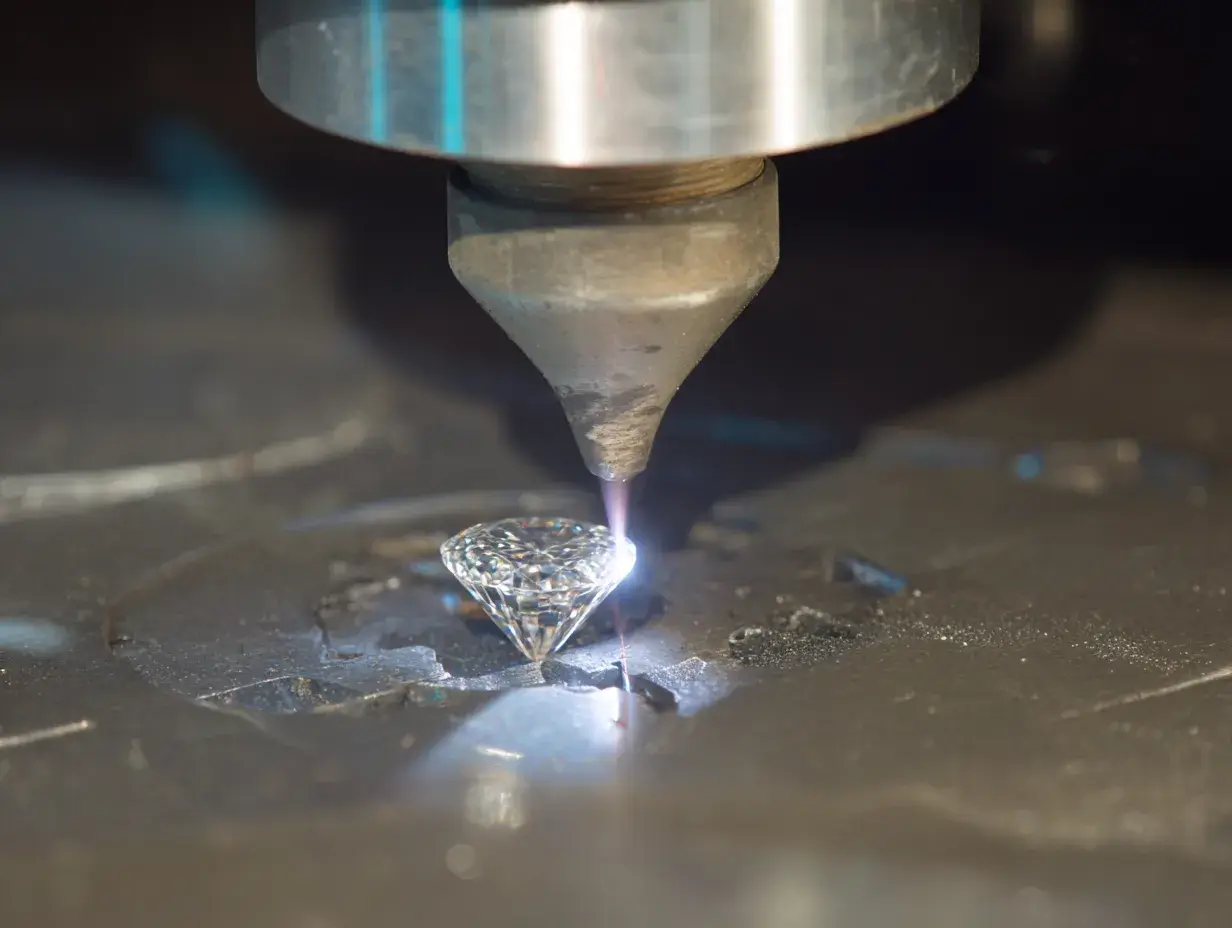
Diamond cutting transforms dull rough stones into brilliant gems. Despite its name, modern “cutting” rarely involves actually cutting—it’s primarily shaping through grinding and polishing.
Planning the Cut
Before any work begins, cutters study each diamond extensively. They mark the stone showing where to make the first shaping cuts, balancing maximum weight retention against optimal proportions for brilliance.
Computer modeling has revolutionized this stage. Software analyzes the rough diamond’s internal structure, identifying inclusions and suggesting cut orientations that minimize their visibility while maximizing yield.
The Cutting Process
Cleaving: For some diamonds, the first step involves cleaving—splitting the stone along its crystallographic planes. A groove is cut, a steel blade inserted, and a sharp tap splits the diamond. This technique requires exceptional skill and is reserved for stones with significant inclusions that can be removed through splitting.
Sawing: Most modern cutting begins with sawing. Diamond-coated blades or laser saws slice through the rough stone. Laser sawing, while slower, allows more complex cuts and greater precision, though it causes more weight loss than traditional sawing.
Bruting (Girdling): The diamond is mounted in a lathe and spun against another diamond, grinding it into a round shape. This forms the girdle—the widest part of the diamond that will sit in the jewelry setting.
Faceting and Polishing
After basic shaping, the diamond receives its facets. The stone is mounted in a dop (holder) and pressed against a rotating wheel coated with diamond powder and oil. The cutter creates 57 or 58 precisely angled facets for a round brilliant cut.
Each facet must be cut at exact angles—even minor deviations reduce brilliance. Modern automated polishing machines can create perfectly symmetrical facets, though skilled human polishers still handle the finest stones.
The final polish determines the stone’s surface quality. A well-polished diamond appears glassy smooth, maximizing light reflection. After polishing, diamonds are boiled in hydrochloric and sulfuric acids to remove polishing compound residue.
Quality Inspection
Finished diamonds undergo thorough inspection. Gemologists verify cut quality, symmetry, and polish grade. The stone may be sent to laboratories like GIA or IGI for certification, providing an independent quality assessment that adds value and buyer confidence.
Designing Diamond Jewelry for Mass Production
Mass production requires designs that balance aesthetic appeal with manufacturing efficiency. Unlike one-of-a-kind custom pieces, mass-produced jewelry must be reproducible hundreds or thousands of times while maintaining consistent quality.
Design Considerations
Jewelry designers creating for mass production consider several factors:
Manufacturability: Can the design be reliably reproduced using available techniques? Complex designs with many small details may be difficult to cast consistently.
Material efficiency: Does the design minimize metal waste? Efficient designs reduce production costs and environmental impact.
Stone requirements: Are diamonds in standard sizes readily available? Using common diamond sizes (0.50ct, 0.75ct, 1.00ct) simplifies sourcing.
Setting practicality: Can diamonds be set efficiently? Some setting styles require extensive hand labor, making them expensive for mass production.
Market appeal: Does the design align with current trends while having lasting appeal? Mass producers want designs with multi-year sales potential.
The Design Process
Modern jewelry design begins with hand sketches that capture the designer’s vision. These sketches show the piece from multiple angles, noting dimensions, stone placement, and design details.
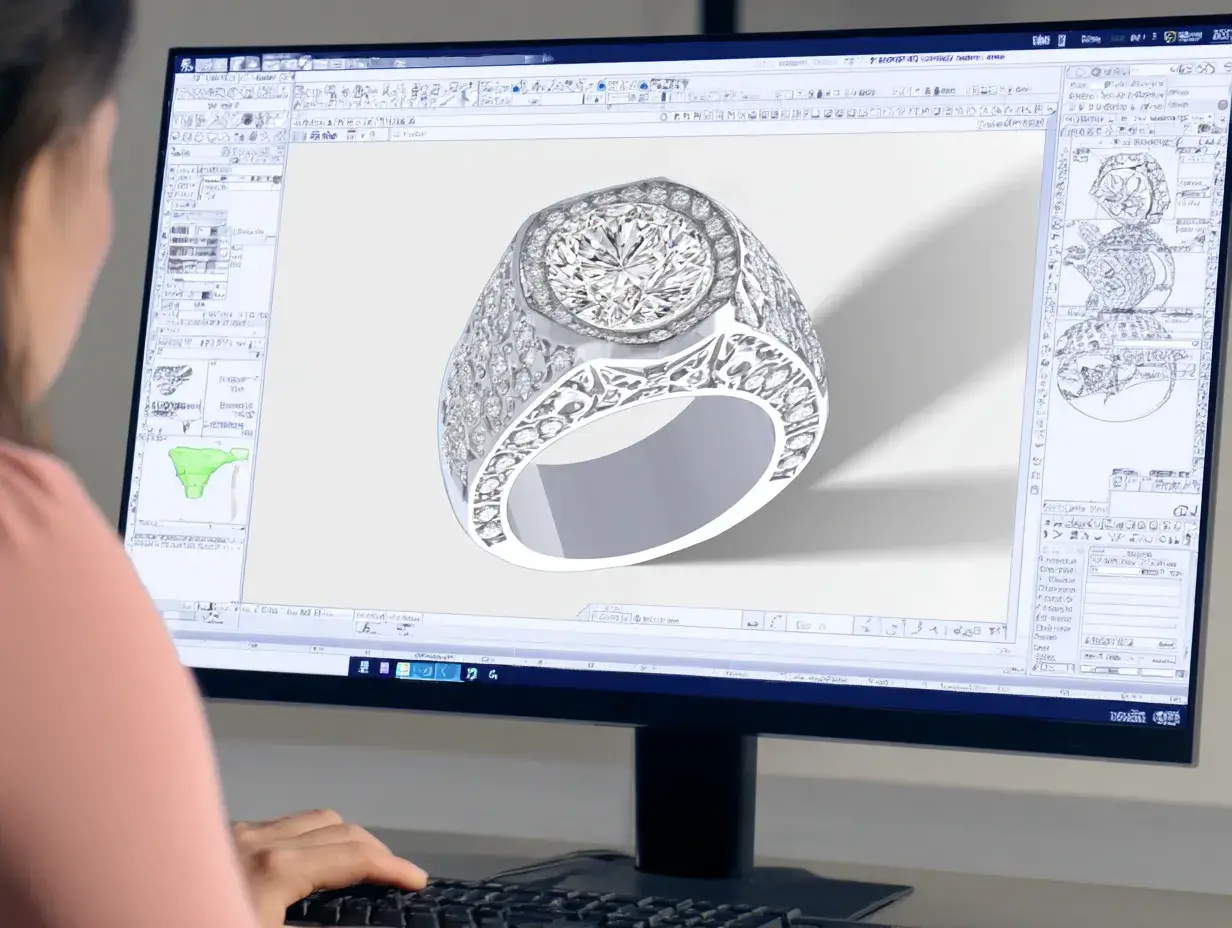
Once approved conceptually, sketches are converted to CAD (Computer-Aided Design) models. CAD software allows designers to create precise 3D renderings showing every angle and detail. These digital models can be rotated, zoomed, and modified easily—far more efficient than creating physical prototypes of every design variation.
CAD files serve multiple purposes: they provide exact specifications for manufacturers, generate realistic renderings for marketing materials, and create files for 3D printing prototype models.
Mass Production Manufacturing Techniques
Several manufacturing methods enable diamond jewelry mass production. Each offers different advantages for cost, speed, and quality.
Lost-Wax Casting
Lost-wax casting is the most common mass production technique. The process begins with creating a master model—either hand-carved from wax or 3D printed from CAD files. This master is used to make a rubber mold.
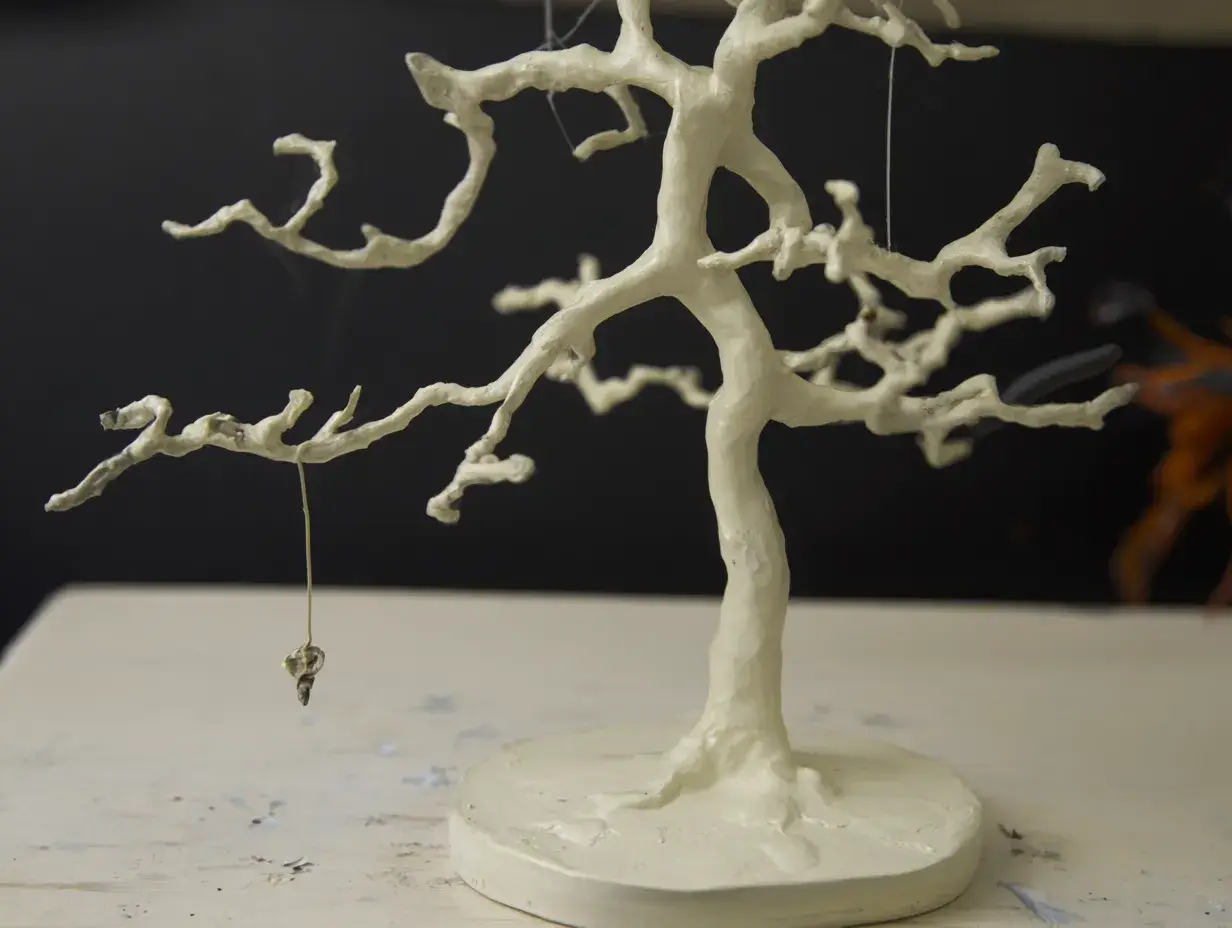
The rubber mold is vulcanized (heated under pressure) to cure it, creating a reusable template. Wax injectors then shoot hot wax into the mold, creating wax copies of the original design. Dozens or hundreds of these wax pieces are attached to a central wax sprue, forming a “wax tree.”
This wax tree is encased in investment (a plaster-like material), then heated in a furnace. The wax melts and drains out (hence “lost wax”), leaving a hollow investment mold. Molten precious metal—gold, platinum, or silver—is poured or vacuum-drawn into the hot mold.
After cooling, the investment is broken away, revealing a tree of metal jewelry pieces. Individual pieces are cut from the tree, cleaned, and sent for finishing.
Lost-wax casting excels at reproducing complex designs with fine details. A single rubber mold can produce thousands of wax copies, making it highly economical for mass production.
Die Striking and Stamping
Die striking uses tremendous pressure (many tons per square inch) to stamp metal into shape. Metal sheet is placed between precisely machined steel dies, and hydraulic presses force the dies together, compressing the metal into the desired shape.
This process creates very strong jewelry—the pressure forces metal atoms closer together, increasing density and durability. Die-struck pieces have crisp details and smooth surfaces requiring minimal finishing.
Die striking works best for relatively flat designs like wedding bands, medallions, and some bracelet components. It’s extremely efficient for high-volume production once the expensive steel dies are created.
Electroforming
Electroforming creates hollow jewelry through electrochemical deposition. A wax or resin model is coated with conductive paint, then suspended in an electrolyte bath containing dissolved metal. Electric current causes metal ions to deposit onto the model, gradually building up a metal shell.
Once the metal coating reaches desired thickness, the piece is removed, the interior core is melted out, and the hollow jewelry remains. Electroformed pieces are lightweight yet strong—ideal for large earrings, necklaces, and decorative elements where weight is a concern.
Hand Fabrication
Even in mass production, some techniques require hand work. Hand fabrication involves shaping metal wire and sheet using traditional goldsmithing tools—saws, files, pliers, and torches.
While slower than other methods, hand fabrication creates pieces impossible to achieve through casting or stamping. It’s often used for unique designs, high-end pieces, or components later assembled into larger pieces.
CAD and 3D Technology in Production
Computer technology has revolutionized diamond jewelry mass production, enabling precision, consistency, and efficiency impossible with traditional methods alone.
Computer-Aided Design (CAD)
CAD software designed specifically for jewelry allows designers to create highly detailed 3D models. Popular programs include Matrix, RhinoGold, and Blender with jewelry-specific plugins.
These programs offer tools for:
- Creating precise ring shanks with exact dimensions
- Designing prong settings that perfectly fit specific diamond sizes
- Adding intricate surface textures and patterns
- Checking for manufacturing issues (like walls too thin for casting)
- Calculating metal weight and cost
CAD models can be instantly modified—changing stone size, metal type, or design elements takes minutes rather than days of re-carving physical models.
3D Printing
3D printers create physical models directly from CAD files. Modern resin 3D printers can produce wax-like models with incredibly fine detail—as precise as 25 microns (0.025mm).
These printed models replace traditional hand-carved wax masters in the lost-wax casting process. A designer can create a digital model in the morning, print it by afternoon, and have investment molds ready the next day.
For mass production, 3D printing enables rapid prototyping. Designers test multiple variations before committing to expensive rubber molds and full production runs.
Some advanced facilities use direct metal 3D printing, building jewelry directly from precious metal powder. While slower and more expensive than casting, this technology creates complex geometries impossible through other methods.
Computer-Aided Manufacturing (CAM)
CAM systems control automated manufacturing equipment. CNC (Computer Numerical Control) machines mill wax models or directly carve precious metals with incredible precision.
Laser welders, guided by computer systems, join metal components with pinpoint accuracy. Automated stone-setting machines hold pieces in precise positions while robotic arms place diamonds into settings.
Diamond Setting Methods
After jewelry pieces are cast and finished, diamonds must be securely set. Different setting styles offer varying aesthetics, security, and production efficiency.
Prong Setting
Prong settings use small metal claws to hold diamonds. This style maximizes diamond visibility and light entry, enhancing brilliance. Four-prong or six-prong configurations are most common.
In mass production, prong settings are efficient—they accommodate slight size variations in diamonds and can be set relatively quickly by skilled setters. The metal casting includes pre-formed prongs that are bent over the diamond after placement.
Channel Setting
Channel settings place diamonds in a groove between two metal walls. The stones sit flush with the metal surface, protected from snagging on clothing or other objects.
This style requires diamonds of precisely matched size and height. In mass production, diamonds are carefully sorted and matched before setting to ensure a smooth, even appearance.
Pavé Setting
Pavé setting places many small diamonds close together, creating a glittering, “paved” surface. Tiny metal beads or prongs hold each diamond.
This technique is labor-intensive. Setters drill individual holes for each diamond, carefully size each hole to fit its stone, then raise beads from surrounding metal to secure stones. Despite automation advances, pavé work remains largely hand-crafted even in mass production.
Bezel Setting
Bezel settings surround diamonds completely with a metal rim. The rim is pushed down over the diamond’s girdle, holding it securely while creating a smooth, modern appearance.
Bezels protect diamond edges well—ideal for rings worn during active lifestyles. They require precise sizing, as the bezel must fit each diamond exactly.
Setting Process
Professional stone setters use specialized tools including:
- Setting burs: Rotating cutting tools that create perfectly sized seats for diamonds
- Prong pushers: Tools that bend prongs over diamonds without damaging them
- Beading tools: Create decorative metal beads in pavé work
- Microscopes: Provide magnification for precise positioning
Quality setting requires skill developed over years. Even with modern tools, experienced setters command high wages for their precise, damage-free work.
Quality Control and Inspection
Mass production without rigorous quality control would produce inconsistent, potentially defective jewelry. Multi-stage inspection ensures every piece meets standards.
Raw Casting Inspection
Immediately after casting, pieces are examined for defects:
- Porosity: Tiny holes from trapped gases during casting
- Incomplete filling: Areas where molten metal didn’t completely fill the mold
- Distortion: Warping from improper cooling
- Surface roughness: Texture transferred from degraded molds
Defective castings are melted and recycled rather than proceeding through expensive finishing steps.
Pre-Setting Inspection
Before diamond setting, metal pieces undergo detailed examination:
Dimensional accuracy: Calipers and micrometers verify sizes match specifications. Ring sizes, prong heights, and setting depths must be correct.
Surface finish: Pieces are checked for scratches, pits, or polish imperfections.
Structural integrity: Prongs, clasps, and joints are tested for strength.
Setting Quality Check
After diamonds are set, inspectors verify:
Stone security: Diamonds should not move when gently pushed with a setting tool. Loose stones must be re-set.
Alignment: Stones should sit level and straight, not tilted.
Prong coverage: Prongs must adequately cover diamond girdles without covering too much of the crown.
No damage: Setting shouldn’t chip or scratch diamonds.
Final Inspection
Completed pieces undergo thorough final inspection:
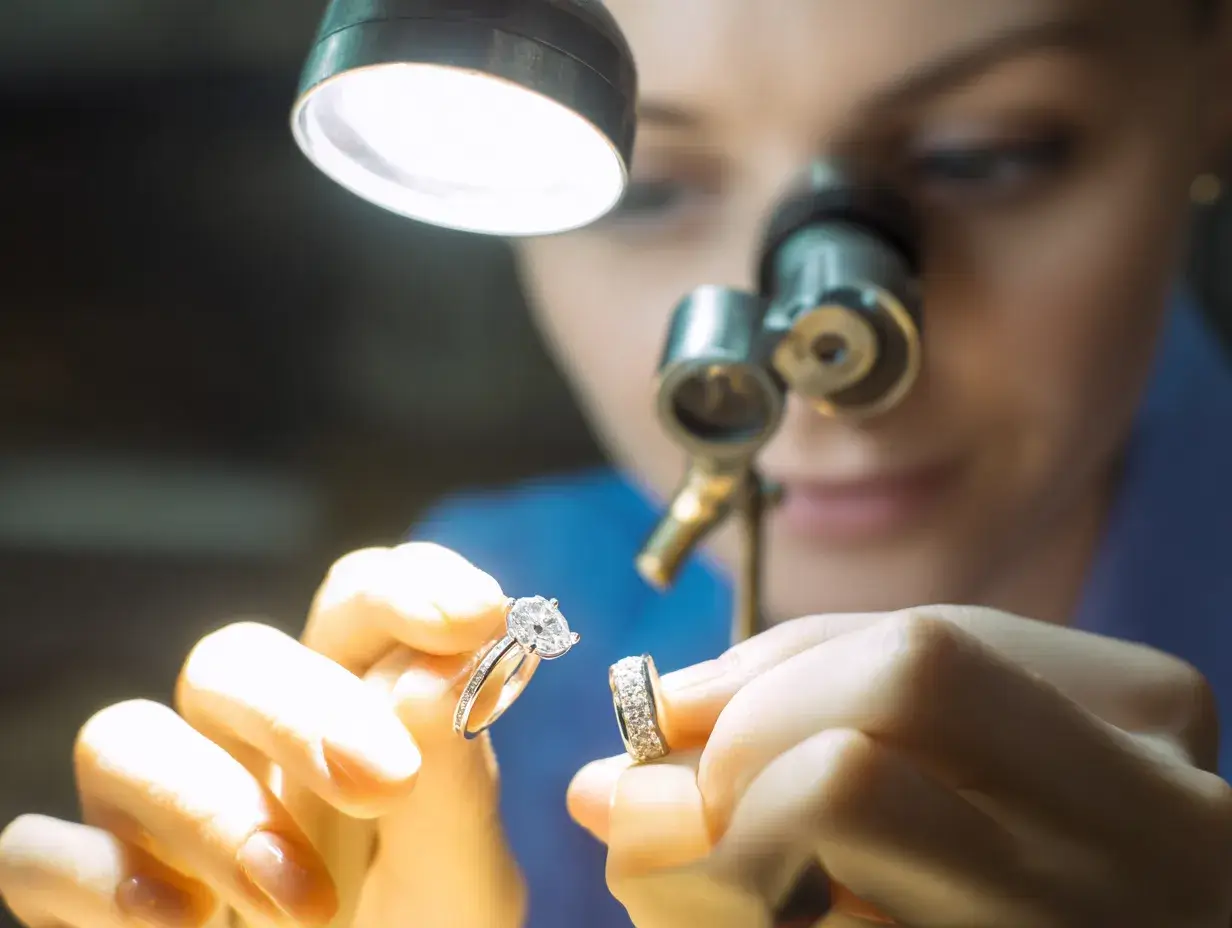
Visual examination: Inspectors use loupes or microscopes to check for any defects missed in earlier stages.
Fit and function: Clasps must open and close smoothly. Rings must be perfectly round. Hinges must operate freely.
Weight verification: Pieces are weighed to confirm they contain specified metal amounts.
Documentation: Each piece’s inspection results are recorded, creating quality assurance records.
Only pieces passing all inspections proceed to packaging and sale. Quality control failure rates in well-managed facilities typically run 2-5%—high enough to catch problems, low enough that production remains economical.
Finishing and Packaging
After quality inspection, jewelry undergoes final finishing steps that prepare it for sale.
Polishing
Professional polishing creates the lustrous surface finish consumers expect. Pieces are held against rotating wheels coated with polishing compounds of decreasing abrasiveness—similar to using progressively finer sandpaper.
Tripoli compound removes scratches and tool marks. Rouge compound creates the final high polish. Different polishing techniques create different finishes—high polish, satin, or matte.
Plating
Many pieces receive rhodium plating—particularly white gold jewelry. White gold’s natural color has yellowish tones; rhodium (a platinum-family metal) creates a bright white surface.
Pieces are cleaned, then suspended in rhodium electroplating solution. Electric current deposits an ultra-thin rhodium layer (typically 0.1-1.0 microns) onto the jewelry surface.
Rhodium plating also provides extra hardness and tarnish resistance. However, it eventually wears off with use, requiring periodic re-plating.
Cleaning
Before packaging, jewelry undergoes thorough cleaning to remove polishing compounds, fingerprints, and any residues:
Ultrasonic cleaning: High-frequency sound waves agitate cleaning solution, removing debris from hard-to-reach areas.
Steam cleaning: Pressurized steam blasts away remaining contaminants.
Final inspection: Pieces are examined one last time under bright light to ensure perfect cleanliness.
Packaging
Presentation significantly affects perceived value. Mass-produced jewelry is typically packaged in:
- Ring boxes: Padded boxes holding rings securely
- Necklace boxes: Long boxes with interior mounting systems
- Earring cards: Cards with slots or holes holding earrings
- Pouches: Fabric or leather pouches for additional protection
Higher-end pieces receive premium packaging—branded boxes, certificates of authenticity, care instructions, and appraisal documents.
Lab-Grown Diamonds in Mass Production
Lab-grown diamonds have revolutionized jewelry manufacturing, offering identical physical properties to natural diamonds at significantly lower costs.
Production Methods
HPHT (High Pressure High Temperature) mimics natural diamond formation. A tiny diamond seed is placed in carbon source material (usually graphite), then subjected to pressures exceeding 50,000 atmospheres and temperatures above 1,400°C. Carbon atoms crystallize around the seed, growing a larger diamond over several days.
CVD (Chemical Vapor Deposition) grows diamonds in a sealed chamber. A diamond seed is heated to around 800°C while hydrogen and methane gases flow over it. Microwave energy breaks apart the gas molecules, allowing carbon atoms to deposit on the seed in crystalline structure. This process produces diamonds with fewer metallic inclusions than HPHT.
Advantages for Mass Production
Lab-grown diamonds offer several benefits for jewelry manufacturers:
Consistent supply: Production can be scaled to meet demand, unlike mining which depends on deposit availability.
Predictable sizing: Labs can grow diamonds to specific target sizes, reducing sorting needs.
Cost efficiency: Lab diamonds typically cost 30-50% less than comparable natural diamonds, making diamond jewelry more accessible.
Ethical certainty: Lab diamonds have no conflict mineral concerns, appealing to ethically conscious consumers.
Detection and Disclosure
While identical in appearance and physical properties, lab-grown diamonds can be distinguished from natural using specialized equipment that detects slight differences in trace elements or fluorescence patterns.
Reputable manufacturers clearly disclose when jewelry contains lab-grown diamonds. The Federal Trade Commission requires clear labeling, and gemological laboratories issue certificates identifying diamonds as laboratory-grown.
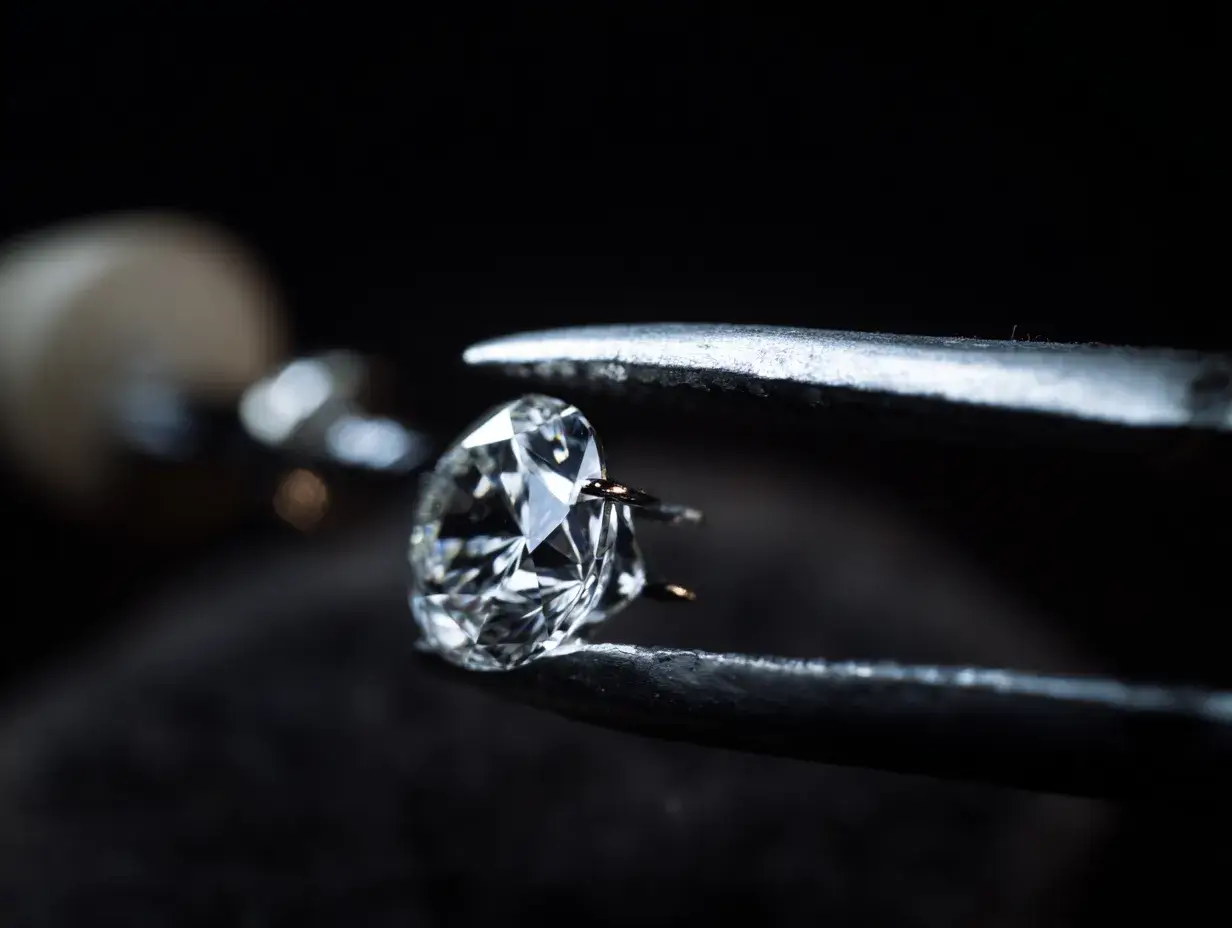
Essential Tools for Diamond Jewelry Making
Professional jewelry manufacturing requires specialized tools. While large-scale producers use industrial equipment, understanding basic tools helps appreciate the craft.
Recommended Tools for Jewelry Enthusiasts
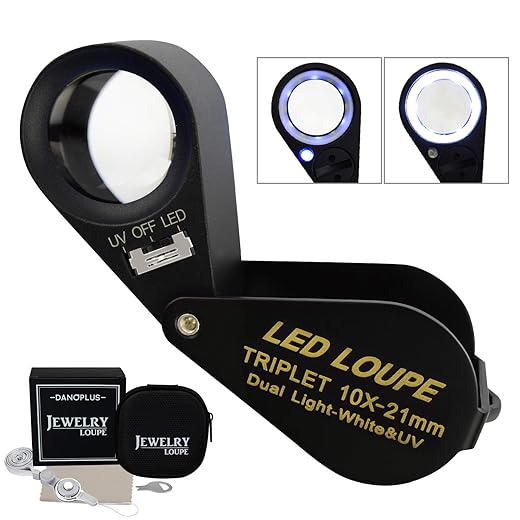
1. Jeweler’s Loupe 10x Magnification
Essential for examining diamonds and inspecting jewelry quality. A 10x loupe is the industry standard for diamond grading and quality inspection. Look for triplet lens design which reduces distortion and provides crystal-clear viewing.
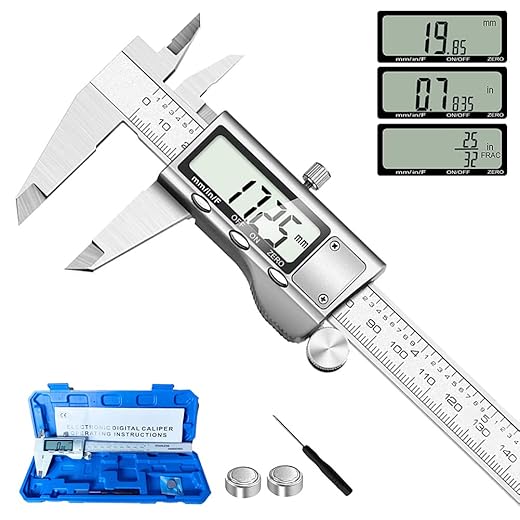
Precise measurement is critical in jewelry manufacturing. Digital calipers measure ring sizes, stone dimensions, and metal thickness to 0.01mm accuracy. Essential for quality control and ensuring pieces meet specifications.
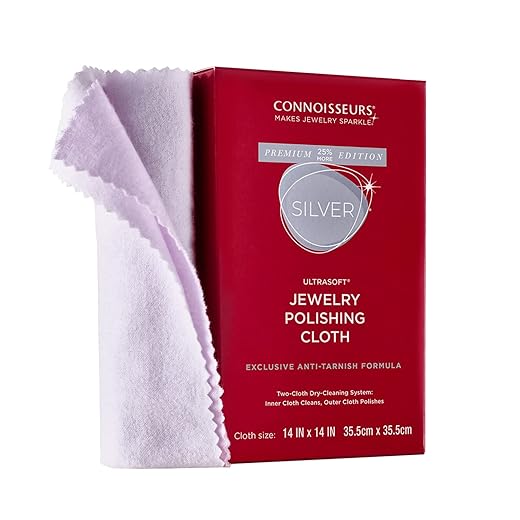
Maintain your diamond jewelry’s brilliance with professional polishing cloths. These dual-sided cloths have an outer layer impregnated with polishing compounds and an inner layer for final buffing.
Professional jewelers use ultrasonic cleaners daily. High-frequency sound waves create microscopic bubbles that remove dirt, oils, and polishing compounds from intricate settings and hard-to-reach areas.

Verify diamond authenticity with a thermal conductivity tester. These electronic devices distinguish real diamonds from simulants like cubic zirconia by testing how quickly heat transfers through the stone.

Note: As an Amazon Associate, I earn from qualifying purchases. Product recommendations are based on professional jewelry making standards and user reviews.
Frequently Asked Questions
Conclusion: The Remarkable Journey of Diamond Jewelry
The mass production of diamond jewelry represents a remarkable convergence of nature, science, craftsmanship, and technology. From diamonds formed billions of years ago deep within Earth’s mantle to finished pieces displayed in jewelry stores worldwide, the journey involves countless skilled professionals and sophisticated processes.
Modern manufacturing has made diamond jewelry more accessible without sacrificing quality. Advanced sorting ensures optimal use of each rough diamond. Precision cutting maximizes brilliance. CAD and 3D printing enable complex designs previously impossible. Automated systems provide consistency while skilled craftspeople add the human touch that makes jewelry special.
The rise of lab-grown diamonds adds another dimension, offering ethical alternatives and expanding possibilities for designers and consumers. Whether featuring natural or lab-grown stones, mass-produced diamond jewelry maintains high standards through rigorous quality control at every stage.
Understanding this process deepens appreciation for diamond jewelry. Each piece represents geology spanning eons, cutting expertise refined over generations, design creativity, manufacturing precision, and meticulous quality assurance. The next time you admire a diamond ring or necklace, you’ll recognize the extraordinary journey behind its creation.
Key takeaways:
- Diamond jewelry mass production balances efficiency with quality through multi-stage processes
- The 4Cs (Cut, Color, Clarity, Carat) guide every production decision
- Advanced technology (CAD, 3D printing, automated systems) works alongside skilled craftspeople
- Multiple quality control checkpoints ensure consistent results
- Both natural and lab-grown diamonds follow similar manufacturing processes
- Proper tools and equipment are essential at every production stage
Whether you’re shopping for your first diamond piece or building a collection, understanding production processes helps you make informed decisions and truly appreciate the craft behind these timeless treasures.
For more information about diamonds and jewelry care, explore our guides on diamond jewelry, jewelry cleaning and maintenance, and precious metals.

Hi, I’m Sara Hein, a passionate jewelry researcher and educator. I created Jewelry Carats to share well-researched insights on gemstones, precious metals, and jewelry care. My goal is making expert jewelry knowledge accessible to everyone.