
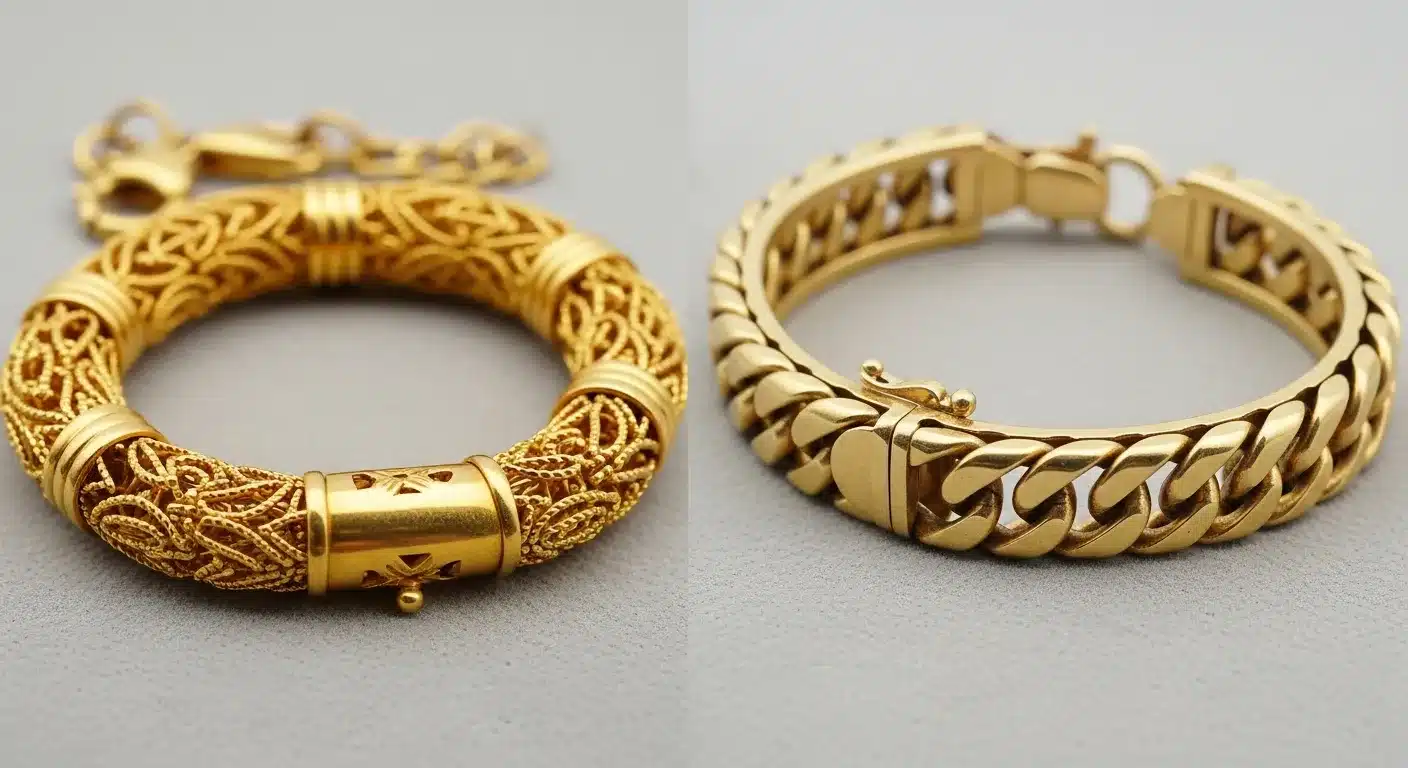
Complete Identification Guide
Finding “Korea” stamped inside a ring, bracelet, or necklace often raises questions about origin, authenticity, and value. This mark indicates the piece was manufactured in Korea, but understanding what that means requires distinguishing between two dramatically different types of Korean jewelry: traditional high-karat gold pieces and mass-produced export items. The manufacturing era, gold purity, and intended market all determine what “Korea” signifies on your jewelry.
The Korean jewelry industry experienced significant evolution from the 1960s through the 1990s, producing everything from 24-karat traditional pieces for domestic use to 10-karat costume jewelry for American mall stores. Recognizing these distinctions helps you accurately identify what you own and understand its true value in today’s market.
Two Distinct Types of Korean Jewelry
Korean jewelry falls into two completely different categories that shouldn’t be confused. Traditional Korean gold jewelry represents centuries-old craftsmanship traditions focused on purity and quality, while export-market pieces emerged during Korea’s rapid industrialization to meet Western demand for affordable fashion jewelry. The mark “Korea” appears on both types, but the similarity ends there.
Traditional Korean Gold Jewelry
Traditional Korean gold jewelry is renowned for exceptional purity, typically ranging from 22-karat to 24-karat. This jewelry was crafted primarily for the domestic Korean market, where high gold content holds cultural and financial significance. Korean families have historically viewed gold jewelry as portable wealth, evidenced dramatically during the 1997-1998 financial crisis when over 100,000 South Koreans donated personal gold collections worth more than $100 million to help their country through economic turmoil.
These pieces feature minimal gemstones because structural requirements for stone-setting necessitate stronger, lower-karat gold alloys. When diamonds or other gems do appear in traditional Korean jewelry, the gold is typically 18-karat rather than the usual 22-24-karat standard. Traditional Korean pieces include plain gold chains, simple rings, and classic bracelets valued primarily for their gold weight and purity rather than elaborate design.
Mass-Produced Export Jewelry
Mass-produced Korean jewelry intended for export markets tells a completely different story. Manufactured from the 1960s through the 1990s during Korea’s industrial boom, these pieces were designed specifically for Western consumers seeking affordable fashion jewelry. Export pieces typically contain 10-karat or 14-karat gold when solid, though many are gold-plated over base metals or ferrous materials.
The manufacturing process for export jewelry involves significant gold solder use, which dilutes actual fineness below stamped levels. A piece stamped “14K” might actually test closer to 12-karat due to solder content. These items feature machine-made construction, simulated stones like cubic zirconia, and designs marketed toward American and European tastes. You’ll frequently find these pieces in mall jewelry stores and vintage costume jewelry collections from the 1970s-1980s.
The Korean Export Boom Era (1960s-1990s)
Understanding when your Korean jewelry was manufactured provides crucial context for identification and valuation. The Korean jewelry export industry experienced distinct periods that produced different quality levels and styles.
1960s-1970s: Industry Establishment
During the 1960s and 1970s, Korea emerged as a manufacturing hub for costume jewelry and lower-karat gold pieces. The country developed specialized production facilities capable of producing jewelry at scales and prices that undercut American manufacturers. Early export pieces from this era often show craftsmanship superior to later mass-production periods, though gold content remained lower than traditional Korean standards.
Jewelry marked simply “Korea” without “South” or “North” designation typically dates to this period or earlier, before the distinction became commercially relevant for export markets. The Korean peninsula divided politically in 1953, but jewelry exports came almost exclusively from South Korea throughout the modern era.
1980s: Peak Production Period
The 1980s represented peak output for Korean jewelry exports. Manufacturers refined production techniques, expanded capacity, and flooded Western markets with affordable gold-plated and low-karat pieces. This era produced the majority of vintage Korean jewelry currently found in estate sales and online marketplaces.
Quality varied significantly during this period. Some manufacturers maintained reasonable standards while others prioritized volume over craftsmanship. The prevalence of gold plating increased as manufacturers sought to offer “gold” jewelry at ever-lower price points.
1990s-Present: Market Evolution
By the 1990s, Korean jewelry manufacturing began shifting focus. Some companies moved upmarket toward designer pieces, while mass-production increasingly relocated to China and other lower-cost manufacturing centers. Contemporary Korean jewelry design has gained international recognition for innovative, artistic approaches that blend traditional Korean aesthetics with modern minimalism.
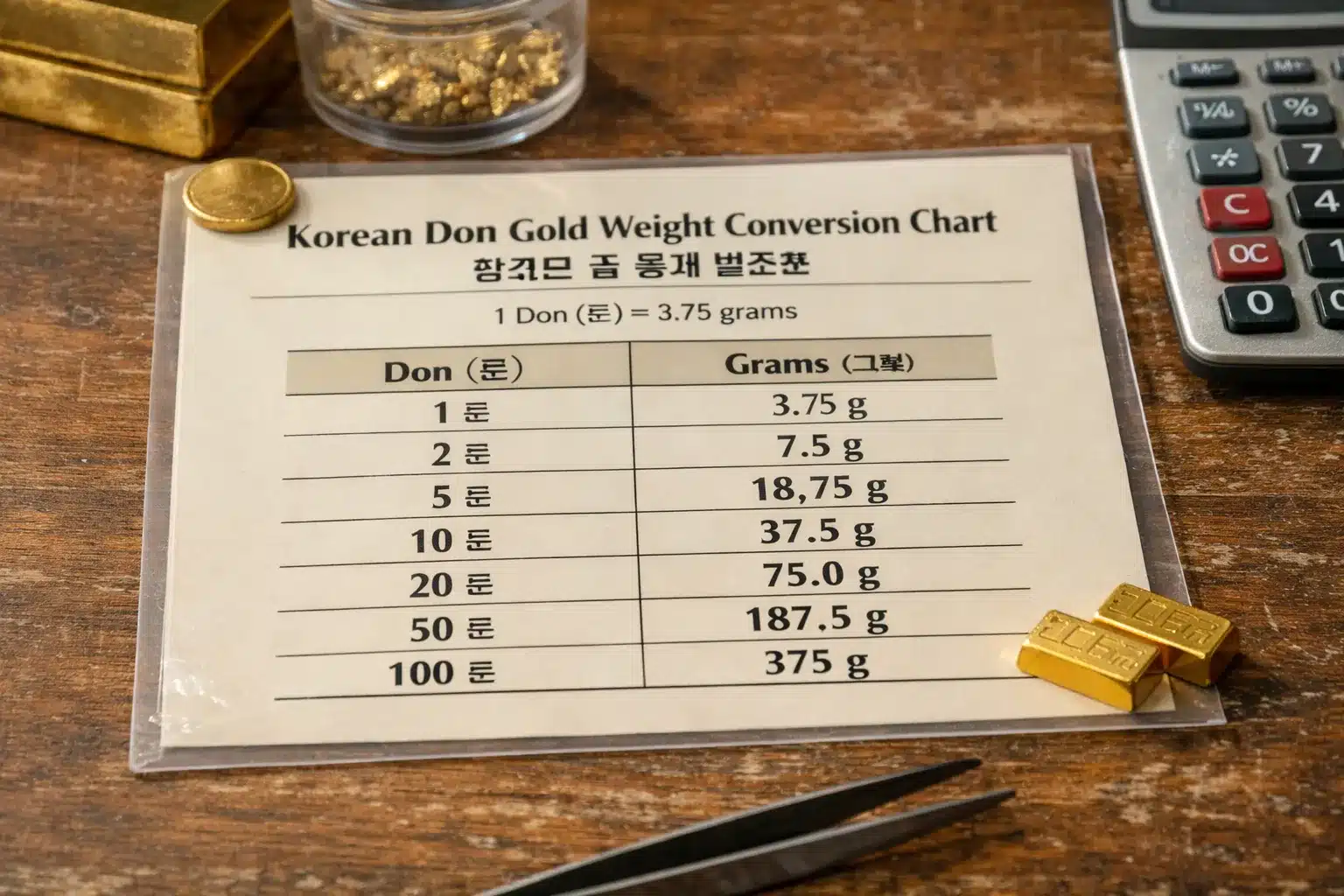
The “Don” Gold Weight Measurement System
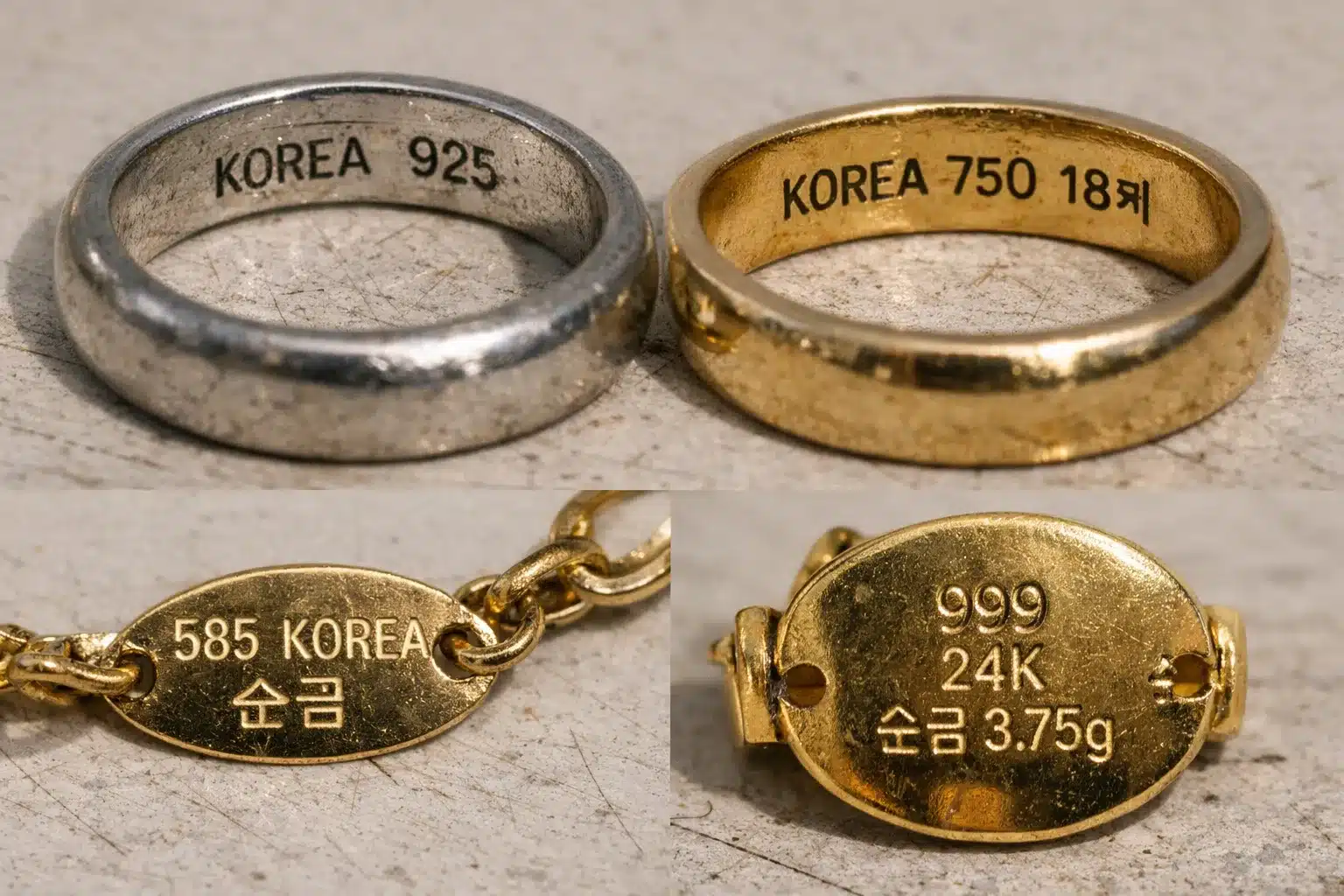
Traditional Korean gold jewelry uses a unique weight measurement unit called the “don,” which equals 3.75 grams. This measurement system predates Korea’s adoption of metric standards and remains relevant when evaluating traditional pieces. Understanding don measurements helps verify authenticity and calculate actual gold content.
A “10-don chain,” for example, should weigh approximately 37.5 grams of pure gold content, not including clasps or findings which might be lower-karat alloys. Korean gold dealers and families traditionally measured and priced gold using this system, though many contemporary Koreans find the don symbol difficult to read if they’re not in the jewelry business.
The challenge for Western buyers is that don markings use Korean script that most jewelers outside Korea cannot interpret. Traditional pieces may be marked with their don weight rather than karat fineness, requiring testing to verify actual gold content. This linguistic barrier contributed to confusion about Korean gold jewelry quality in export markets.
How to Identify Korean Jewelry Quality
Determining whether your Korea-marked jewelry is traditional high-karat gold or mass-produced export quality requires examining multiple factors. No single indicator provides definitive identification, but combining several observations yields reliable results.
Where to Find Markings
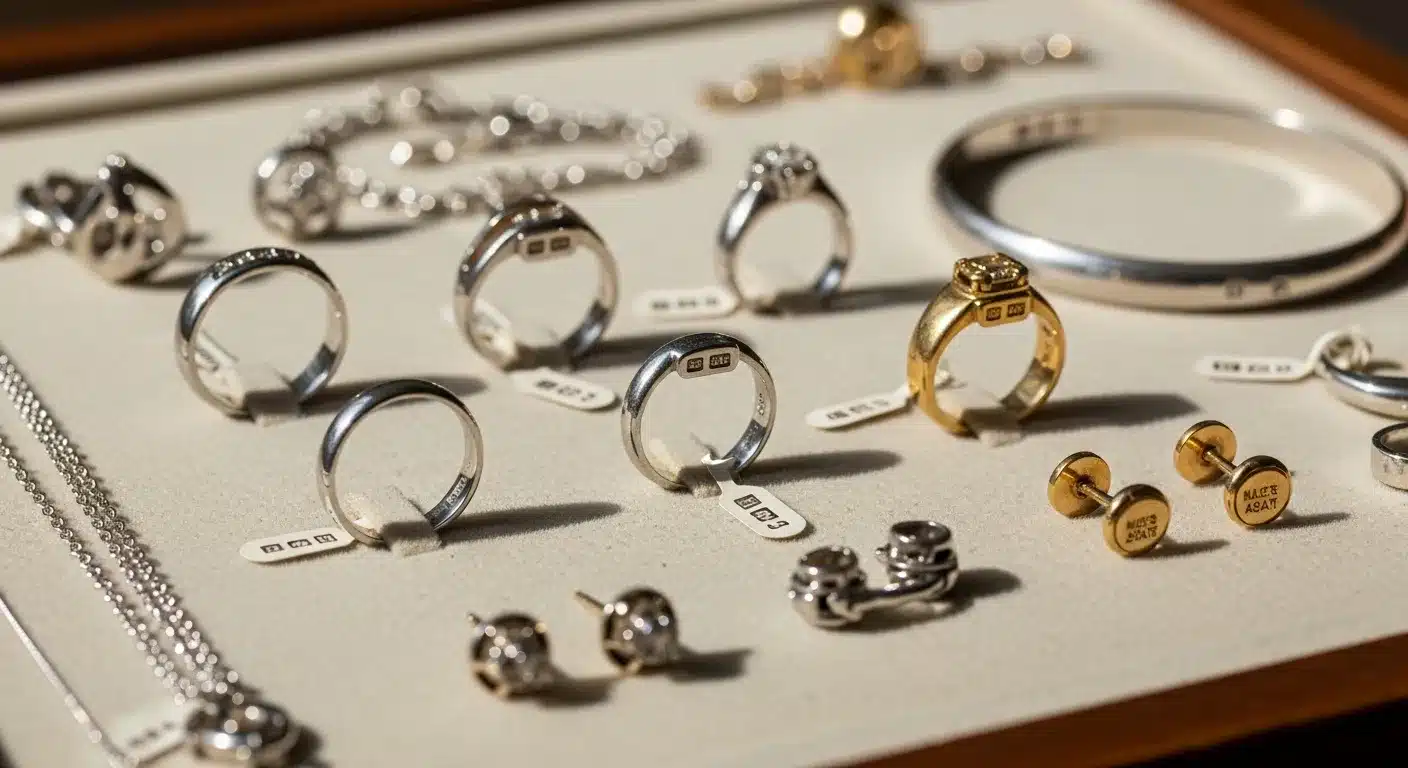
Korean jewelry marks typically appear in standard locations: inside ring bands, on bracelet clasps, near necklace clasps, or on earring posts. The marks might include “Korea,” “Made in Korea,” karat stamps like “10K” or “14K,” or Korean script characters indicating don weight or purity.
Traditional pieces often show minimal markings beyond purity stamps or don weight. Export pieces more frequently display multiple marks including “Korea,” karat stamps, and sometimes manufacturer codes or patent numbers.
Physical Examination Steps
Start with a magnet test—genuine gold is not magnetic. If your piece attracts a magnet, it’s either gold-plated over ferrous metal or not gold at all. This simple test immediately identifies many lower-quality export pieces.
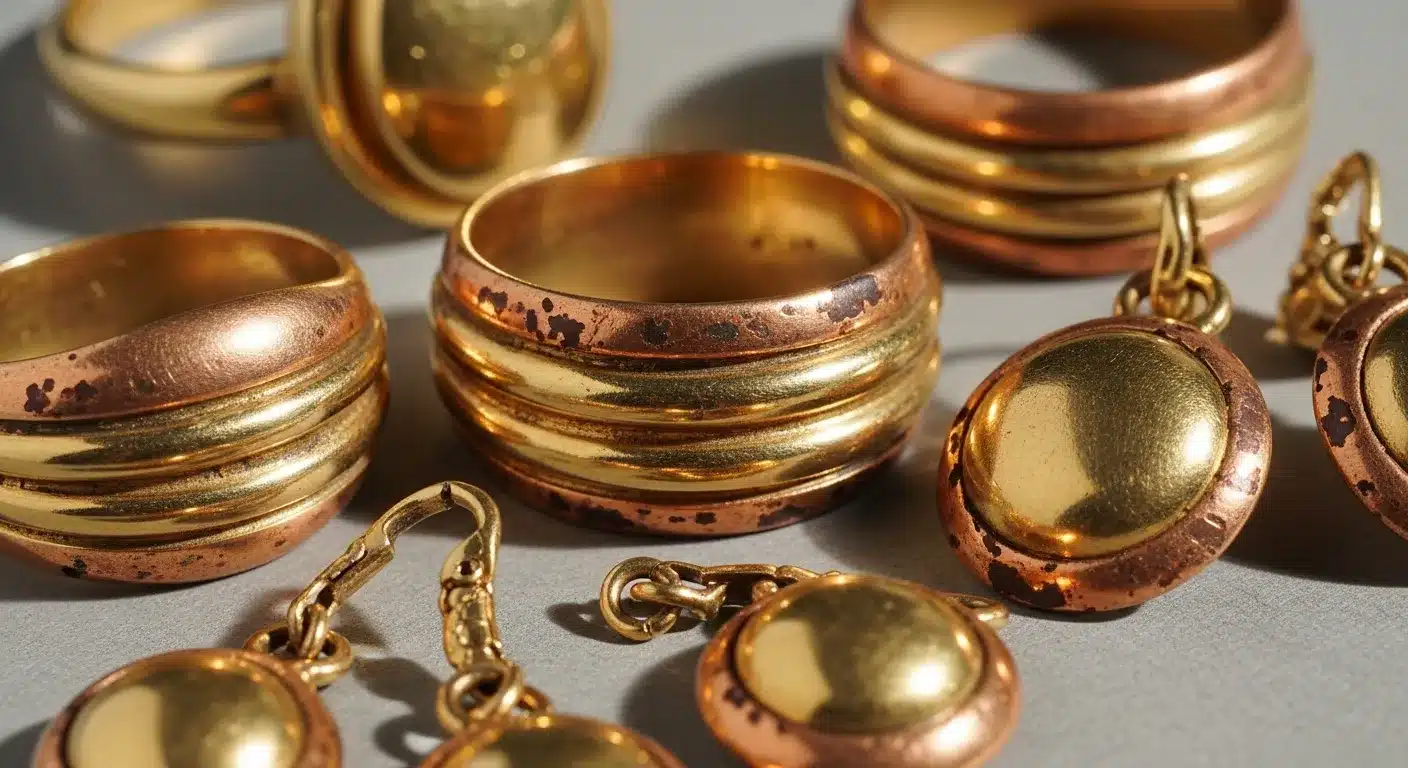
Examine color and patina carefully. Traditional high-karat Korean gold shows the characteristic rich yellow color of 22-24-karat gold. Export pieces with 10-14-karat gold appear lighter, more yellow-orange. Gold plating may show wear at edges, revealing base metal underneath. Look for areas of high friction: clasps, ring bands, chain links.
Weight provides valuable clues. Traditional Korean gold feels substantially heavy for its size due to high gold content. Mass-produced pieces often feel lightweight, especially if gold-plated over hollow forms or thin sheet metal.
Construction Quality Indicators
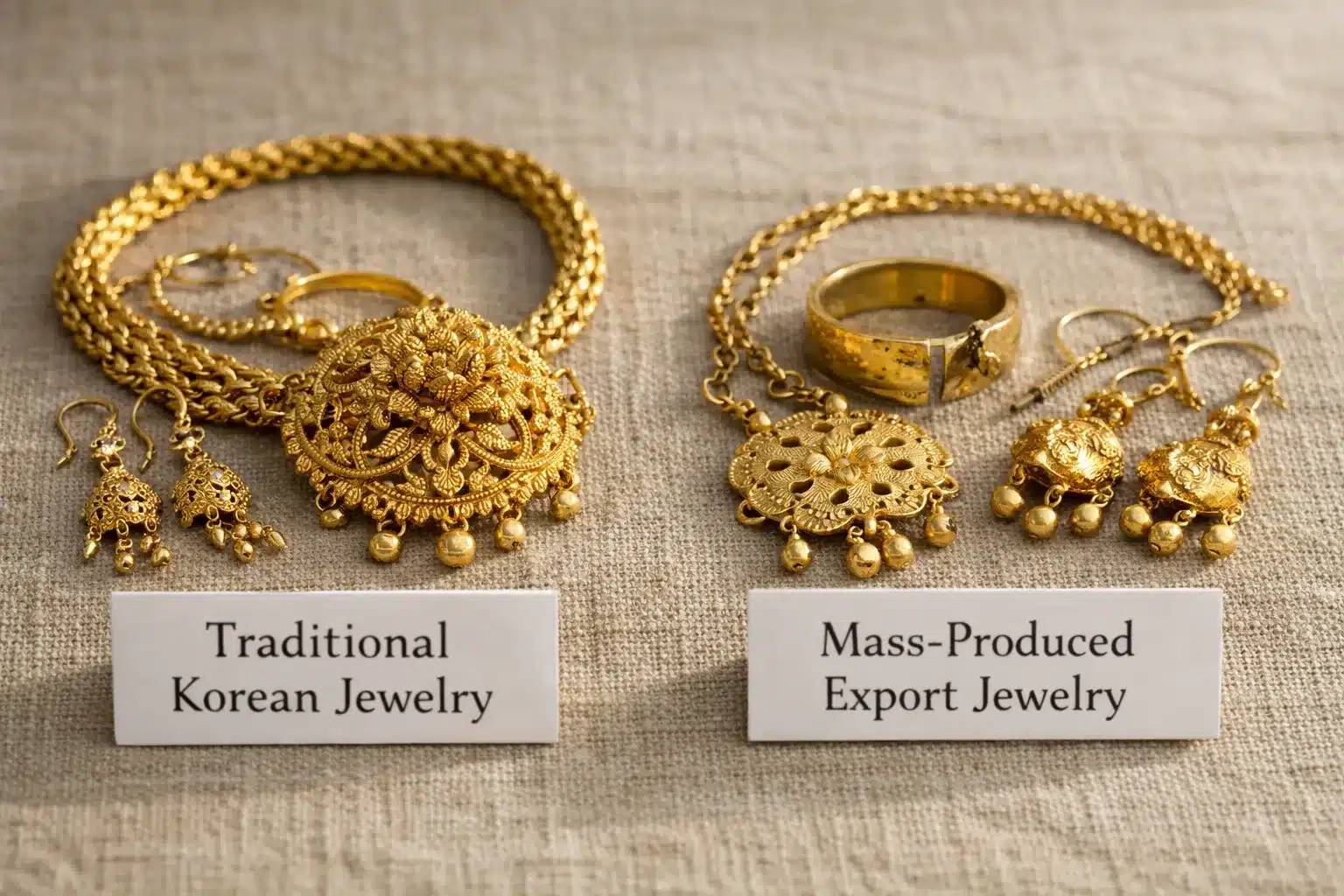
Traditional Korean gold jewelry shows hand-finished or high-quality machine work with attention to detail. Joints are smooth, chains move freely, surfaces show even polish. Mass-produced export pieces often display visible solder beads, rough finishing, and evidence of rushed manufacturing. Examine solder joints particularly carefully—excess solder indicates lower-quality construction and dilutes gold content in supposedly solid pieces.
Stone settings, when present, reveal much about quality. Traditional pieces with genuine stones show secure, professional settings. Export jewelry typically features glued-in simulated stones, poorly-finished prong work, or stones with obvious plastic appearance. The presence of rhinestones or glass “gems” strongly indicates export-market costume jewelry.
Testing Korean Gold at Home and Professionally
Several testing methods help verify whether your Korea-marked jewelry contains solid gold, gold plate, or no gold at all.
Home Testing Methods
The magnet test provides the first screening step. Beyond magnets, you can conduct a simple float test—genuine gold has high density and sinks immediately in water. While this doesn’t distinguish between karat levels, it identifies non-gold metals.
Examining wear patterns under magnification reveals plating. Gold plate eventually wears through at contact points, showing different-colored metal beneath. If edges, engraving, or high-wear areas show copper, brass, or silver color, the piece is plated.
The ceramic scratch test involves drawing your jewelry across unglazed ceramic tile. Real gold leaves a gold-colored streak; gold plate shows base metal color after light pressure penetrates the thin gold layer. This test damages jewelry slightly, so use it only on inconspicuous areas.
Professional Testing
Jewelers and gold buyers use electronic testers that measure electrical conductivity to determine karat level without damage. Acid testing with nitric acid provides more definitive results—genuine gold resists acid that dissolves base metals and lower-karat alloys. Professional testing costs typically range from $10-30 per piece.
For valuable or questionable pieces, consider X-ray fluorescence (XRF) testing, which provides precise elemental analysis without touching the jewelry. Major cities have XRF testing services, and many jewelry appraisers include it in comprehensive evaluations. This testing definitively distinguishes 22-karat traditional Korean gold from 10-karat export pieces.
Korean Jewelry Value and Pricing
Understanding value ranges helps set realistic expectations whether you’re buying, selling, or simply curious about what you own. Korean jewelry value depends primarily on gold content, condition, age, and market type.
Traditional High-Karat Pieces
Traditional Korean gold jewelry’s value closely follows gold spot price, with minimal premium for workmanship in simple pieces. A 10-don (37.5 gram) 22-karat chain worth approximately $1,800-2,000 based on current gold prices, depending on market conditions. Pawn shops typically offer 60-75% of melt value for traditional Korean gold, while specialized Asian gold dealers pay 85-95% of refined gold value.
Antique traditional pieces with historical or artistic significance command premiums above gold content. Museum-quality items from the Silla, Goryeo, or Joseon dynasties represent national treasures rather than typical consumer jewelry and require specialized evaluation.
Export Market Jewelry
Mass-produced Korean export jewelry from the 1960s-1980s varies widely in value. Solid 10-14-karat pieces are worth their gold content minus refining costs, typically yielding 70-85% of calculated gold value when sold. A 10-karat gold ring weighing 5 grams contains approximately 2.1 grams of pure gold, worth roughly $140-160 at current prices.
Gold-plated Korean jewelry has minimal precious metal value—perhaps $5-20 for the thin gold layer. These pieces sell primarily as vintage costume jewelry, with prices ranging from $10-50 depending on design appeal, condition, and collector interest. Certain 1980s Korean costume jewelry has gained vintage appeal, but most remains low-value fashion jewelry.
Where to Sell Korean Gold
Selling options include pawn shops, gold buyers, jewelry stores, and online marketplaces. Pawn shops offer immediate cash but typically pay only 30-60% of gold value. General gold buyers pay 70-85% for straightforward pieces. Specialized Asian gold dealers, particularly in areas with Korean communities, often pay premium prices for traditional high-karat pieces because they understand the market better.
Online selling through platforms like eBay or specialized jewelry sites can yield retail-level prices but requires photography, descriptions, shipping, and dealing with potential buyer issues. For vintage costume pieces, online sales to collectors often exceeds scrap gold value.
Common Mistakes and Misconceptions
Several persistent myths about Korean jewelry lead to confusion and disappointment. Recognizing these misconceptions helps set accurate expectations.
Myth: All Korea-Marked Jewelry is Gold Plated
While much Korean export jewelry is gold-plated, this blanket assumption ignores traditional high-purity Korean gold. Many people discard or undervalue genuine 22-24-karat pieces because they assume “Korea” means costume jewelry. Testing reveals whether you have traditional gold or plated fashion jewelry.
Myth: Korean Gold is Inferior Quality
Traditional Korean gold actually exceeds Western jewelry standards, with 22-24-karat purity versus the 14-18-karat typical in American jewelry. The confusion stems from conflating traditional pieces with mass-produced export items. High-karat Korean gold represents some of the purest gold jewelry available commercially.
Myth: “Made in Korea” is Better than “Korea”
Some believe “Made in Korea” marks indicate higher quality than simple “Korea” stamps. In reality, both marks appear on traditional and export pieces. The phrasing reflects manufacturing period and intended market rather than quality level. Testing gold content provides reliable quality assessment regardless of mark wording.
Myth: North Korean Jewelry Flooded Western Markets
North Korea has produced minimal jewelry for export markets. Virtually all Korea-marked jewelry found in the United States and Europe originated in South Korea. The simplified “Korea” stamp typically predates periods when “South Korea” distinctions became commercially relevant.
Korean Jewelry Cultural Traditions
Korean jewelry carries cultural significance beyond its material value, particularly traditional pieces that reflect centuries-old customs and beliefs.
Doljanchi First Birthday Gifts
Korean tradition involves gifting gold jewelry at a child’s first birthday celebration (Doljanchi or Dohl). Guests present 24-karat gold rings and bangle bracelets, creating the child’s starter gold collection. This custom treats jewelry as both adornment and financial security, with parents often saving these pieces for the child’s future use or investment.
Traditional Design Elements
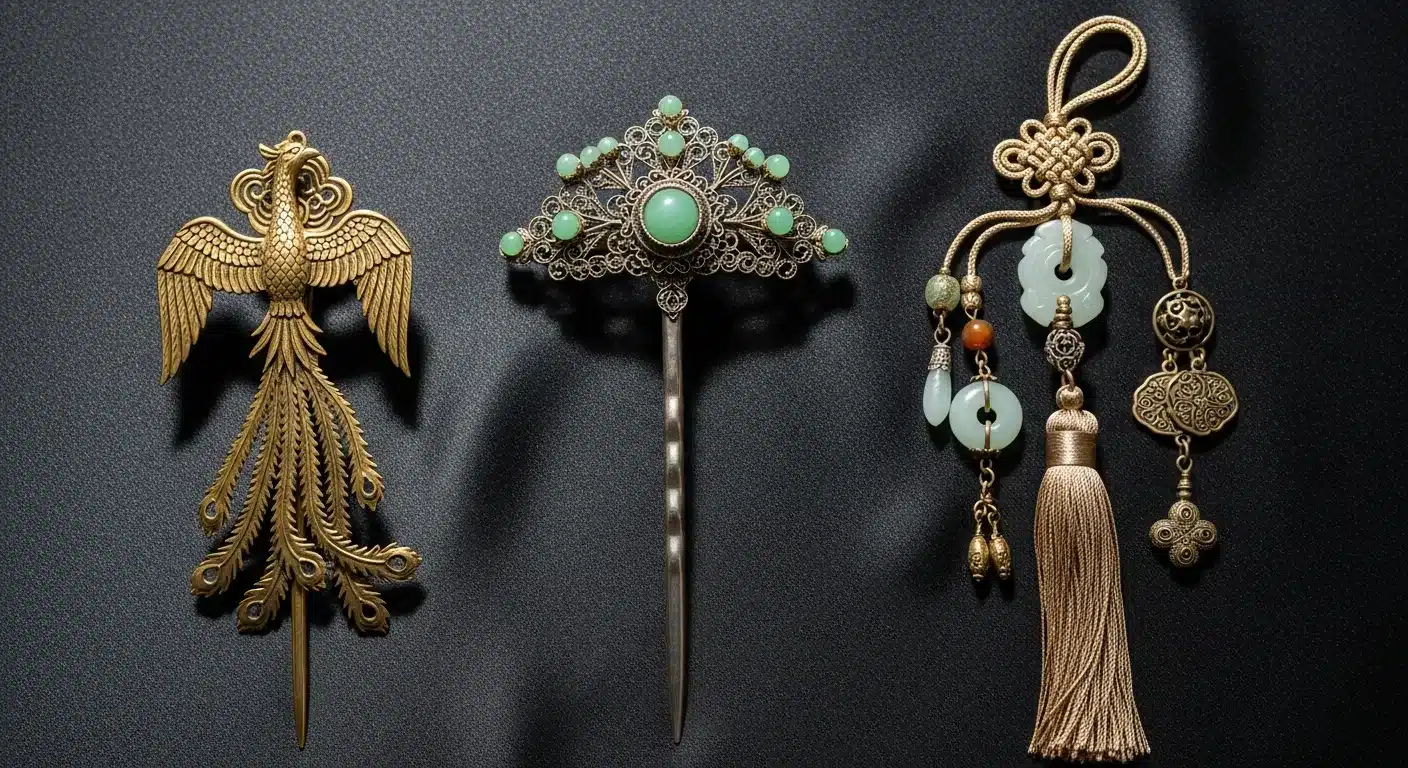
Historical Korean jewelry features distinctive motifs with symbolic meanings. The Phoenix represents peace and honor, appearing on hair pins, pendants, and buttons. Dragon shapes were reserved for supreme leaders and royalty. The Ttolchcham, a traditional pin, incorporates jade carved as flowers or butterflies, its name meaning “trembling pin” because delicate springs made decorative elements vibrate with movement.
Traditional Norigae pendants hung from women’s hanbok clothing, combining elaborate knots, precious metal pendants, and tassels. These pieces served as good luck charms passed through generations, carrying family history and spiritual significance beyond monetary value.
The 1997 Financial Crisis Gold Donation
The “Collect Gold for the Love of Korea” campaign during the 1997-1998 Asian financial crisis demonstrated gold jewelry’s role in Korean culture. Facing potential national bankruptcy, the South Korean government called on citizens to donate gold. Over 3.5 million people responded, donating $2.2 billion worth of gold jewelry, wedding rings, family heirlooms, and gold bars. Each South Korean donated an estimated $640 in personal gold collections, helping the nation repay International Monetary Fund loans ahead of schedule. This unprecedented collective sacrifice illustrates why gold jewelry holds such profound meaning in Korean society.
Buying Korean Gold Jewelry Today
Modern Korean jewelry includes both traditional high-karat pieces and contemporary designer work that blends Korean aesthetics with international styles.
Contemporary Korean Designers
Modern Korean jewelry design has gained global recognition. Brands like 1064 Studio, Portrait Report, and Numbering create minimalist pieces that reference traditional Korean aesthetics while appealing to contemporary tastes. These designers work primarily in sterling silver and gold-plated metals, focusing on design innovation rather than high-karat gold.
This contemporary work bears little resemblance to either traditional 24-karat pieces or 1980s export jewelry. Contemporary Korean designers compete internationally on design merit, producing limited-edition pieces for fashion-conscious consumers rather than mass-market products.
Sourcing Traditional Pieces
Authentic traditional Korean gold jewelry is increasingly difficult to find outside Korean communities. Family collections typically remain in families, and quality pieces rarely enter general circulation. Korean jewelers in major cities occasionally offer traditional pieces, though prices reflect high gold content and cultural value.
Estate sales, particularly in areas with Korean immigrant populations, sometimes yield traditional pieces. However, expertise in identification is crucial because export-quality pieces vastly outnumber traditional jewelry in secondary markets.
Authentication and Appraisal
Professional authentication becomes important for valuable pieces, significant purchases, or insurance purposes.
When to Seek Professional Appraisal
Professional appraisal is warranted when dealing with pieces that appear to be high-karat traditional jewelry, items with unusual or antique characteristics, or jewelry you’re considering purchasing at significant cost. Certified appraisers with Asian jewelry expertise provide the most reliable evaluations.
Expect to pay $75-150 per piece for comprehensive written appraisals including photographs, measurements, metal testing, and current market value estimates. This investment protects against purchasing counterfeit pieces or undervaluing genuine traditional jewelry.
Red Flags in Authentication
Be suspicious of claims that Korean jewelry is “rare” or “valuable” based solely on age without testing gold content. Most 1970s-1980s Korean jewelry is mass-produced costume jewelry with minimal value. Sellers who refuse to allow testing or professional examination often know pieces aren’t what they claim.
Beware of gold-plated pieces misrepresented as solid gold. Worn areas, unusually light weight, and magnetic attraction all indicate plating. Demand verification before paying prices appropriate for solid gold jewelry.
Frequently Asked Questions About Korean Jewelry
Is jewelry marked “Korea” real gold?
Jewelry marked “Korea” may or may not be real gold, depending on type. Traditional Korean jewelry is typically 22-24 karat genuine gold, while mass-produced export pieces made from the 1960s-1990s may be 10-14 karat gold, gold-plated, or contain no precious metal at all. The only reliable way to determine gold content is through magnet testing, acid testing, or electronic gold testing. A magnet test provides a quick initial screen—real gold is not magnetic, so any magnetic attraction indicates the piece is gold-plated over ferrous metal or contains no gold.
Export jewelry was manufactured specifically for Western markets and often features simulated stones, machine-made construction, and lower gold content than traditional Korean pieces. If you inherited jewelry or found an old piece marked “Korea,” professional testing costs $10-30 and definitively answers whether it contains solid gold and at what karat level.
How can you tell the difference between traditional and export Korean jewelry?
Traditional and export Korean jewelry differ dramatically in gold purity, weight, construction quality, and appearance. Traditional pieces are almost always plain gold items like chains, simple rings, and bracelets in 22-24 karat gold, with rich deep yellow color and substantial weight for their size. They rarely feature gemstones, and when stones appear, the gold is typically 18-karat for structural strength.
Export jewelry tends to be 10-14 karat if solid gold, or gold-plated over base metals. These pieces feel lightweight, show machine-made construction with visible solder beads, and frequently include simulated stones like cubic zirconia or rhinestones. Export jewelry often displays ornate designs aimed at Western fashion tastes, while traditional pieces emphasize simple forms that showcase gold purity. Weight testing helps significantly—traditional high-karat gold feels noticeably heavier than export pieces of similar size due to gold’s high density.
What is the “don” measurement used in Korean gold jewelry?
The “don” is Korea’s traditional gold weight measurement unit, equal to 3.75 grams. Traditional Korean gold jewelry is often sold and marked by don weight rather than using the gram-based metric system. A “5-don bracelet” should contain 18.75 grams of gold, while a “10-don chain” weighs 37.5 grams. This measurement system predates Korea’s adoption of metric standards and remains relevant when evaluating traditional pieces.
The challenge for Western buyers is that don markings use Korean script that most non-Korean jewelers cannot read. Even many Korean-Americans not in the jewelry business find traditional don symbols difficult to interpret. When evaluating traditional Korean gold, knowing the don system helps verify authenticity by confirming weight matches claimed don measurements. However, most export jewelry never used don measurements, as these pieces were manufactured in karat-based systems for Western markets.
How much is Korean gold jewelry worth?
Korean gold jewelry value depends entirely on type and gold content. Traditional high-karat pieces worth their gold content based on current precious metal prices. For 22-karat gold, calculate 91.6% of the total weight as pure gold, then multiply by current gold spot price. A 20-gram traditional Korean bracelet in 22-karat gold contains approximately 18.3 grams of pure gold, worth roughly $1,200-1,400 depending on daily gold prices.
Mass-produced export jewelry varies widely. Solid 10-14 karat pieces are worth their gold content, while gold-plated items have minimal precious metal value, perhaps $5-20 for thin plating. When selling Korean gold, expect pawn shops to offer 30-60% of gold value, general gold buyers to pay 70-85%, and specialized Asian gold dealers to offer the best prices—often 85-95% of refined gold value for traditional high-karat pieces. Vintage costume jewelry from the 1970s-1980s may have collector value separate from precious metal content, typically selling for $10-50 depending on design and condition.
Where can I sell my Korean gold jewelry?
Several selling options exist, each with different advantages. Specialized Asian gold buyers, particularly in areas with Korean communities, typically offer the best prices for traditional high-karat Korean jewelry because they understand the market and can resell efficiently. These dealers often pay 85-95% of refined gold value. General gold buyers and jewelry stores offer 70-85% of gold value for straightforward pieces, providing a reliable middle option.
Pawn shops provide immediate cash but typically pay only 30-60% of gold value, making them the least profitable option unless you need money urgently. Online selling through platforms like eBay can yield retail-level prices but requires effort, quality photography, shipping logistics, and patience to find buyers. For lower-value gold-plated pieces, online vintage jewelry marketplaces sometimes exceed scrap value by appealing to collectors interested in 1980s fashion jewelry. Choose your selling method based on whether you prioritize maximum value or quick, convenient sale.
What does “Made in Korea” mean on vintage jewelry?
Jewelry marked “Made in Korea” indicates manufacture in South Korea, most likely during the 1960s-1990s export boom when Korean manufacturers produced massive quantities of costume and lower-karat jewelry for Western markets. The “Made in Korea” phrasing appeared more frequently on export pieces than traditional jewelry, as export manufacturers needed to comply with country-of-origin marking requirements for international trade.
This mark doesn’t automatically indicate quality level—both solid gold and gold-plated pieces bear “Made in Korea” stamps. The phrasing is essentially identical to simple “Korea” markings in terms of what it tells you about the jewelry. Testing gold content, examining construction quality, and checking for simulated stones provides much more useful information than the specific wording of the origin mark. Vintage Korean jewelry from the 1970s-1980s has gained some collector interest, but most pieces remain low-value fashion jewelry rather than precious metal investments.
Conclusion: Understanding Your Korean Jewelry
Jewelry marked “Korea” encompasses a wide spectrum from museum-quality 24-karat traditional pieces to inexpensive gold-plated costume jewelry. Understanding these distinctions helps you accurately identify what you own, make informed buying or selling decisions, and appreciate the cultural significance of authentic traditional pieces. The key to proper identification lies in testing gold content, examining construction quality, and recognizing the vast differences between traditional domestic jewelry and mass-produced export items.
Whether you inherited Korean jewelry, found a vintage piece, or are considering a purchase, take time to verify gold content through magnet testing, professional evaluation, or electronic testing. The difference between 24-karat traditional gold and gold-plated export jewelry represents hundreds or thousands of dollars in actual value. Korean gold jewelry at its finest—traditional high-karat pieces—represents some of the purest gold craftsmanship available, while export jewelry fills a different role as affordable fashion pieces from a specific historical period.
For more information about jewelry identification and evaluation, explore our related guides: Costume Jewelry Makers Marks Database, How to Tell If Jewelry Is Real Gold, and How to Date Vintage Jewelry.

Hi, I’m Sara Hein, a passionate jewelry researcher and educator. I created Jewelry Carats to share well-researched insights on gemstones, precious metals, and jewelry care. My goal is making expert jewelry knowledge accessible to everyone.