
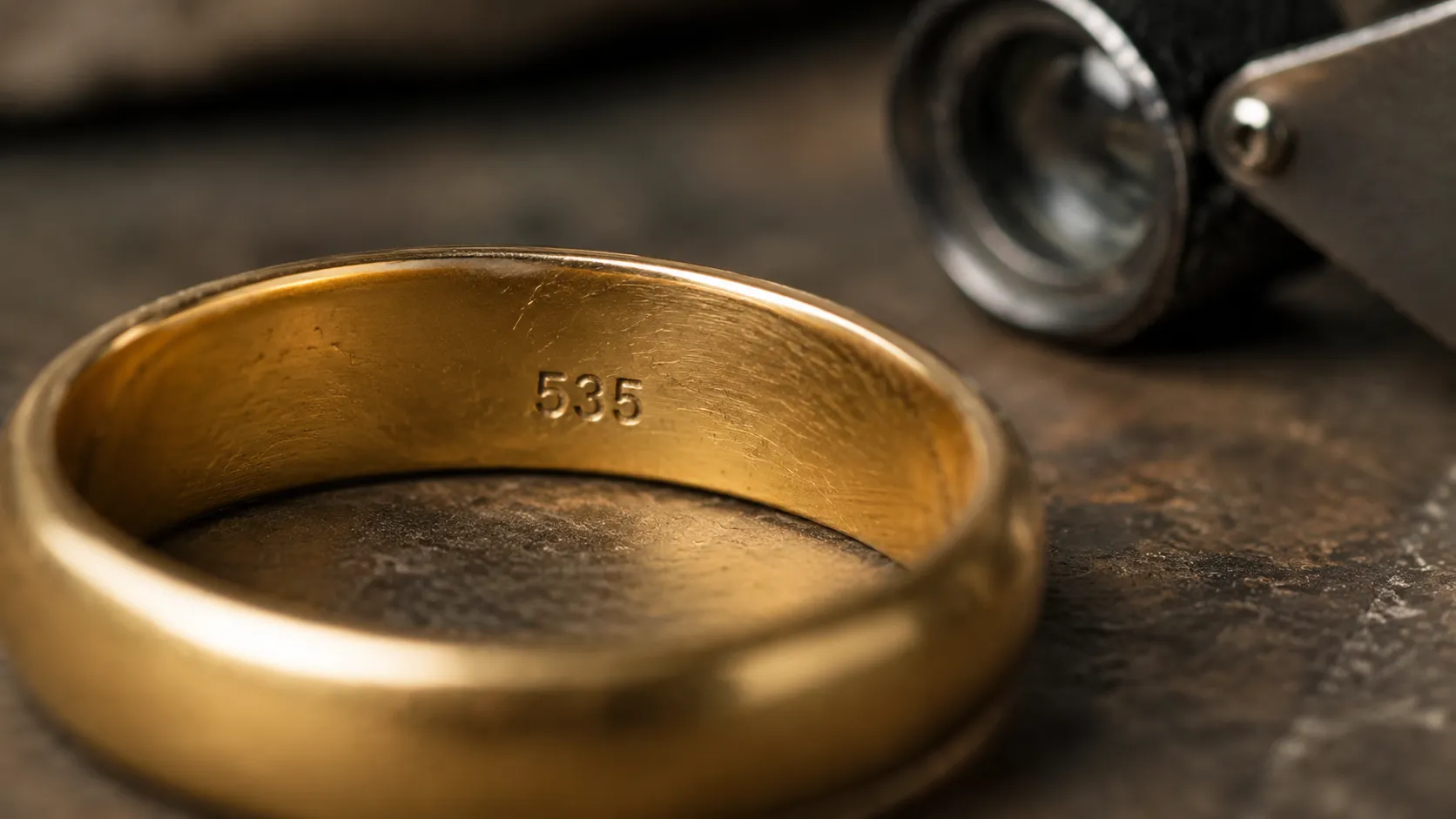
Short answer: a “535” stamp is not a widely recognized standard gold fineness mark. By itself, it does not prove that an item is gold, that it contains 53.5% gold, or that it is “pure gold.” In some cases, the stamp may actually be a worn or poorly struck “585,” but the jewelry must be inspected or tested before drawing any conclusion.
Is 535 a Gold Purity Mark?
Gold purity is often expressed using a three-digit millesimal number. This number indicates how many parts out of 1,000 are pure gold. For example, a 750 stamp normally identifies an alloy containing 750 parts gold per 1,000, equivalent to 75% gold.
However, 535 is not included among the commonly recognized gold fineness standards used in major hallmarking systems. Officially recognized marks commonly include numbers such as 375, 585, 750, 916 and 999.
Therefore, it would be incorrect to identify an item as gold simply because it carries the number 535.
Does 535 Mean 53.5% Gold?
Not necessarily. Although millesimal fineness numbers normally represent parts per thousand, not every three-digit number found on jewelry is a purity mark.
The number may instead be:
- a manufacturer’s internal code;
- a model or design number;
- an inventory or production reference;
- an incomplete or poorly struck hallmark;
- a non-standard mark from an unidentified source;
- another number that has become difficult to read.
Without additional marks or professional testing, 535 alone should not be interpreted as 53.5% gold.
Could the Stamp Actually Be 585?
Yes, this is one of the most important possibilities to investigate. On a small, worn or scratched piece of jewelry, the number 8 in a 585 stamp can sometimes resemble a 3.
A 585 stamp indicates 585 parts of gold per 1,000, or 58.5% gold. It is one of the markings commonly used for 14-karat gold.
This does not mean that every 535 stamp is really 585. The mark should first be examined under magnification, preferably from different angles and under good lighting.
Common Gold Purity Stamps
The following markings are commonly encountered on gold jewelry:
- 375 — 37.5% gold, commonly identified as 9K gold;
- 417 — approximately 41.7% gold, commonly identified as 10K gold;
- 585 — 58.5% gold, commonly identified as 14K gold;
- 750 — 75% gold, commonly identified as 18K gold;
- 916 — approximately 91.6% gold, commonly identified as 22K gold;
- 999 — approximately 99.9% gold, commonly identified as 24K or nearly pure gold.
Standards and legal marking requirements can vary between countries, so the complete set of marks and the origin of the item should always be considered.
How to Identify a 535 Jewelry Stamp
If you find 535 stamped inside a ring, on a clasp or on another piece of jewelry, follow these steps.
1. Examine the Stamp Under Magnification
Use a jeweler’s loupe or a clear macro photograph. Check whether the middle digit could actually be an 8, making the mark 585 rather than 535.
2. Look for Other Marks
Inspect the entire item for letters, symbols, logos or additional numbers. A complete hallmark may contain a maker or sponsor mark, a fineness mark and an assay office symbol. These surrounding marks may be more useful than the number 535 alone.
3. Consider the Item’s Origin
If you know the brand, seller or country where the jewelry was purchased, contact the manufacturer or consult the relevant hallmarking authority. Marking systems are not identical in every country.
4. Do Not Rely on a Magnet Test
A magnet can provide a preliminary clue, but it cannot prove that an item is gold. Many non-gold metals are also non-magnetic, while some genuine pieces may contain magnetic components in clasps or springs.
5. Ask a Professional Jeweler to Test It
A qualified jeweler, precious-metal dealer or assay office can examine the mark and test the metal. X-ray fluorescence testing, commonly called XRF, can analyze an item without significantly damaging it. Acid testing may also be used, although it should be performed carefully by an experienced person.
Does a 535 Stamp Prove That Jewelry Is Genuine?
No. A stamp alone never provides absolute proof of authenticity. Marks can be misunderstood, incorrectly applied or even counterfeited.
The United States Federal Trade Commission advises consumers to consider both the quality mark and the name or registered trademark of the business responsible for the item. Professional testing is particularly important before buying, selling or insuring valuable jewelry.
Is Jewelry Marked 535 Valuable?
The number 535 alone is not enough to determine value. The value of a piece may depend on:
- the metal confirmed by testing;
- the item’s weight;
- the presence and quality of gemstones;
- the manufacturer or designer;
- age, rarity and provenance;
- condition and craftsmanship.
Do not buy or sell an item as gold solely because it has a 535 stamp.
Frequently Asked Questions
Is 535 the Same as 14K Gold?
No. The number commonly associated with 14K gold in the millesimal system is 585. A mark that appears to read 535 could possibly be a worn 585 stamp, but this must be verified.
Does 535 Mean Pure Gold?
No. Pure or nearly pure gold is normally marked 999 or 24K. The claim that 535 means 95% pure gold is incorrect.
Can 535 Be a Silver Mark?
535 is not a commonly recognized sterling silver fineness mark. Sterling silver is typically marked 925. Nevertheless, 535 could still be a manufacturer’s or model code rather than a statement about metal purity.
Can I Test the Jewelry at Home?
Home tests may offer clues but can be inconclusive or damage the item. If the piece could be valuable, the safest option is professional examination and metal testing.
The Bottom Line
A 535 stamp does not have a single, universally accepted meaning in jewelry. It should not automatically be interpreted as a gold purity mark. The mark could be an internal code, a non-standard marking or a worn 585 stamp.
Examine all the marks carefully and have the metal professionally tested before deciding what the item is made from or how much it is worth.
Authoritative References
- London Assay Office — What Is a Hallmark?
- GIA — Guide to Gold Purity and Karat Marks
- Federal Trade Commission — Buying Gold and Silver Jewelry

Hi, I’m Sara Hein, a passionate jewelry researcher and educator. I created Jewelry Carats to share well-researched insights on gemstones, precious metals, and jewelry care. My goal is making expert jewelry knowledge accessible to everyone.