
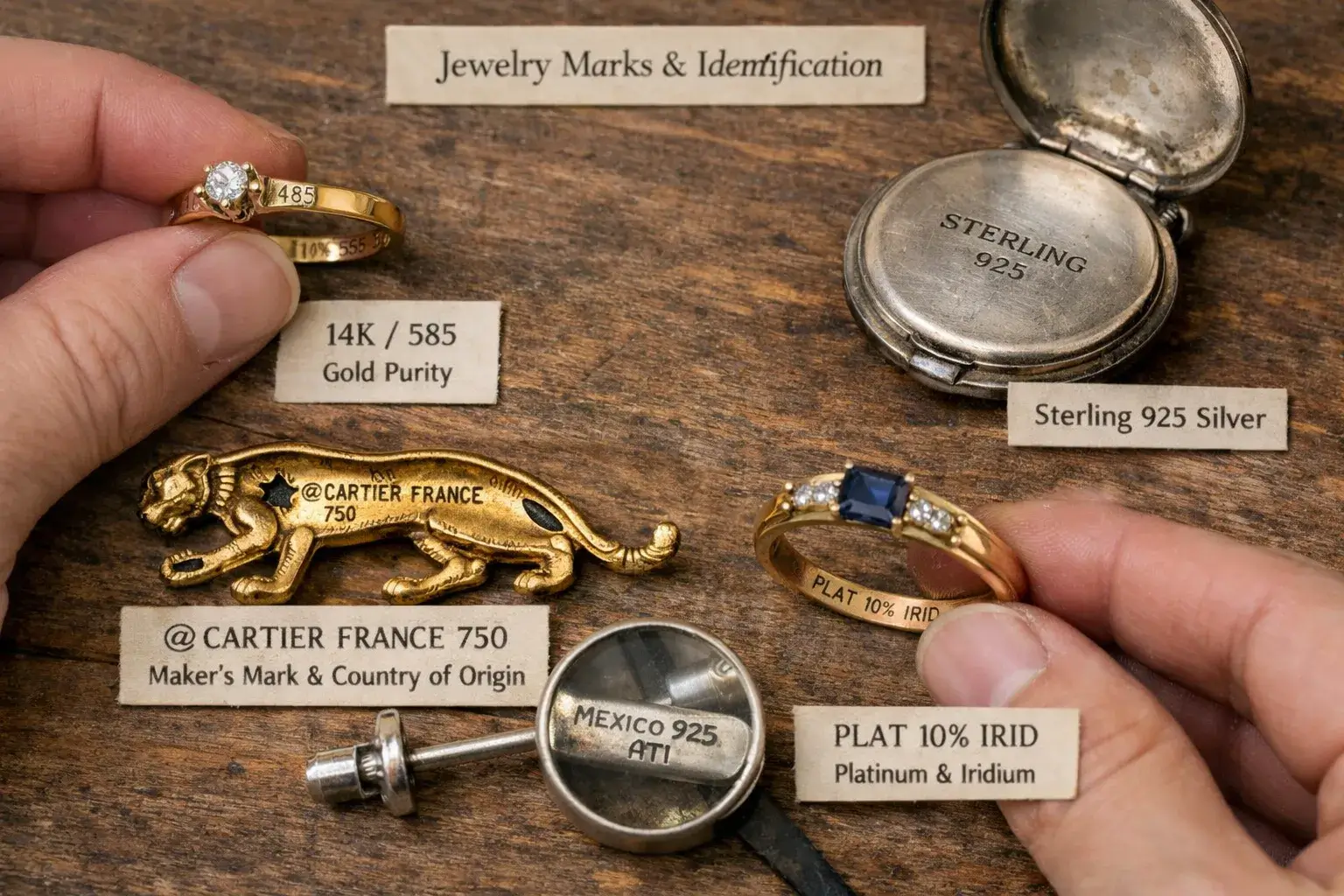
Those tiny symbols stamped on your jewelry aren’t just decorative—they’re a coded language that reveals everything about your piece’s authenticity, metal purity, origin, and value. Whether you’ve inherited a family heirloom or purchased a vintage find, learning to read jewelry marks transforms you from a casual admirer into an informed collector.This comprehensive guide will teach you how to identify, locate, and interpret every type of jewelry mark, from purity stamps to maker’s marks to country-specific hallmarks. By the end, you’ll be able to authenticate your jewelry like a professional appraiser.
What Are Jewelry Marks?
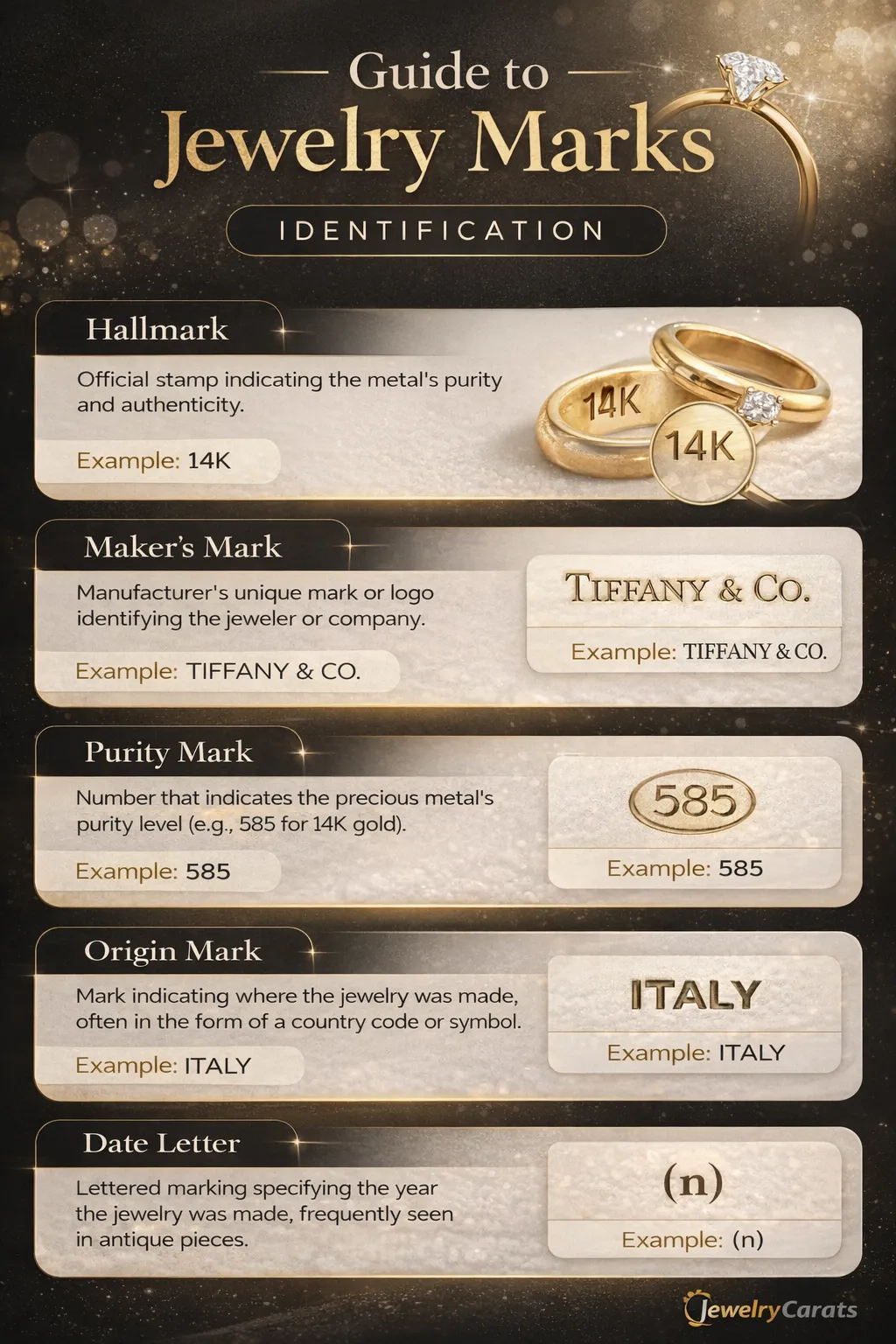
Jewelry marks—also called hallmarks, quality marks, or purity stamps—are small symbols, numbers, or letters engraved onto jewelry during manufacturing. These marks serve as an official certification system, providing crucial information about your piece.
Think of jewelry marks as a piece’s passport. Just as a passport contains your name, nationality, and photo, jewelry marks contain the metal type, purity level, maker identity, and sometimes even the exact date and location of manufacture.
Common mark types include:
- Purity marks: Numbers indicating metal content (e.g., “925” for sterling silver, “14K” for 14-karat gold)
- Maker’s marks: Symbols or initials identifying the manufacturer or designer
- Hallmarks: Official stamps from government assay offices certifying metal quality
- Date letters: Codes indicating the year of manufacture (common in UK jewelry)
- Trademark symbols: Logos representing specific jewelry brands
Why Jewelry Marks Matter: 5 Critical Reasons
Understanding jewelry marks isn’t just for collectors and appraisers. Anyone who owns, buys, or inherits jewelry should know how to read these marks. Here’s why:
1. Verify Authenticity
Counterfeit jewelry floods the market. Marks are your first line of defense against fake gold, plated silver masquerading as solid, and brand knockoffs. A genuine “925” stamp with proper depth and placement confirms authentic sterling silver, while sloppy or mismatched marks signal a fake.
2. Determine True Value
The difference between 10K and 18K gold is thousands of dollars. The difference between solid gold and gold-plated is even more dramatic. Marks tell you exactly what you’re dealing with—and what it’s actually worth.
3. Understand Metal Purity
Not all gold is created equal. Pure gold (24K) is too soft for jewelry, so it’s mixed with other metals. The karat mark tells you the exact gold content: 18K is 75% gold, 14K is 58.5%, and 10K is 41.7%. This matters for durability, color, and value.
4. Trace History & Provenance
Maker’s marks and hallmarks connect your jewelry to its creator and origin. A “Tiffany & Co.” mark significantly increases value. UK hallmarks with date letters tell you the exact year your piece was assayed—unlocking its historical story.
5. Avoid Costly Mistakes
Imagine paying for 18K gold only to discover it’s 10K. Or buying “sterling silver” that’s actually silver-plated brass. Marks prevent these expensive mistakes. A few minutes with a loupe can save you hundreds or thousands of dollars.
The 4 Main Types of Jewelry Marks Explained
Jewelry marks fall into four distinct categories, each serving a different purpose. Understanding the difference between them is essential for proper identification.
Purity Marks (Metal Content Stamps)
Purity marks are the most common type of jewelry mark. They indicate the exact percentage of precious metal in your piece.
How they work: Pure metals like gold, silver, and platinum are too soft for jewelry use. They’re mixed with harder metals (alloys) to create durable pieces. Purity marks tell you what percentage is precious metal versus alloy.
Common examples:
- Gold: 10K, 14K, 18K, 24K (US/UK) or 417, 585, 750, 999 (European millesimal system)
- Silver: 925 (sterling silver = 92.5% pure), 800 (German silver), STERLING, STG
- Platinum: 950, 900, 850, PLAT, PT
Important note: Both systems mean the same thing. “18K” and “750” both indicate 75% pure gold. The US/UK uses karats for gold, while Europe uses the millesimal system (parts per thousand).
→ Learn more: Complete Guide to Gold Hallmarks
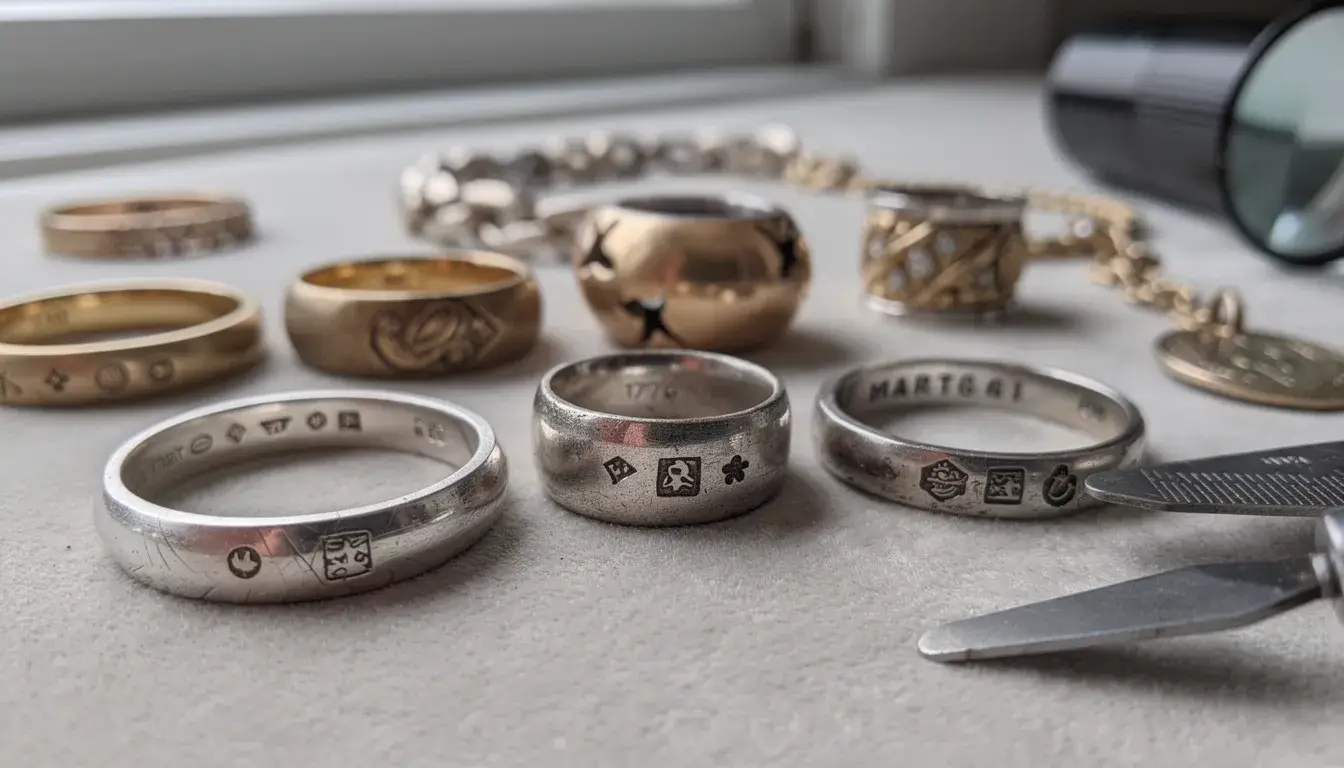
Maker’s Marks (Manufacturer Identification)
Maker’s marks identify who created the jewelry. These can be initials, symbols, logos, or full company names.
What they look like: Sometimes elegant symbols (Cartier’s interlocking Cs), sometimes simple initials (T&Co for Tiffany), sometimes full names stamped in tiny letters.
Why they matter: A maker’s mark from a prestigious house like Tiffany, Cartier, Van Cleef & Arpels, or Bvlgari can multiply a piece’s value by 10x or more. Even lesser-known makers add provenance and historical interest.
When they appeared: Maker’s marks became standardized in the early 1900s, though some jewelers marked pieces earlier. Antique jewelry often lacks maker’s marks—this was normal before modern regulations.
→ Learn more: Sterling Silver Marks: Complete Guide
Hallmarks (Official Assay Office Stamps)
Hallmarks are government-regulated stamps applied by official assay offices after testing metal purity. They’re most common in countries with strict hallmarking laws like the UK, France, and several other European nations.
What they certify: Hallmarks go beyond purity—they confirm where the piece was tested, which office tested it, and often the exact year. In the UK, a complete hallmark includes four or five separate stamps:
- Maker’s mark: Identifies the manufacturer
- Standard mark: Shows metal purity (e.g., lion for sterling silver, crown for gold)
- Assay office mark: Indicates which office tested it (leopard’s head for London, anchor for Birmingham, etc.)
- Date letter: A letter code indicating the year
- Duty mark: Older pieces may show a monarch’s head (tax paid)
US note: The United States doesn’t require hallmarks, only voluntary purity stamps. However, the National Stamping Act prevents manufacturers from lying about metal content.
Trademark & Patent Marks
Some jewelry bears additional marks beyond purity and maker identification:
- Copyright mark (©): Indicates a copyrighted design (post-1976 in US)
- Registered trademark (®): Shows a registered brand name
- Patent numbers: Design patents (especially on older pieces), format: D followed by numbers
- Designer signatures: Actual artist signatures (less common, usually on high-end contemporary pieces)
Where to Find Marks on Your Jewelry
Jewelry marks are intentionally placed in discreet locations where they won’t affect the piece’s appearance. Knowing where to look is half the battle.
Rings
Location: Inside the band, usually on the inner curve opposite the stone or design.
What to look for: Most rings have marks grouped together—you’ll often find both purity stamps (14K) and maker’s marks side by side.
Pro tip: Antique European rings sometimes have marks on the outside of the band. UK rings typically mark inside, French rings sometimes mark outside.
Exception: Very thin bands or eternity bands may not be marked at all—there’s simply no space. This doesn’t mean they’re fake.
Necklaces & Chains
Location: On or near the clasp. Look at the clasp itself, the jump ring connecting the clasp, or a small tag hanging near the clasp.
What to look for: High-end brands often engrave their name directly on the clasp. Purity marks typically appear on a small flat area of the clasp or on a separate tag.
Pro tip: Some necklaces have marks on decorative elements near the clasp—check any flat surfaces within the first few inches of the clasp.
Bracelets
Location: Near the clasp, on a flat link, or inside a bangle.
What to look for: Link bracelets usually mark on the flat surface of a link near the clasp. Bangle bracelets mark on the inside surface. Vintage bracelets sometimes mark inside the hinge area.
Charm bracelets: Check both the bracelet chain and individual charms—each may have separate marks.
Earrings
Location: On the post (studs), inside the clip-back, or on the finding (the part that goes through your ear).
What to look for: Marks are tiny on earrings. You’ll almost certainly need magnification.
European rule: In some countries like France, each earring is considered a separate piece and should have its own complete set of marks.
Hoops and drops: Larger earrings may have marks inside the hoop or near hinges.
Brooches & Pins
Location: On the pin stem, near the catch, or on the back of the brooch itself.
What to look for: Vintage brooches often have multiple marks on the back—purity, maker’s mark, and sometimes a patent number.
Pendants
Location: On the back, often near the bail (the loop that connects to the chain).
What to look for: Flat-backed pendants mark on the back surface. Dimensional pendants mark on the bail or on a small flat area at the top.
Essential Tools for Reading Jewelry Marks
Jewelry marks are deliberately small to avoid affecting the piece’s appearance. Proper tools are essential for reading them accurately.
Jeweler’s Loupe (10x Magnification) – Essential
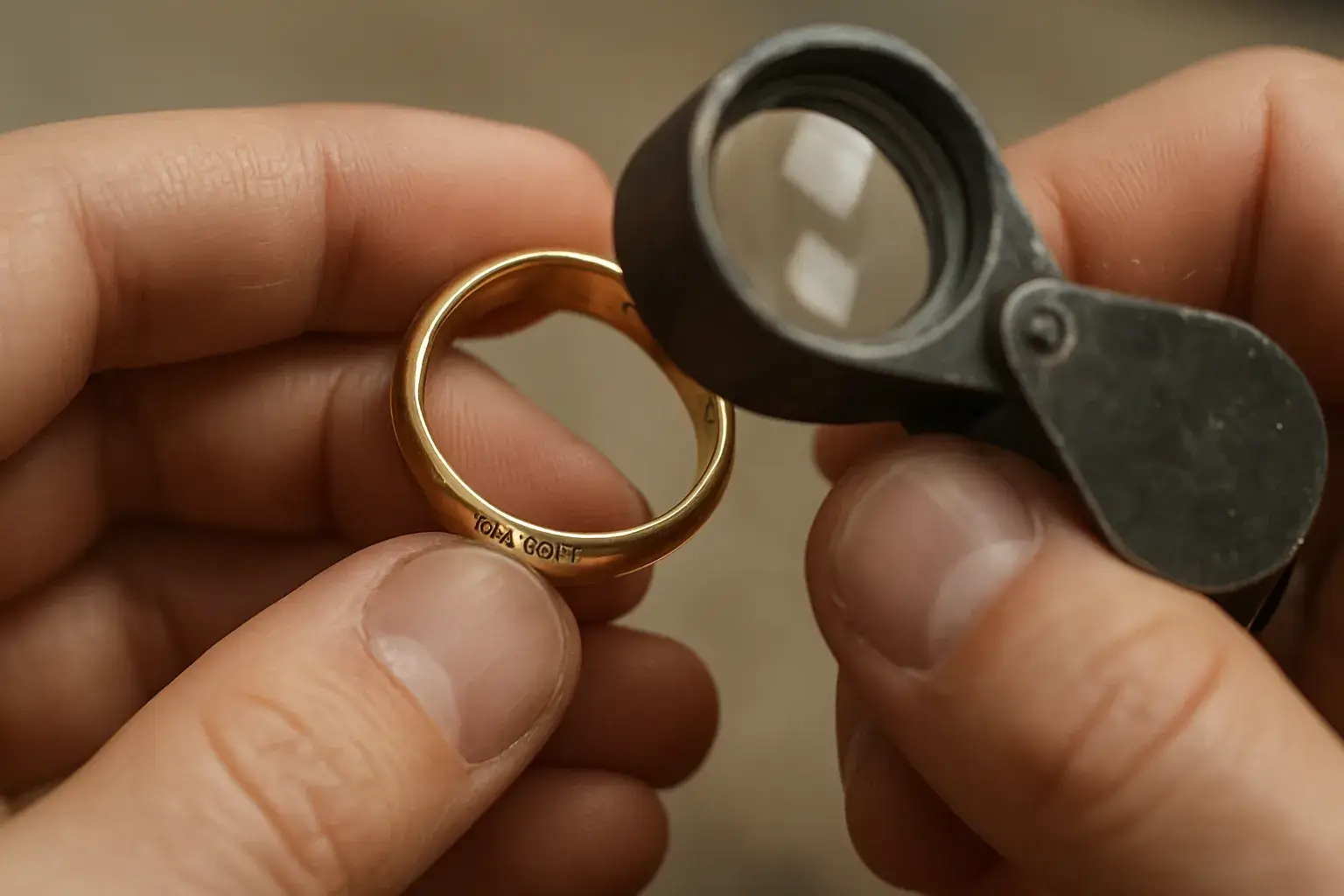
A jeweler’s loupe is a small magnifying glass specifically designed for examining jewelry. The standard is 10x magnification.
Why 10x? This magnification level is powerful enough to see tiny marks clearly without distorting what you see. It’s the industry standard used by professional jewelers and appraisers.
Cost: $10-$50 for a quality loupe
How to use: Hold the loupe close to your eye, bring the jewelry up to the loupe (not the other way around), and use good lighting. It takes practice—don’t be discouraged if it’s awkward at first.
🔍 Recommended: Professional 10x Jeweler’s Loupe with LED Light – Essential for reading tiny hallmarks. Clear optics, bright LED, pocket-size. (~$15-20)
Good Lighting – Critical
Even with perfect magnification, poor lighting hides marks. You need bright, direct light.
Best options:
- Natural daylight near a window
- LED desk lamp with adjustable arm
- Professional jewelry lighting (for serious collectors)
Avoid: Overhead lighting that creates shadows in the marked area.
💡 Recommended: Adjustable LED Desk Lamp with magnifying glass – Perfect for jewelry examination. (~$25-30)
Smartphone Camera with Macro Mode – Modern Alternative
Modern smartphones with macro lenses can capture marks clearly, letting you zoom in digitally.
Advantages: You can take photos and examine them later, share with experts for identification, or save for records.
Disadvantages: Not as immediate as a loupe, and some marks require changing angles which is easier with a physical loupe.
Reference Materials – For Identification
Seeing the marks is step one. Identifying what they mean requires reference materials:
- Online hallmark databases: UK Assay Office, Lang Antiques, and other reputable sites
- Books: “Jackson’s Hallmarks” (UK), “Encyclopedia of American Silver Manufacturers” (US)
- Maker’s mark databases: For identifying designer and manufacturer marks
📖 Recommended book: “Jackson’s Hallmarks” – The definitive reference for British hallmarks and date letters. Essential for serious collectors. (~$50-70)
Digital Scale (Optional but Helpful)
A jeweler’s scale measuring to 0.01 grams helps determine if a piece’s weight matches its marked purity. Gold-plated pieces weigh significantly less than solid gold.
⚖️ Jeweler’s scale: Digital Pocket Scale 0.01g Precision – Accurate weight verification for gold, silver, platinum. (~$15-20)
Acid Test Kit (For Professionals)
Acid testing chemically verifies gold purity. Unless you’re a dealer or serious collector, this isn’t necessary—and it can damage jewelry if done incorrectly.
🧪 Gold testing kit: Professional Gold Test Kit – Tests 10K, 14K, 18K, 22K gold accurately. Includes testing stone and acids. (~$25-35)
Gold Jewelry Marks & Purity Stamps
Gold is the most commonly marked jewelry metal. Understanding gold marks is essential for determining value and authenticity.
The Karat System (US/UK)
The karat system divides pure gold into 24 parts. Pure gold is 24 karat (24K). Lower karat numbers indicate gold mixed with other metals.
Common gold karat marks:
- 24K (999 or 1000): 99.9% pure gold – Too soft for most jewelry, used in coins and bullion
- 22K (916): 91.6% pure gold – Common in Asian and Middle Eastern jewelry
- 18K (750): 75% pure gold – Luxury standard in US, ideal balance of purity and durability
- 14K (585): 58.5% pure gold – Most popular in US for engagement rings and daily wear
- 10K (417): 41.7% pure gold – Minimum to be called “gold” in US, very durable
- 9K (375): 37.5% pure gold – Common in UK, not legal to call “gold” in US
What the numbers mean: To calculate gold percentage, divide the karat number by 24. So 18K = 18÷24 = 0.75 = 75% gold.
The Millesimal System (Europe/International)
European jewelry uses three-digit numbers representing parts per thousand of pure gold.
Common millesimal marks:
- 999 or 1000: Essentially pure gold (equal to 24K)
- 916: 91.6% gold (equal to 22K)
- 750: 75% gold (equal to 18K)
- 585: 58.5% gold (equal to 14K)
- 417: 41.7% gold (equal to 10K)
- 375: 37.5% gold (equal to 9K)
How to read them: Think of the number as “parts per thousand.” So 750 means 750 parts gold out of 1,000 total parts—or 75% gold.
Gold Color Indicators
Gold comes in different colors depending on which metals are mixed with it. Some jewelry includes additional letter marks indicating color:
- YG: Yellow Gold
- WG: White Gold
- RG or PG: Rose Gold or Pink Gold
Example mark: “14K WG” means 14-karat white gold.
Gold Plating Marks – Important Warning
These marks indicate gold PLATING over another metal—not solid gold. The piece contains very little actual gold.
- GP: Gold Plated – Thin layer of gold over base metal
- GEP: Gold Electroplated – Same as GP
- RGP: Rolled Gold Plate – Thicker than GP but still not solid gold
- GF: Gold Filled – Thicker gold layer than plating (usually 5% of weight), but still not solid
- HGE: Heavy Gold Electroplate – Marketing term, still just plating
- Vermeil: Gold plated over sterling silver (not base metal)
Value difference: A gold-plated bracelet might contain $5 worth of gold. A solid 14K gold bracelet of the same weight might contain $200-$500 worth of gold. The marks make all the difference.
Special Gold Marks
- P after karat (14KP): “Plumb gold” – guarantees the piece is at least the marked purity, not below
- KT instead of K: Alternative karat abbreviation, same meaning
- Ct or CT: Carat (for gemstones) NOT karat (for gold) – don’t confuse them
Want to dive deeper into gold marks? Read our comprehensive Understanding Gold Hallmarks: Complete Guide for detailed information on every karat mark, the millesimal system, and how to verify real gold.
Sterling Silver Marks & Hallmarks
Silver jewelry uses a simpler marking system than gold, but with important variations by country and era.
The 925 Sterling Standard
Sterling silver is 92.5% pure silver mixed with 7.5% other metals (usually copper). Pure silver is too soft for jewelry, so the sterling formula creates a durable alloy while maintaining silver’s beauty.
Common sterling silver marks:
- 925: International standard for sterling silver (92.5% pure)
- STERLING: Word mark, same meaning as 925
- STER or STG: Abbreviated versions
- .925: Sometimes includes a decimal point
All of these mean the same thing: 92.5% pure silver. If your piece has any of these marks, it’s genuine sterling silver.
UK Sterling Silver Hallmarks
British sterling silver has distinctive hallmarks dating back centuries:
- Lion Passant (walking lion): The UK standard mark for sterling silver since 1544
- Lion Rampant: Scottish sterling silver mark (standing lion)
- Hibernia (crowned harp): Irish silver mark
UK silver hallmarks usually include multiple marks: the lion for sterling standard, an assay office mark (leopard’s head for London, anchor for Birmingham, etc.), a date letter, and a maker’s mark.
Other Silver Purity Marks
- 800: 80% pure silver, common in German and older European silver
- 835: 83.5% pure silver, another European standard
- 900: 90% pure silver, called “coin silver” in US (old US coins were 90% silver)
- 950: 95% pure silver, Britannia silver (UK), or French silver
- 958 or .958: 95.8% pure silver, another Britannia standard
- 999 or .999: Essentially pure silver, used in coins and bullion, rarely in jewelry
French Silver Hallmarks
France uses pictorial hallmarks instead of numbers:
- Minerva head (woman’s head in profile): 950/1000 silver (95% pure)
- Crab: 800/1000 silver (80% pure)
Silver Plating Marks – Not Solid Silver
Like gold, silver can be plated over base metals. These marks indicate plating, not solid silver:
- EPNS: Electroplated Nickel Silver – base metal with thin silver coating
- Silver Plate or Silver Plated: Thin silver over base metal
- SP: Silver Plate
- Nickel Silver or German Silver: No silver at all! It’s a copper-nickel-zinc alloy that looks like silver
Critical difference: A sterling silver necklace might be worth $50-$200 for the silver content alone. An identical-looking silver-plated necklace might contain 50 cents worth of silver. The marks tell you which you have.
Vermeil – Special Case
Vermeil (pronounced ver-MAY): Sterling silver plated with gold. It’s solid silver underneath, with a thick gold coating on top (minimum 2.5 microns).
Marks: Usually marked “Vermeil” or “925 Vermeil” or both silver (925) and gold (18K) marks.
Value: More valuable than regular gold-plated jewelry because the base is sterling silver, but less than solid gold.
Master silver identification: Our detailed Sterling Silver Marks Guide covers UK hallmarks, international marks, and how to spot silver plating.
Platinum Jewelry Marks
Platinum is rarer and more valuable than gold, so proper marking is essential to verify authenticity.
Platinum Purity System
Platinum uses the millesimal system (parts per thousand), similar to European gold and silver marks.
Common platinum marks:
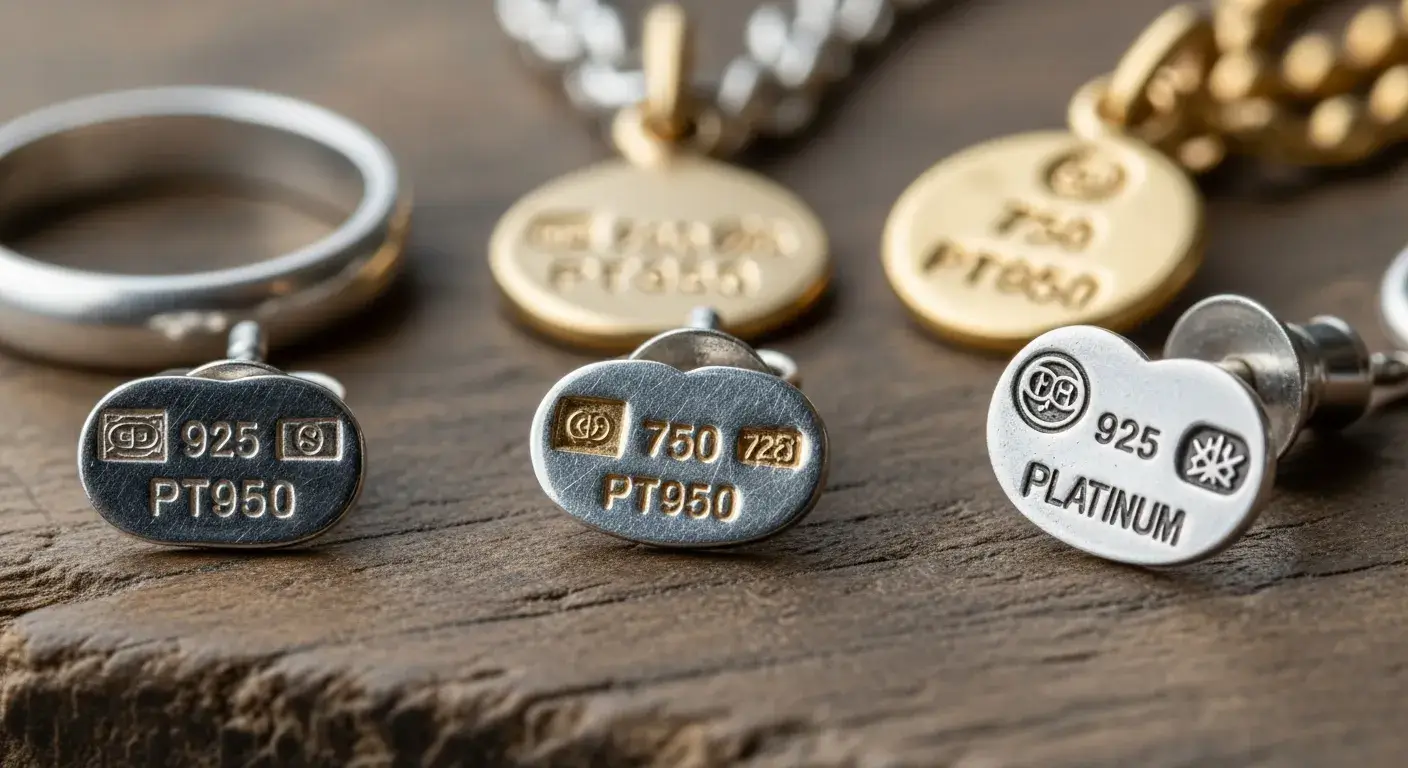
- 950 or PLAT950: 95% pure platinum – Most common standard worldwide
- 900 or PLAT900: 90% pure platinum – Sometimes used in Europe
- 850 or PLAT850: 85% pure platinum – Less common, mainly vintage pieces
- PLATINUM or PLAT: Word marks, usually indicate 95% purity
- PT or Pt: Platinum abbreviation, usually with number (PT950)
Why Platinum Purity Matters
Unlike gold and silver, platinum is naturally white and doesn’t tarnish. The 5-15% of other metals mixed in are typically iridium, ruthenium, or palladium—other platinum-group metals that enhance durability.
Jewelry use: 950 platinum is strong enough for daily wear while maintaining platinum’s natural beauty and density.
Platinum vs. White Gold – Don’t Confuse Them
Many people confuse platinum with white gold. They look similar but are completely different metals:
Platinum:
- Naturally white
- Marked: 950, PLAT, or PT
- Heavier and denser
- More expensive
- Develops patina over time
White Gold:
- Yellow gold mixed with white metals
- Marked: 14K, 18K, WG, or 585, 750
- Lighter weight
- Less expensive
- Often rhodium-plated to enhance whiteness
How to tell: Check the marks. Platinum pieces say “PLAT” or “950.” White gold pieces say “14K” or “18K.” If there’s no marking, platinum feels noticeably heavier than white gold of the same size.
Platinum Alloy Marks (Rare)
Some platinum jewelry specifies which metals are mixed in:
- PLAT IRID: Platinum alloyed with iridium
- 950 Ru: Platinum with ruthenium
Everything about platinum: Check our Platinum Jewelry Marks: Complete Guide to learn about 950 vs 900 platinum, platinum vs white gold differences, and verification methods.
Understanding Maker’s Marks: Who Made Your Jewelry?
Maker’s marks transform jewelry from anonymous objects into pieces with documented history and provenance. A famous maker’s mark can multiply value dramatically.
What Maker’s Marks Look Like
Maker’s marks vary widely in style:
- Initials: Simple letters like “TF” or “RB”
- Full names: “TIFFANY & CO” or “CARTIER”
- Symbols: Logos, animals, shields, or abstract designs
- Combinations: Initials within a shaped border (oval, rectangle, diamond)
Famous Maker’s Marks to Know
These marks significantly increase a piece’s value:
- Tiffany & Co: Usually “Tiffany & Co” or “T & Co” – American luxury jeweler since 1837
- Cartier: “Cartier” signature or interlocking C’s – French luxury house since 1847
- Van Cleef & Arpels: “VCA” or full name – French high jewelry since 1906
- Bvlgari: “BVLGARI” (uses ancient Roman “V” instead of “U”) – Italian luxury since 1884
- Harry Winston: “HW” or full name – “King of Diamonds” since 1932
- David Yurman: “DY” signature cable – Contemporary American designer
- Georg Jensen: “GJ” or full name – Danish silver master since 1904
Value impact: An unsigned vintage ring might sell for $500. The same ring with a Tiffany mark might sell for $5,000 or more.
Reading Maker’s Marks
To identify an unknown maker’s mark:
- Photograph it clearly: Use macro mode or a loupe, ensure good focus
- Note all details: Letters, symbols, borders, any numbers
- Research online databases: Lang Antiques, 925-1000, and other hallmark sites have searchable databases
- Consider the era: Style of the piece helps narrow down when it was made
- Consult references: Books like “American Jewelry Manufacturers” by Rainwater
- Ask experts: Jewelry forums, appraisers, or antique dealers
When Maker’s Marks Change
Many jewelers changed their marks over time due to:
- Company name changes or mergers
- New regulations requiring different formats
- Evolution of branding strategies
- Ownership transfers
Example: Tiffany used several different mark variations from 1850s to present. Identifying which mark helps date the piece.
Unsigned Doesn’t Mean Worthless
Many valuable antique pieces lack maker’s marks. Before 1900, marking wasn’t universal. Focus on:
- Quality of craftsmanship
- Materials and gemstones
- Style and design elements
- Age and condition
Country-Specific Hallmark Systems
Different countries have distinct hallmarking traditions. Understanding these systems helps identify origin and date jewelry.
United Kingdom (England, Scotland, Ireland, Wales)
The UK has the world’s most comprehensive hallmarking system, dating back to 1300.
UK hallmark components (modern pieces have 4-5 marks):
- Maker’s Mark: Manufacturer’s registered mark
- Standard Mark: Metal purity symbol
- Lion Passant (walking lion): Sterling silver
- Crown: Gold
- Orb: Platinum
- Assay Office Mark: Where tested
- Leopard’s head: London
- Anchor: Birmingham
- Rose: Sheffield
- Castle: Edinburgh
- Harp: Dublin (pre-1923)
- Date Letter: Year of assay (explained in next section)
- Duty Mark (older pieces): Monarch’s head (tax paid, discontinued 1890)
Why UK hallmarks matter: They let you date a piece to the exact year and trace its journey through the assay office system.
France
French hallmarks use pictorial symbols rather than letters and numbers.
Key French marks:
- Eagle’s head: Gold (various purities, most common is 18K)
- Minerva head: 950/1000 silver (95% pure)
- Crab: 800/1000 silver (80% pure)
- Boar’s head: Imported gold
- Lozenge with maker’s initials: Maker’s mark (diamond shape required since 1797)
French system: Separate marks for domestic vs. imported goods, with different symbols.
United States
The US has no mandatory hallmarking system, only voluntary purity stamps.
US regulations:
- National Stamping Act (1906) prohibits false marking but doesn’t require marking
- If a purity mark is used, it must be accurate
- Trademark (maker’s mark) registration optional but common
What this means: American jewelry may only have a karat mark (14K) with no official hallmark. Unmarked US jewelry isn’t necessarily fake—many legitimate pieces lack marks, especially older or small items.
Other European Countries
- Germany: Crescent moon and crown (800 silver common in antique pieces)
- Italy: Numbered mark system, often includes province code
- Netherlands: Lion marks, sword for purity
- Portugal: Eagle head for gold
- Russia: Complex system with kokoshnik (woman in headdress) and numbers
Asian Countries
- India: BIS hallmark (Bureau of Indian Standards) with purity number
- China: Often uses numbers (999 for 24K gold, 925 for silver) but counterfeits common
- Thailand: Quality mark system for gold (96.5% and 90% purity common)
Dating Jewelry with Date Letters (UK System)
UK hallmarks include a letter code that reveals the exact year your jewelry was assayed. This system is unique to British jewelry and incredibly valuable for dating pieces.
How Date Letters Work
Each UK assay office used a different alphabetical cycle for date letters. The letter, its font, and the shape of the surrounding shield all combine to indicate a specific year.
Example: A London hallmark with lowercase “a” in a specific shield shape means 1896. The same lowercase “a” in a different shield shape means 1916. Context matters.
Reading Date Letters
Components to check:
- The letter itself: A through U (typically, J is skipped)
- Letter case: Uppercase vs. lowercase
- Font style: Roman, italic, gothic, etc.
- Shield shape: Rectangular, rounded, pointed, crowned, etc.
- Assay office: Each office used different cycles
Date Letter Cycles
Most assay offices used 20-25 year cycles (A-U or A-Z), then started over with a new font and shield shape.
Example London cycles:
- 1876-1895: Lowercase italic in round-bottom shield
- 1896-1915: Lowercase roman in square shield
- 1916-1935: Uppercase roman in square shield
- 1936-1955: Lowercase sans-serif in square shield
Finding Date Letter Information
You need reference materials to decode date letters:
- Online: UK Assay Office website has complete date letter tables
- Books: “Jackson’s Hallmarks” is the definitive reference
- Apps: Several hallmark identification apps include date letters
Modern Date Letters (Post-1975)
Since 1975, all UK assay offices use the same date letter system, making identification easier. They cycle through letters every 25 years.
Why Date Letters Matter
- Authenticity: Correct date letters are hard to fake accurately
- Historical context: Knowing the exact year adds to provenance
- Style verification: Does the jewelry style match the date?
- Value: Pieces from significant years or famous periods command premiums
Learn to date jewelry precisely: Our guide How to Date Antique Jewelry by Marks explains UK date letter tables, style periods, and dating techniques in detail.
How to Spot Fake Jewelry Marks
Counterfeiters stamp fake marks on low-quality jewelry to deceive buyers. Learning to spot fake marks protects you from costly mistakes.
Red Flags: Signs of Fake Marks
1. Poor Quality Stamping
Authentic marks: Sharp, clean, evenly stamped with consistent depth
Fake marks: Blurry, uneven, too shallow, or hand-scratched appearance
What to do: Compare to known authentic examples. Genuine marks are machine-stamped with precision.
2. Wrong Location
Authentic marks: Placed in standard locations for that jewelry type
Fake marks: Unusual placement or marks on inappropriate parts
Example: Marks on the front of a ring instead of inside the band
3. Incorrect Mark Combinations
Authentic marks: Follow country-specific regulations and conventions
Fake marks: Impossible combinations (e.g., “24K” on a piece that’s obviously white gold, or UK hallmarks on a piece with wrong date letter for its style)
4. Misspellings
Common fakes: “TIFFINY” instead of “TIFFANY,” “CARTERE” instead of “CARTIER”
Check carefully: Use magnification—counterfeiters count on people not looking closely
5. Modern Marks on Antique Styles
Red flag: Victorian-era design with laser-engraved modern marks
What to know: Mark styles evolved over time. Modern, crisp laser marks didn’t exist in 1900.
6. Weight Discrepancy
Test: Does the piece’s weight match its marked purity?
Red flag: A piece marked “18K” that feels very light is probably gold-plated
Why: Gold is dense. Solid gold has a characteristic heft.
7. Missing Secondary Marks
High-end brands: Often have multiple marks (purity + maker + patent/trademark)
Red flag: A piece marked “Cartier” but with no purity mark or serial number
Research: Know what a complete authentic mark set looks like for that brand
Common Counterfeiting Techniques
- Over-stamping: Adding fake marks to unmarked jewelry
- Plating over marks: Gold-plating jewelry with genuine gold marks underneath (the marks are real, but the gold is only surface-level)
- Frankenstein pieces: Combining authentic marked parts with fake parts
- Copied marks: Reproducing famous maker’s marks on new pieces
Testing Methods to Verify Authenticity
Acid Test (Destructive)
Jewelers use acid to test gold purity chemically. Gold of different karats reacts differently to specific acids.
Limitation: Only tests the surface—can’t detect gold plating over another metal
Risk: Causes small marks on the jewelry
XRF Analysis (Non-Destructive)
X-ray fluorescence machines analyze metal composition without damaging jewelry.
Advantage: Accurate, fast, no damage
Limitation: Expensive equipment—must be done by professionals
Magnet Test (Quick Check)
Gold, silver, and platinum are not magnetic. If a “gold” piece is attracted to a magnet, it’s not gold (or only plated).
Limitation: Not all fake gold is magnetic, so passing the magnet test doesn’t guarantee authenticity
Density Test
Measure weight and volume, calculate density. Gold has specific density (19.3 g/cm³ for pure gold, less for karat gold).
Advantage: Can be done at home with a scale and water
Limitation: Requires precise measurement and calculations
When in Doubt: Consult Professionals
If you suspect fake marks or need authentication:
- Independent appraisers: Look for GIA (Gemological Institute of America) credentials
- Reputable jewelers: Established shops with good reputations
- Brand authenticators: For luxury brands, go to authorized dealers or brand boutiques
- Avoid: Pawn shops for authentication (conflict of interest), online “experts” with no credentials
Cost: Professional appraisal typically costs $50-$150 per piece but can save you thousands by avoiding fakes or confirming authentic pieces.
Protect yourself from fakes: Read our comprehensive How to Spot Fake Jewelry Marks for red flags, testing methods, and real case studies of counterfeit detection.
Frequently Asked Questions About Jewelry Marks
What does 925 mean on jewelry?
“925” indicates sterling silver—92.5% pure silver mixed with 7.5% other metals (usually copper). This is the international standard for silver jewelry and guarantees authentic sterling silver. If your piece is marked 925, it’s genuine silver, not plated.
What’s the difference between 14K and 18K gold?
14K gold is 58.5% pure gold, while 18K is 75% pure gold. 18K has a richer yellow color and is more valuable, but 14K is more durable for daily wear. Both are genuine gold—the number just indicates how much gold versus alloy metals. In Europe, you’ll see these marked as 585 (14K) and 750 (18K).
What if my jewelry has no marks at all?
Unmarked jewelry isn’t necessarily fake or low quality. Small pieces (earring backs, thin chains, etc.) often can’t be marked due to size. Antique jewelry predating hallmarking laws may be unmarked. Handmade artisan pieces sometimes lack marks. The absence of marks means you’ll need other authentication methods like professional testing or evaluation of craftsmanship and materials.
Can hallmarks be faked?
Yes, but authentic hallmarks are difficult to replicate perfectly. Fake marks typically have poor stamping quality, incorrect fonts, wrong locations, or impossible combinations (like marks from different time periods together). Counterfeiters also often misspell brand names. Using magnification and comparing to verified examples helps identify fakes. When buying expensive pieces, always verify authenticity with a professional.
What does GP mean on jewelry?
“GP” stands for Gold Plated—a thin layer of gold over base metal. This is NOT solid gold. Gold-plated jewelry contains very little gold (often just a few dollars worth) and will wear off over time. Look for solid gold marks (10K, 14K, 18K, 585, 750) instead. Similar marks like GEP (gold electroplate) and HGE (heavy gold electroplate) also indicate plating, not solid gold.
How do I know if my gold is real?
Check for karat marks (10K, 14K, 18K) or European marks (417, 585, 750). Real gold won’t be attracted to magnets. It should feel heavy for its size—gold is dense. Real gold doesn’t tarnish or change color. For certainty, have it professionally tested with acid tests or XRF analysis. Watch for warning signs: extremely light weight, marks that say “GP” or “GF,” discoloration revealing other metal underneath, or no marks at all on what’s claimed to be gold.
What does a lion mark mean on silver?
A walking lion (Lion Passant) is the UK hallmark for sterling silver (92.5% pure). It’s been used since 1544 and guarantees British sterling standard. A standing lion (Lion Rampant) indicates Scottish silver. These are official assay office marks, not just manufacturer stamps—they certify the silver was tested and approved by government authorities. The lion mark is one of the most recognized and trusted silver hallmarks in the world.
What does 585 mean on a gold ring?
“585” is the European way of marking 14-karat gold. It means 585 parts pure gold out of 1,000 total parts—or 58.5% gold. This is exactly the same as 14K in the US/UK system. Both marks indicate the same gold purity. European jewelry typically uses three-digit numbers (millesimal fineness) while American jewelry uses karats (14K, 18K, etc.).
Can I look up jewelry marks online?
Yes, several databases help identify jewelry marks. The UK Assay Office has comprehensive hallmark information. Lang Antiques offers a searchable maker’s mark database. Online Hallmarks has extensive international marks. However, be cautious—not all online resources are accurate. Cross-reference multiple sources and consider professional authentication for valuable pieces. Take clear photos of your marks and note any other identifying features before searching.
What’s the difference between a hallmark and a maker’s mark?
A hallmark is an official government stamp certifying metal purity (applied by assay offices in countries like the UK). A maker’s mark identifies who manufactured the piece (the jeweler’s signature). Many pieces have both—the hallmark proves it’s genuine gold or silver, while the maker’s mark tells you who made it. In casual usage, people often use “hallmark” to refer to all jewelry marks, but technically they’re different types of marks with different purposes.
Are old jewelry marks more valuable?
Age alone doesn’t make marks more valuable, but antique marks can increase value by confirming provenance and historical significance. Victorian-era marks connect pieces to that period. Famous maker’s marks from defunct companies (like Black, Starr & Frost) add collector interest. UK date letters prove exact age. However, what really matters is the combination: a well-made antique piece from a notable maker in good condition with clear marks is valuable. A poor-quality old piece with marks may not be worth much more than its gold content.
What does “PLAT” mean on jewelry?
“PLAT” indicates platinum—a precious metal rarer and more valuable than gold. Platinum jewelry is usually 95% pure (marked PLAT or 950) compared to gold’s 58-75% purity in most jewelry. Platinum is naturally white, very durable, and hypoallergenic. Don’t confuse it with “plated”—PLAT with no other words means solid platinum. A mark like “Gold Plated” or “GP” means plating, not platinum.
How accurate are smartphone apps for identifying hallmarks?
Hallmark identification apps are useful starting points but shouldn’t be your only resource. They work well for common, well-documented marks but struggle with obscure makers, worn marks, or country-specific variations. Many apps have incomplete databases. They’re helpful for quick checks and learning but not definitive for valuable pieces. For anything expensive, combine app results with professional appraisal. The best apps include Lang Antiques’ resources, UK Assay Office tools, and comprehensive jewelry mark databases.
Can jewelry be marked incorrectly?
Yes, but it’s illegal in most countries. The US National Stamping Act prohibits false or misleading marks. However, errors happen: manufacturing mistakes, worn stamps creating unclear marks, or repairs that remove/obscure original marks. Vintage jewelry might have incorrect marks from before modern regulations. Deliberately fraudulent marking is jewelry fraud and prosecutable. If you suspect incorrect marking on a valuable piece, have it professionally tested—the metal content matters more than what the mark claims.
What marks should I look for when buying engagement rings?
For the metal: Look for karat marks (14K, 18K, or PT for platinum). Verify the mark matches what you’re paying for. For diamonds: GIA certification paperwork is more important than marks on the ring itself. Check for maker’s marks from reputable jewelers (Tiffany, Cartier, etc. significantly affect value). Avoid marks indicating plating (GP, GEP). Ensure any wedding sets have matching marks if sold as a set. For vintage rings, UK hallmarks with date letters add provenance and verify age.
Key Takeaways: Mastering Jewelry Mark Identification
Learning to read jewelry marks empowers you to:
- Verify authenticity before spending money on potentially fake pieces
- Understand true value based on metal purity and maker’s identity
- Date and authenticate antique and vintage jewelry
- Avoid costly mistakes when buying or selling jewelry
- Appreciate history by tracing your pieces back to their origins
Essential tools: A 10x jeweler’s loupe, good lighting, and reliable reference materials. These three things let you examine any piece properly.
Most important marks to know:
- 925 = Sterling silver
- 14K or 585 = 14-karat gold
- 18K or 750 = 18-karat gold
- 950 or PLAT = Platinum
- GP, GF, or “plated” = Not solid precious metal
Remember: When in doubt about valuable pieces, consult a professional appraiser. The cost of authentication is minimal compared to the potential loss from buying fakes or selling authentic pieces without knowing their true value.
Jewelry marks are a fascinating language that connects modern collectors to centuries of craftsmanship tradition. Every mark tells a story—now you know how to read it.
Want to learn more about jewelry identification? Check out our related guides:
- Understanding Gold Hallmarks – Complete Guide to Gold Jewelry Marks
- Sterling Silver Marks – Complete Identification Guide
- How to Date Antique Jewelry by Marks – Complete Guide
- Platinum Jewelry Marks – Complete Guide to PT & PLAT Stamps
- How to Spot Fake Jewelry Marks – Complete Detection Guide